COURTESY OF UNLV
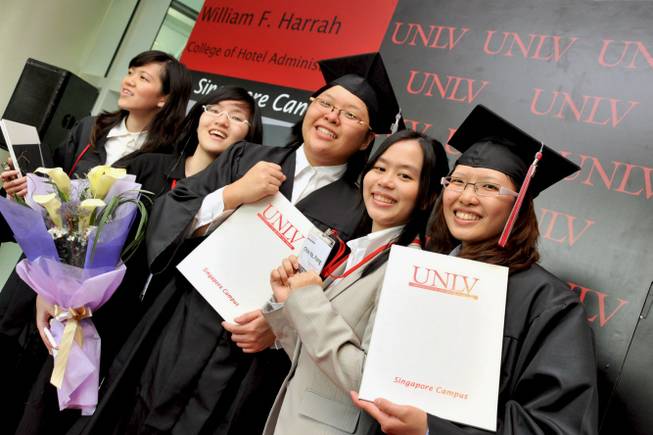
Students of the first graduating class of UNLV’s Singapore campus celebrate after receiving their degrees from the William F. Harrah College of Hotel Administration.
Saturday, July 4, 2009 | 2 a.m.
Sun Archives
- UNLV Singapore campus graduates first class (6-6-2009)
- Regents give go-ahead to explore UNLV campus in U.A.E. (4-4-2008)
- UNLV wants to open campus in Middle East (3-21-2008)
Sun Coverage
Beyond the Sun
Singapore
United Arab Emirates
Last month 41 students in UNLV’s College of Hotel Administration walked across a stage and accepted their diplomas.
President David Ashley made a speech.
Their parents waved and took pictures.
Tassels were flipped to the other side of the mortarboards.
But these students weren’t setting off for careers on the Las Vegas Strip and the stage wasn’t at the Thomas & Mack Center.
These students were the university’s first graduating class at its satellite campus — 8,800 miles away in Singapore.
They represent the promise — and the controversy — of American universities dabbling in international education.
UNLV’s William F. Harrah College of Hotel Administration opened the overseas campus in 2006 after noticing that the largest group of international students applying to the Las Vegas campus came from Asia. The Singapore campus — housed inside the national library — also gives Nevada faculty and students a chance to study hospitality in Asia.
About 215 full-time students are enrolled in the program, which offers every class needed to get a UNLV degree.
The program was launched with a $2.2 million loan from the Singapore government that doesn’t need to be repaid if the campus fails, and ongoing costs are covered by tuition and income from seminars.
Although critics have general concerns about American universities opening campuses abroad, the UNLV program has few detractors.
In fact, its success has generated discussion at UNLV about opening another overseas campus, this one in the United Arab Emirates.
Hospitality industry executives are enthusiastic about the program, noting that despite the large percentage of international tourists coming to Las Vegas, few entry-level employees have international or intercultural experience. Prospective hires who have lived or worked in foreign countries will have an edge over their peers because they won’t have to learn cultural sensitivity on the job, said Thom Reilly, executive director of the Harrah’s Foundation. That’s especially important during a recession, when recent graduates often compete for jobs with veteran hospitality workers.
Opening the Singapore campus also was an efficient way to accommodate the growing number of Asians interested in studying at UNLV without affecting local admissions or budgets, hospitality college Dean Stuart Mann said.
The Singapore campus also accepts exchange students from Thailand and other Southeast Asian countries. Students in Las Vegas and Singapore can go back and forth between the campuses.
Other universities across the country — and around the world — offer satellite, international campuses.
New York University has nine academic facilities on five continents. The University of Paris has a degree-granting campus in Abu Dhabi. The Weill Cornell Medical College in Qatar graduated its first class in May 2008. Ivy League medical and graduate schools operate in India.
But unlike most other programs, where students attending international campuses aren’t considered mainstream members of the student body, UNLV’s Singapore students are considered full-fledged UNLV students and card-carrying Rebels. All classes are taught in English and students are required to complete the same graduation requirements on either side of the Pacific. The curriculum is the same, many of the faculty are the same and even tuition is the same (international students pay nonresident tuition, whether in Las Vegas or Singapore).
The campus grants only two degrees: A Bachelor of Science in hotel administration and an Executive Master of hospitality administration. Those degrees are identical to the ones students would earn in Las Vegas.
American satellite campuses have critics, including among academics, who worry that overseas campuses distract from a public university’s mission to educate local students, or that the campuses offer lower-quality education compared with the home campus, or that the learning experience would be inauthentic in countries where freedom of speech and women’s and gay rights are limited.
The hospitality college had similar concerns and was careful from the beginning not to set up shop in a country where it would not be able to exert full control over the curriculum, Mann said.
Singapore was selected in part because “the faculty wanted to have a free-standing program, independent of an Asian university,” the dean said.
Because of the Singapore success, Mann is scouting top tourism destinations for the next wave of international campus sites.
UNLV has won regents’ approval to develop a hospitality-school campus in the United Arab Emirates. Campus construction would be funded by the Ras al Khaimah government and the campus would be larger and more traditional than the one in Singapore. It was originally slated to be completed by 2011.
The only thing standing in the way is money. The collapse of international markets and falling oil prices have hit the U.A.E. hard. Mann said as soon as the money comes through, construction will begin.
The U.A.E. has close ties to the Las Vegas gaming industry. A government-owned conglomerate of Dubai (a member of U.A.E.) owns half of CityCenter on the Strip, and MGM Mirage in 2007 announced plans for a $3 billion mixed-use resort in the U.A.E. with investors there.
Next on the campus’ radar: Latin America or the tropics.
“If we have four overseas campuses, students could spend a year at each campus,” Mann said. “They would have a truly international degree.”
UNLV’s approach, which allows students to spend as much as four years overseas to take all the courses they need for their major degree, contrasts with independent study-abroad programs that offer limited one-semester or one-year programs that usually include only general education courses.
It’s also a boon for hospitality faculty who can take a semester off from their duties here to teach in Singapore and have access to the Singapore campus facilities for their research.
“The faculty are able to bring those experiences back to the Las Vegas campus,” Mann said. “It enriches their courses and their teaching.”
Stephanie Tavares can be reached at 259-4059 or at [email protected].

Join the Discussion:
Check this out for a full explanation of our conversion to the LiveFyre commenting system and instructions on how to sign up for an account.
Full comments policy