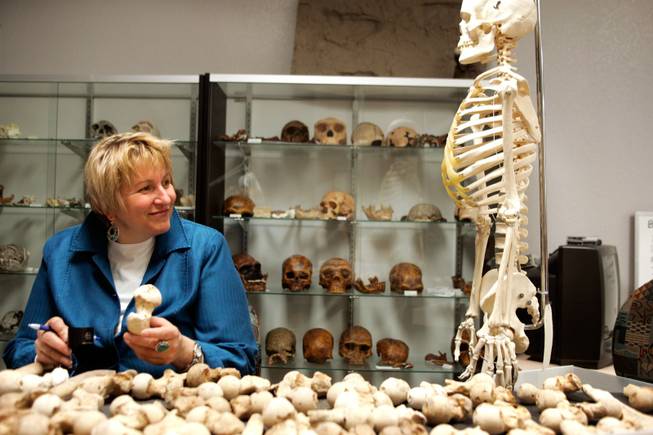
Debra Martin, chairwoman of UNLV’s anthropology department, works among bones dating back as far as 5,000 years that were recovered from a tomb outside Dubai, United Arab Emirates. Martin’s department has lost three full-time faculty members to buyouts.
Sunday, Feb. 8, 2009 | 2 a.m.
Sun Archives
Debra Martin, chairwoman of UNLV’s anthropology department, visited a colleague’s house for dinner recently. Before they finished the first glass of wine, talk turned to the state’s financial crisis — no surprise considering the toll budget cuts are taking on the university and its staff.
Grim conversations of the sort that took place that night have become commonplace on campus and off, reflecting a drop in faculty morale that threatens to dismantle years of efforts to build UNLV’s reputation.
In recent times, as the institution grew, deans stacked their faculties with successful scholars such as Martin, people with the academic pedigree to help the university produce more research and attract better students. Now, with the future uncertain, even some of UNLV’s newest recruits are wondering whether they should stay.
The best will have options. Martin, for instance, has been contacted by other universities searching for senior faculty members. A researcher who has won numerous grants from the National Science Foundation and other nonuniversity sources, she arrived at UNLV in 2006 after spending 25 years at Hampshire College, a liberal arts college in Massachusetts where she was for a time dean of the School of Natural Science.
Since arriving at UNLV, she has turned down invitations to discuss new opportunities.
But, she said, “This year I haven’t been so quick to say I’m not interested.”
Whether the financial crisis will trigger an exodus of talent at UNLV will depend on the level of commitment the state shows toward investing in higher education.
In January the campus community greeted the governor’s recommendation to slash UNLV’s state funding in half with emotions ranging from distress to shock and anger. But with Nevada’s legislative leaders saying they will not accept such a large reduction, many faculty members don’t think their university will lose anything near the amount the governor proposed.
Eric Sandgren, dean of engineering, expects budget cuts to stay below 10 percent. He and some fellow deans report that buyouts aside, they have not lost workers as a result of the school’s precarious financial position. Like other Las Vegans, faculty members whose homes are worth less than the mortgages they owe will be reluctant to move. For many of those who try, landing new employment during a nationwide economic crisis will be difficult.
Still, administrators have reason to worry.
With layoffs, buyouts and attrition reducing the school’s faculty roster, professors are teaching larger classes, which leaves them less time for research. They are bracing for cuts in health benefits and at least two years without raises. Most are not part of the state pension system, so their retirement savings are wrapped up in accounts whose value has plummeted with the economy.
Reductions this academic year have left scars. Martin’s department lost three of its
17 full-time faculty members to buyouts. Prospects are slim for replacing them soon.
A sense of uncertainty pervades the campus, with academics wondering what UNLV will look like next semester — whether budget cuts will leave programs intact, how much time professors will have for research.
Dan Cook, who came to UNLV in summer 2005 to help launch an entertainment engineering and design program, said though he is not actively seeking a different job, he has spoken to entertainment industry contacts to let them know he is interested in hearing about openings.
As he explains, “I’m not looking to jump ship right now.” But he says he doesn’t want to be left “hanging out there in the breeze if they come through and cut these things.”
Cook’s program, which merges engineering with fine arts, demonstrates UNLV’s relevance to Las Vegas. The program prepares students to design, build and operate the complex mechanical systems that allow Cirque du Soleil and other entertainment companies to deliver onstage stunts. This semester Cook is teaching four classes.
Jefferson Kinney, an assistant professor of psychology who started at UNLV in summer 2007, said with a budget reduction of the magnitude the governor suggested, “it’d be possible that the very work that I do would no longer be possible here.”
The university’s emphasis on expanding research programs is one reason Kinney, who worked at the National Institute of Mental Health and The Scripps Research Institute, came to Las Vegas. He studies the neurobiology of learning and memory and the causes of disorders such as schizophrenia and Alzheimer’s. He expects to fund his future research almost exclusively through federal grants — money that will go with him if he leaves UNLV.
Even with many states facing budget shortfalls, Kinney said his colleagues outside Nevada are “shocked at the discussions that are going on here.” When he tells them about the size of potential cuts, the most common reaction is “a few seconds of silence,” he said.
Still, Kinney plans to stay at UNLV, buoyed by his optimism that the governor’s recommendations will not become reality. Many of his colleagues remain committed to the university, too, their loyalty stemming from a sense of ownership. UNLV, at a half-century old, is young by academia’s standards, and faculty members take pride in helping to build what many believe is an up-and-coming higher education institution.
Marketing department Chairman Michael LaTour said he and his wife, a hotel college faculty member, have invested “emotional equity” in UNLV. The couple’s research helped the university rank among the top 10 in the United States for scholarly research on advertising, according to one recent study.
LaTour said many students share his vision of UNLV as a university “on a trajectory to be like UCLA.” Those students are one reason he and his wife want to stay in Las Vegas. “We’re very invested in their success,” said LaTour, whom UNLV recruited in fall 2004. “We don’t want to let them down.”
And in many ways, UNLV continues moving forward despite the bad news.
In September, Levent Atici, who joined the anthropology department in fall 2007 after earning a Ph.D. from Harvard University, established a zooarchaeology laboratory where he and students analyze animal bones excavated from archaeological sites. Atici, an assistant professor, counts himself among the upbeat: “I’m not considering leaving ... I love the university and its larger goals.”
Even if UNLV does not lose large numbers of faculty members, the process of rebuilding will be grueling. Administrators have had few opportunities to hire, with the university leaving about 100 faculty positions — a tenth of the total roster — vacant to save money.
In rare searches taking place, the state’s financial crisis is scaring off applicants. Chris Hudgins, dean of liberal arts, said of five finalists for an experimental psychology job, two withdrew their candidacies in part because of the budget.
Repairing campus morale — and faith in the state — will take time. It could be years before the university recaptures the atmosphere of excitement that helped draw scholars such as Martin, Cook, Kinney, LaTour and Atici to Las Vegas. Nasser Daneshvary, faculty senate chairman, said he receives e-mail saying, “Why should I spend my career or my life in a state that doesn’t appreciate me?”

Join the Discussion:
Check this out for a full explanation of our conversion to the LiveFyre commenting system and instructions on how to sign up for an account.
Full comments policy