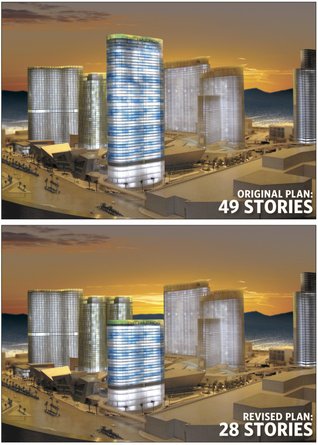
STEVE MARCUS AND CHRIS MORRIS / LAS VEGAS SUN PHOTO ILLUSTRATION
Sunday, Feb. 8, 2009 | 2 a.m.
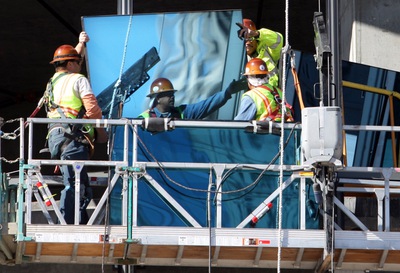
Workers move a piece of exterior glass into place Wednesday during construction of the Harmon at MGM Mirage's CityCenter on Wednesday. It's unclear how much of the building's design will have to be changed.
Sun Archives
- Harmon cancellation helps some, hurts others (1-16-2009)
- Watchers were not watched (1-15-2009)
- How did CityCenter tower flaws persist? (1-8-2009)
- MGM Mirage cancels CityCenter condo project (1-7-2009)
Beyond the Sun
What if they had shorted the Empire State Building by a couple of football fields?
Or gave the Great Pyramid a flattop? Or built the Eiffel Platform?
Size certainly isn’t everything when it comes to buildings, of course. But the impact of many iconic structures is in their sheer stature. That is why it’s so startling — disappointing, even — that the Harmon hotel, CityCenter’s gateway to the Las Vegas Strip, has suddenly been cut down to about half its intended size.
Topping out at 28 stories instead of the proposed 49, the incredible shrinking Harmon seems unfortunately fated to look like a stubby, squashed stepchild next to its soaring CityCenter siblings, the 61-story Aria Resort & Casino and the 57-story Vdara condo-hotel.
That is the result of construction flaws — 15 floors of wrongly installed rebar — that forced MGM Mirage, which is developing the project with Dubai World, to rapidly call for a significant reduction of the nongaming boutique hotel. MGM Mirage canceled the Harmon’s 207-unit condominium component — the top half of the building — and postponed the opening of the hotel to late 2010.
Bleep happens, of course. Every architect has a story, a nightmare tale, of hair-raising contingencies and last-minute changes in plans. MGM Mirage downplays the effect at the Harmon, arguing that the height will scarcely be visible from the street.
But architects not associated with the project say there is no disputing that CityCenter’s grand and gracious addition to the Las Vegas skyline has been compromised.
“Changes happen, yes, but this is more than a change,” said David Schwarz, the noted Washington, D.C.-based architect who is designing the Smith Center for the Performing Arts in downtown Las Vegas. “I’ve never heard of a building being cut in half before.”
With its elegantly elliptical curve and signature variegated blue-and-white exterior suggesting sea glass, the Harmon was expressly designed by British superstar architect Lord Norman Foster to be one of the newly defining iconic buildings in this young, aspiring city. It was designed to harmonize in scale and detail with the other elements of the complex.
Foster is indisputably one of world’s great architects, says Brian Andrews, a visiting professor at the UNLV School of Architecture. “To bring him in and say ‘OK, design this tower,’ and he designs it with a certain proportional system, and then to cut it in half — it’s a disaster.
“And it sends a very bad message to other architects about Las Vegas,” Andrew said. “I’m just worried that other architects are going to say, ‘I’m not going to work in Vegas — look what they did to Foster.’ ”
The other components of the 67-acre project — a Mandarin Oriental Hotel designed by Kohn Pedersen Fox, the dual Veer condominium towers designed by Helmut Jahn, the Aria designed by Cesar Pelli and the Vdara designed by Rafael Vinoly — are expected to open on schedule December.
It’s still unclear how Harmon will be capped, and what reengineering will be required for such infrastructure elements as elevators and vents. If the Harmon’s exterior isn’t significantly redesigned, it risks looking unmistakably out of proportion. Think 28 oz. of tomatoes squished into a 16 oz. can.
However it is eventually received, the Harmon’s height will alter the overall aesthetic effect of CityCenter and the skyscape of modern Las Vegas. When CityCenter opens, the lights will be on at the Harmon but nobody will be home.
That is not what MGM Mirage wanted when it convened a dream team of eight internationally known architects to design CityCenter as “an integrated urban project,” a city within a city. Much of the talk dealt with the importance of the vertical aspect of the project and how the buildings would be designed to work in visual concert.
In other words, if you change one element, all the others will be affected.
The kneecapping of the Harmon must be a disappointment for Foster, whose London-based architectural firm Foster + Partners has lots of “world’s first” and “world’s only” projects on its resume. (Representatives of the firm did not respond to repeated inquiries from the Las Vegas Sun.)
Early sales materials declared the Harmon would be “towering and shimmering,” and Foster announced that “The Harmon Hotel, Spa & Residences will reflect our continuing quest for design excellence that embraces the macro down to the micro — the architecture of form to the quality of the finishes.”
Those early materials also noted that plans, architectural renderings, specifications and locations are subject to change without notice.
The downsizing of the Harmon might be taken as part of a general economic slump in Las Vegas, which started with the decline in the real estate market and has worked its way to the Strip.
But it really comes down due to human error.
Peter Cavaluzzi, who led the overall design vision for CityCenter’s master planners, Ehrenkrantz, Eckstut & Kuhn Architects, downplays the effect on the overall aesthetic effect of the complex.
“The most important aspect was to create buildings and activity right at the Strip, which to a large extent is very new for Las Vegas, where everything in the past had pulled back and you have a big lake or a volcano in front of the hotel,” Cavaluzzi says.
“What we tried to do was bring a level of urbanity in public space right to the Strip. That’s experienced in the first three to five floors, and it doesn’t rely on whether or not you go up another 20 floors.”
Cavaluzzi adds that EE&K’s original sketches show a shorter building at the Harmon site.
CityCenter is the first Las Vegas project for EE&K, hired by MGM Mirage for its expertise in how people experience urban public spaces, as opposed to the traditional casino-resort formula.
Schwarz, the Smith Center designer, disagrees. “You cannot believe that in a project that has been touted as so master-planned and so composed, that taking one of the tallest elements that sits on the Strip and cutting it in half is not a significant change,” he says. “It’s going to very much change the relationship of the project to the Strip.”
“One of the things that was interesting about CityCenter is (the master planners) tried to put a bunch of massing on the Strip, and not build tower behind plinth, which is the prototype of almost all of Las Vegas. So the notion of bringing massing forward to the Strip and making it a more urban setting was a very good thing. I don’t know how chopping that building in half will affect that overall read. It’s got to be risky.”
Schwarz says if he were in Foster’s situation, he would ask MGM Mirage to let him redesign the whole thing, which may, in fact, be what’s going on. “I would ask Foster, ‘OK, how do you finish this building to make it look good?’ Just cutting the top of it off, that to me is not a viable solution. How you make it look intentional is, I think, the question.”
Robert Dorgan, director of the UNLV Downtown Design Center, calls himself “a huge Norman Foster fan.” Foster, he says, is “a big time rock star, part of a group called the British Moderns, who took modernism to a new level. He does great materials research and works with great engineers and looks at disciplines outside of architecture to find out what exactly is cutting edge today. And his buildings are so elegant, so simple on one level, and then when you start to look at them, they really are rich.”
So Dorgan was personally excited that Vegas was finally getting a Foster-designed building, especially because there are not many Foster buildings in the United States.
“I’m sure even if it’s half the size, (the Harmon is) still going to be pretty sweet. But they’ve got to be a little disappointed over there.”

Join the Discussion:
Check this out for a full explanation of our conversion to the LiveFyre commenting system and instructions on how to sign up for an account.
Full comments policy