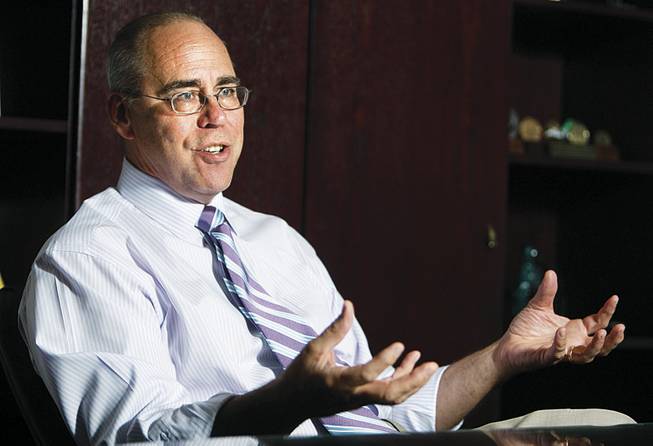
“Universities are going to be the engine of the new economy,” says Neal Smatresk, former provost and new president of UNLV.
Sunday, Aug. 23, 2009 | 2 a.m.
Sun Archives
Beyond the Sun
Sun Coverage
Neal Smatresk has moved into the president’s office at UNLV at perhaps the most challenging of times, the campus straining under wrenching budget cuts.
Smatresk is as an academics expert — he was chief academic officer at the University of Hawaii at Manoa before joining UNLV in 2007 as vice president and provost. Now Smatresk, 58, has been asked to broaden his repertoire by steering the struggling university through a recession and emerge at the other end of the tunnel with a focused mission.
And everyone has his own idea what that mission should be.
We sat down with Smatresk in his office to chat about where he’d like to take the university. Here is part of the conversation.
What do you want people to think when they hear UNLV?
You mean besides Runnin’ Rebels? (laughs).
I want people to see us as an upcoming, enterprising, energetic institution with some standout programs and growing reputation. We get a lot of knocks. We’re a very young institution.
Some people think we want to go out and be Harvard. I have no interest in becoming Harvard.
I’m proud we’ve made a difference in the lives of students who might not otherwise have been able to go to school. Does that mean we should be open access? No. We’ve got to find that right place where we bring students in who have a reasonable chance to succeed in our environment.
We take children further from their starting point, in my opinion, than Harvard or Stanford or USC could. I would submit the great work being done in higher education is being done in the UNLV’s of this country. We need to embrace our mission, rather than be tempted to become Harvard in the desert.
Some people say UNLV should focus on fundamental degree programs and let other universities focus on research.
When a scientist brings in a million-dollar grant, it means work for grad students, it attracts postdoctoral students who want to study here. It means money for state-of-the-art equipment for use by all of those students.
None of those things would happen without the grant, and we don’t get the grant without a research mission and the scholarly presence of our faculty.
How can UNLV help Nevada get out of the recession?
This state desperately needs economic diversification. The jobs of the future tend to be knowledge-based jobs with a fairly high degree requirement at the entry level. Universities are going to be the engine of the new economy.
I just attended the National Clean Energy Summit (in Las Vegas) and you can’t go to that and not be converted. We have to make a decision here, in what could be the solar capital of the world, as to whether or not we are going to participate. Taking a pass would be really foolish for the future of this region.
Let’s talk budget cuts.
We’re doing a terrific job generating graduate students because we have tremendously good programs. Our creative writing is rated in the Top Five in the country. Our law school is rising. One out of every four dental applicants in the country applied to UNLV, which is amazing for an almost brand-new program.
But it’s difficult to continue to gain strength when you cut the budget 14.6 percent, when you’ve lost 100 faculty and 250 staff members. If there’s another budget cut from the state, I cannot maintain our current level. We will have to cut critical programs. We’re looking at what would have to go next, and it’s not a fun exercise.
Some of your most successful programs can’t take any more students. Why not expand them?
I’m criticized regularly that we’re not doing more to expand those programs, particularly nursing. Here’s the hard truth: The cost to us of educating a nursing student is three to four times the cost for a liberal arts student. And we are very efficient at educating nurses.
People say, “Why don’t you open up the nursing program, you’re turning away applicants.” The answer is that for every seat I expand in nursing, I have to take away three or four from liberal arts or urban affairs.
The reality is we’re in a relentless race with our colleagues at CSN and Nevada State College for that base of liberal arts students, who actually pay for the higher-cost disciplines. We’re in a Catch-22. The state’s funding formula doesn’t offer incentives for us to expand our high-value workforce development.
And you need public support to get more money. Why is higher education such a hard sell in Nevada?
The economic payoffs of a good higher education system are hard to explain to the average citizen, but our lawmakers should understand it.
Money spent on higher ed has a multiplier effect. Anyone who’s done rudimentary work in economics knows that. Investments pay out at 5 to 1, which is darn good business. But at a place like Stanford it might be 8 or 9 to 1, or even higher. The reason we’re still at 5 to 1 is that our lack of investment in higher ed has delayed the economic diversification in this state.
We need to fund the high-value activities that research universities bring to the table that’s consistent with the kind of workforce the state hopes to have.
Part of that may come from asking counties to participate in community college funding. That would be a great start. Texas and California are great models. People there are proud of their community college systems. They’re funded well and really pay attention to local workforce needs.
How else can UNLV raise money?
We need to look at our tuition structure. The extra tuition out-of-state students pay doesn’t come to UNLV. The state takes it all. We have no incentive to take students who come from out of state. Maybe if we had a better funding model, we could use our nonresidential tuitions to help support our local students.
We also need to realize we’re blocking access to high-demand programs because we don’t charge what the market will bear.
The best example is nursing. Right now you need a grade-point average of 3.7 to get in, which is an expectation on par with medical school. We’re turning children away with a 3.6 GPA, which, I’ll be honest, I never had in my life until I went to grad school. These are smart, motivated students. We want them. But instead, we’re turning them away. Some of them go to competing institutions in neighboring states where they’re charged three times the tuition.
What I would suggest is that when we have these high-demand programs, that we look at differential tuition. Texas has done it, Hawaii did it when I was there. High-cost programs pass those costs on.
People might say that’s going to bar access. I would say it’s going to expand access. It will give us the opportunity to grow. We need to build a funding formula that recognizes the value of the high-demand graduate programs. These are controversial topics. They’re topics that are going to generate tough conversations. But if we don’t have those conversations, what hope do we have of fixing the problem?
Given the circumstances surrounding the firing of your predecessor, David Ashley, did you have any reluctance to accept the job of university president?
Two weeks before the Board of Regents meeting to vote on my appointment, my 80-year-old mother called me from her home in Buffalo, N.Y. She had just learned how to use Google news alert, and she had been reading all about the whole episode with our past president. She was horrified. She says to me, “Honey, I don’t think you should take this position.”
I just started laughing. Because you know, moms never stop loving their children, and she was worried.
I told her I had met with the new chancellor, he was a good guy with his heart in the right place, and I thought I could get along with him. I told her our Board of Regents is probably the best one we’ve had in a long time. And I told her I thought if anybody could help to get rid of the circus atmosphere and bring things back to normal, it’s probably me, so I’m going to give it a shot.
She said, “Well, OK. Be careful.”

Join the Discussion:
Check this out for a full explanation of our conversion to the LiveFyre commenting system and instructions on how to sign up for an account.
Full comments policy