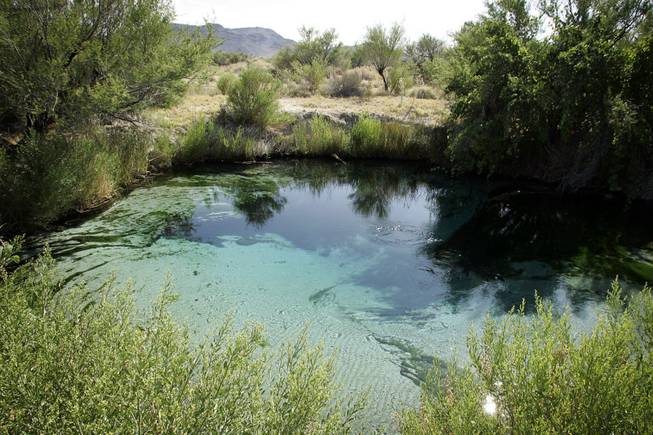
Crystal Spring, in Ash Meadows National Wildlife Refuge near Amargosa Valley in Nye County, is one of many bodies of water that are home to the endangered pupfish. The refuge is a major discharge point for a vast underground aquifer system resulting in an abundance of water for a desert climate.
Sunday, Aug. 16, 2009 | 2 a.m.
Enlargeable graphic
Sun Archives
- Interior bets big on Western solar energy (7-3-2009)
- Solar developers shoot to beat buzzer for cash (3-22-2009)
- LV trying to tap into rural water (4-2-2000)
Sun Coverage
Amargosa Valley
The road to Death Valley from Highway 95 winds through Southern Nevada’s version of farm country.
From the highway, scraggly brush and shuttered bars mask the view of neon green alfalfa growing along dusty side roads. It’s easy to miss the farms entirely — until approaching a small casino that sits near the Nevada state line.
Longstreet Casino’s most recognizable feature, sitting under a windmill, is a giant stucco cow sometimes called “Big Bovine.” Inside the casino, in a large ballroom of the mostly empty building, locals heard a pitch in May for a project that could change the scene outside profoundly.
The presentation came from Jason Higgins, a representative of the Spain-based company Solar Millennium, which wants to build a massive solar plant nearby.
Solar Millennium wants to build a plant that uses water to cool steam into liquid, like a giant swamp cooler. A water-based system would be cheaper and more efficient than the kind of dry cooling many natural gas plants use in the water-deficient desert — fans inside warehouse-like structures.
Higgins, a water surveyor from Las Vegas with big oval eyes set against a square face, was hired to answer a question: Can the company secure enough water rights in the Amargosa Valley to sustain the kind of solar power plant that draws heavily from the aquifer?
“It’s confusing because there are so many opinions of water in this area,” Higgins said to a skeptical couple who demanded to know whether the solar plants would suck the region dry. “I don’t have the answers,” he said. Yet.
Solar Millennium’s more formal public meetings start this week — hearings likely to be repeated by other solar prospectors looking for sites across Southern Nevada. Dozens of developers in the region are involved in the tricky process of winning government approval and finding the capital to build vast plants to harness the sun for energy on federal lands.
Even as momentum from the highest reaches of government builds, touting solar energy as one key source to wean the country off fossil fuels, Solar Millennium and other companies know that solar comes with a set of problems similar to those any massive development project would encounter in Southern Nevada — the need for water, power lines, capital and an accepting public.
The Bureau of Land Management has carved out 670,000 acres of federal land across the West for solar power, including 32,000 acres in Amargosa Valley. (This doesn’t cover Solar Millennium’s proposed site.) The BLM is studying those zones for the purpose of giving energy companies guidelines about locations where they can cluster projects. Run transmission lines around that land and entrepreneurs can be expected to fill them with mirrors or photovoltaic arrays.
Suddenly a clean economy, and the so called promise of “green jobs” in construction and plant maintenance, begins to form.
That’s how it looks on a map.
But solar developers here and across Southern Nevada have run into logistical problems, including tower interference with Nellis Test and Training Range, a lack of suitable transmission lines, and opposition from local conservationists who don’t want to see the desert torn up for solar plants — not to mention a credit market that still has not shaken loose.
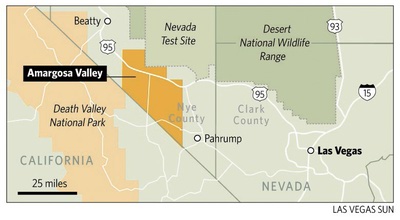
Those nitty-gritty details are playing out in such places as this 500-square-mile stretch of desert south of Beatty running roughly from U.S. Highway 95 down the California border where about 1,500 people live and where 18 companies have active applications to transform federal lands for energy generation.
Plus, there’s the issue of water.
‘Beautiful flat land’
The view from the ballroom window where Higgins made his presentation in May included the same vista that Hank and Robert Records saw in 1950 when they drove through the valley for the first time — desert framed by mountains.
“That beautiful flat land. Something should be done with it,” Hank Records exclaimed, according to a local history book. Years later, his brother Robert joked, “That’s when they should’ve put us in a straitjacket.” Instead, the brothers applied for land under the Desert Land Act.
Farming was the first hope. A railroad that ran through the area was the first to start a large-scale operation. The Tonopah and Tidewater Railroad’s ranch was supposed to demonstrate that the desolate valley could become something else, that ground water pulled up through wells could yield abundant fruits and vegetables. The idea was for homesteaders to fill the area with farms and ship their products on the railroads.
Persuading people to move to such a remote, dry location turned out to be a tough sell. Few farmers came. Those who did weren’t able to make much money farming in the valley.
“My dad always said you can make a living here, but not enough to leave,” said Shelley Kadrmas, who as town secretary runs Amargosa Valley’s affairs from an office in the back of the high school gymnasium.
In 1993 Ponderosa Dairy moved in, owned by the California-based Rockview Farms. Its accompanying lot ballooned to more than 11,000 cows and 7,000 calves. The dairy delivers wholesale organic and nonorganic milk in Nevada and California.
Manager Michael Kwiatkowski says it’s the largest agricultural operation in Southern Nevada, and the area’s biggest employer.
Most of the farmers now sell to the dairy or lease their land directly to the dairy to grow alfalfa to feed the animals.
Still, the valley has never lived up to the expectations of the people who moved there. It has expanded and contracted based on temporary work in nearby mines or the Nevada Test Site. Nearly all of the homes are portable.
“It’s temporary out here and it’s always been that way,” Kadrmas said one afternoon, as teachers at the local school laid out plastic hula dancers and Hawaiian flower-printed crepe paper for an end-of-year potluck that was dreamily given a beach luau theme.
As Michael DeLee, whose family owns part of what was the railroad’s ranch and who runs a real estate business in the area, explains: “Amargosa Valley is always waiting for its ship to come in.”
Indeed, many of the vast circles of alfalfa or the pistachios or trees bearing pomegranates are, in reality, almost water dumps. Landowners use the water so they don’t lose their water rights, which they hope can be converted into something much more valuable because in Nevada, water rights can be bought and sold separately from the land.
To retain their rights, farmers must farm once every five years. So at least every five years, land owners dutifully break out their irrigation systems to water large circular tracts — hoping that someday they’ll be approached with a better deal.
“It wasn’t my intention originally to invest in water rights, but like the owner of any property, you dream about this or that,” said Bill DeWitt, a businessman from California who owns a large stretch of on-again off-again alfalfa fields on land called Funeral Mountain Ranch.
Then DeWitt gave a nod to reality. “You have a horse and it might be a good horse but then it gets a broken leg and what are you going to do? Life is that way.”
The latest broken horse is Yucca Mountain. With its proximity, investors for years assumed the project would be a boon to the area.
DeWitt began acquiring property in 1989, two years after the federal government settled on Yucca Mountain as the site for a national nuclear waste dump.
“I thought it would be like the Hoover Dam project, with thousands of employees,” DeWitt said. Those people would need places to live and shop, he thought.
“I was wrong.”
DeWitt and others now hope solar power will succeed where other ideas failed.
Like all big water holders here, for most of the last year, DeWitt has had solar developers stop by asking to lease or buy his water rights. He’s been in close negotiations with Solar Millennium.
DeWitt said he is waiting to see what “pans out” before he makes a final deal.
Tale of the pupfish
On a July day in Ash Meadows National Wildlife Refuge, Fish and Wildlife Service biologist Cristi Baldino stood at the edge of Kings Pool at Ash Meadows. The pool was as blue as the Caribbean and so clear she had an unadulterated view to the bottom.
Baldino’s Fish and Wildlife Services cap topped a short, red bob and a cheerfully dimpled face as she explained that in cooler weather, this is the spot where she lingers, mesmerized by the rambunctious Ash Meadows Amargosa pupfish in the pool.
“Look at them playing and chasing each other,” Baldino said. “It’s a very soothing experience.”
She pointed to a yellow flower — the Ash Meadows gumplant.
The area is home to life forms that exist only here, a wet spot in the middle of the desert — at least 24 plants and animals.
Little bubbles float to the top of the spring, as gallons of underground water spurt to the surface and down the swirling streams from here. “A lot of people see the water and have the concept it’s endless, but it’s not,” Baldino said.
Hanging in the Fish and Wildlife Service’s bungalow here is a photo from decades ago showing two cars, one with a bumper sticker saying “Kill the Pupfish” and the other, “Save the Pupfish.”
One type of pupfish — the Devil’s Hole pupfish — live in a small crevice adjacent to Ash Meadows that provides a rare view of the underground aquifer in Amargosa Valley. Divers have gone down 500 feet but don’t know how much deeper the water runs because they haven’t been able to dive that far.
The Devil’s Hole pupfish breed along the ledge and because the conditions there are so rare, scientists have never been able to recreate them. Those pupfish have been a source of tension between the residents and the federal government for decades, ever since the discovery that pumping ground water nearby threatened the pupfish.
The locals don’t come a lot to see the pupfish, Baldino said, but attorneys from far away do. They visit to see the pupfish that caused a landmark Supreme Court decision in 1976 giving the National Park Service the right to stop pumping of the aquifer because it endangered the creatures.
Dry or wet system?
Solar Millennium submitted its updated plan to the BLM late last year. The company wants to build two 242-megawatt concentrated solar plants with mirrors taking up 4,000 acres on desert shrub along Farm Road, the main route through what passes for a “downtown” in Amargosa Valley.
The company’s site would be just 1 1/2 miles from the town’s community center, school, library and helipad. It would be less than 20 miles from Devil’s Hole and Ash Meadows. Solar Millennium’s application said it chose the site “due to its excellent solar radiation, access to existing electric transmission corridors, and access to skilled labor and other industrial infrastructure in nearby Las Vegas.”
The application said the company wasn’t sure whether it will build a dry system or a wet system. The difference is staggering.
A wet system would require 2,000 acre-feet of water a year for each of the two plants (an acre-foot of water is equal to roughly 325,000 gallons).
A dry system would require just 10 percent of that. But a dry system is expected to cost 5 percent to 10 percent more to build, and would produce about 20 percent less electricity on the hottest days, developers say.
“The primary potential water source is diversion of agricultural water from existing, active wells near the periphery of the proposed project,” the application states. In other words, the company is going to try to buy or lease water rights allocated to farmers in the area.
Project developer Don Reid translated it this way: “We’re not going to increase water usage in the basin,” he said. “We’re just going to switch it from growing alfalfa to growing megawatts.”
Here’s the problem: The state’s water engineer, Tracy Taylor, says the basin in the area has 24,000 acre-feet of water available each year, of which 17,600 is actively used.
The Park Service contends that if the allocated water rights are fully used every year, the aquifer couldn’t keep up with the demand, said Jennifer Beck, a hydrologist for the Park Service who has looked closely at renewable energy issues.
If solar developers, who parks officials say theoretically want to pump 50,000 acre-feet a year from the aquifer, buy or lease most of the water rights, they will severely deplete the aquifer, the park service said in a letter to BLM this year.
“We support solar but we would just want to recognize that each area has different constraints that should be considered,” Beck said. “The Amargosa desert we would suggest is an area where wet cooled is not the best technology.”
“What I would envision is greatly decreasing water levels, and there is a concern that if the water levels decline significantly in the vicinity (of) Ash Meadows and Devil’s Hole and the area in Devils Hole where the pupfish actually spawn, it wouldn’t take very much to dry that up.”
A few weeks ago, the town of Amargosa Valley asserted its own “vision statement” in a plan it wants Nye County to approve.
The valley “will strive to maintain a rural atmosphere, open spaces, green belts and agriculture, while encouraging controlled growth and safe industries in support of economic diversification,” the plan states. “Growth and development should not come at the expense of the qualities that make the valley special or diminish its natural resources.”
‘It’s an industrial process’
Brian Brown is a date farmer across the border in California and the resource advocate for the Amargosa Conservancy, a local conservation group. He has strong views about using desert land in the area for solar power.
“It’s being passed off as a very simple story of federal land that we want to lease to provide green power for America, and there’s nothing bad about that except it’s an industrial process, and if it was anything other than solar, people would be going, ‘hell no,’ ” he said while walking around his palm-tree laden farm recently.
“If it was a gas or a coal fired plant right in the middle of town, what would they say? They want to come in and sterilize the desert and build a 70,000-acre parking lot. Do we want to spend the rest of our lives staring at miles and miles of solar panels?”
National environmental groups counter such claims by arguing that large-scale solar plants will replace coal-fired power sources, curtailing the gases that contribute to global warming and threaten far more than patches of desert.
As the controversy goes on, some solar developers are not even trying secure water rights for wet cooling. Abengoa Solar recently introduced a plan for a dry-cooled system next to U.S. 95 on a strip of desert it says was paved over for an airstrip. What that company is most concerned about is securing transmission lines.
Ed Goedhart, Amargosa Valley’s conservative Republican assemblyman, believes the valley needs a boost. He split with many of his constituents by opposing the Yucca Mountain project, and then became a solar power evangelist.
“The thing I like about solar is that the sun isn’t going to call us up and say, ‘My rays are going to double in price in the next six months,” Goedhart said in an interview last spring. “You’re locked into this energy source and it isn’t going to be controlled by market manipulators or other countries. It’s a fixed cost.”
Lately, however, Goedhart has grown pessimistic about its chances in the valley.
“If you look at the risks involved, all the hurdles, the sun the moon the stars all have to line up in perfect alignment,” he said recently. “It’s so complex, so burdensome. I think it would be a miracle to get one plant built.”

Join the Discussion:
Check this out for a full explanation of our conversion to the LiveFyre commenting system and instructions on how to sign up for an account.
Full comments policy