
Las Vegas Sun

November 26, 2009

Currently: 60° | Complete forecast | Log in

Looking in on: Education:

District’s new teachers fewer than in recent years, full of enthusiasm

Image

Steve Marcus

Teachers Natalie Truong, left, and Leann Trousdale, center, talk with Clark County Education Association staff member Rhonda Fields during an orientation for new Clark County School District teachers Wednesday at Coronado High School. The district has hired 360 teachers for the school year starting Aug. 24, the fewest in 10 years.

Saturday, Aug. 15, 2009 | 2 a.m.
Click to enlarge photo

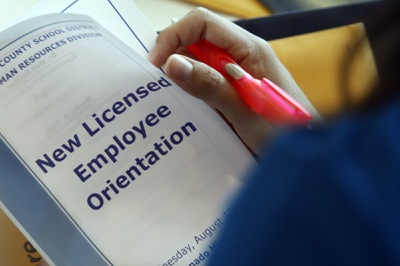
A teacher new to the district looks over a booklet during the orientation. Teachers starting here this year have come from as far away as New York and New Jersey, some for their first teaching jobs, others with decades of experience elsewhere.

Some came from across town to attend this week’s new-teacher orientation, excited about their first classroom jobs. Others, with decades of experience, arrived from as far away as New York and New Jersey.

It was the smallest crowd in years, reflecting how growth in the Clark County School District has flattened, diminishing the need to recruit several thousand new teachers. Still, Coronado High School’s cafeteria, filled with 360 new teachers, was brimming with enthusiasm.

Among those in the crowd: Bridgette Carter, who taught for seven years in Alabama before her soldier husband was reassigned to Las Vegas. Because Carter’s skills as an autism expert were in high demand, she quickly landed a position at Mountain View Elementary.

Carter said she was worried that she might feel a little lost in the nation’s fifth-largest school district. She’s glad that her rookie class was the smallest group the district has added in about 10 years.

By the end of the second day of orientation, Carter said the experience “was awesome ... I’m really looking forward to getting into the classroom.”

• • •

The finer points of hand-washing and the best technique for covering coughs and sneezes will be some of the first lessons district teachers will review with students when the school year starts Aug. 24.

The district’s flu response plan was tested in May, when the nationwide outbreak of the H1N1 virus — also known as swine flu — reached Clark County. Diana Taylor, director of health services for the district, said school nurses will review best practices with staff at each campus.

In a telephone news conference with reporters this week, U.S. Education Secretary Arne Duncan said public schools will play a key role in preventing the spread of the flu. In addition to educating students and parents about preventive measures, campuses are logical locations for wide-scale vaccinations. The H1N1 vaccine is in production and expected to become available in October.

Dr. Thomas Frieden, director of the federal Centers for Disease Control and Prevention, told reporters that it doesn’t appear that closing schools significantly reduces the total number of flu cases in a community. He recommended that local and state officials weigh the potential loss of valuable class time for students — and lost wages for parents who lack emergency child care — against the possible benefit of fewer cases of flu.

If schools must be closed, districts should be ready with alternative means of instruction, such as online classes, Duncan said.

But ultimately it comes down to common sense.

Parents know when their children are feeling sick, Duncan said. And when they are, keep them home from school.

• • •

Nevada education officials aren’t willing to accept that the Silver State might be disqualified from competing in the “Race to the Top” — the name of a federal $5 billion initiative to reward states and schools that show a commitment to innovation and reform.

The proposed requirements of the initiative include that states cannot have any law that prohibits the use of test data in evaluating teacher performance.

Nevada is one of four states that have such a provision on the books.

The situation was the top topic at a recent meeting of the Nevada Association of School Boards in Ely, Vice President Carolyn Edwards told her Clark County colleagues at Thursday’s meeting.

“I can tell you this battle isn’t over,” Edwards said. “Two of the three other states (that might be disqualified) are California and New York.”

Los Angeles Unified is the nation’s second-largest school district, with about 800,000 students. New York City Public Schools is the country’s largest district, where enrollment tops 1.1 million.

Discussion: 8 comments so far…

  1. Isn't that special, three of the four largest school districts have the influence to keep legislatures from "using test data" to evaluate teacher/administration performance.

    NO ACCOUNTABILITY!

    Break up the monopoly called CCSD. Smaller school districts will result in grassroots community involvement and likely higher educated more qualified and independent BOARDS!

  2. I am for evaluating teachers, but for the most part administrators are UNFAIR when it comes to evaluations. Here's a novel idea -- why not have teachers evaluate administrators. I can tell you right now many of the administrators in this district should return to the classroom for some extra seasoning. Unfortunately, the ADMINISTRATORS ASSOCIATION rules the district and this action would NEVER occur. Hey Emily, why not ask teachers how they would like to evaluate administrators. I am sure you would get an earful. (BTW - CCEA conducts annual surveys regarding administrators, but the results are carefully hidden from view. Why, CCSD wants it that way, And what does CCEA get for keeping the results secret???? $150K. With that kind of money, I would keep my trap shut, too.)

  3. I find it interesting that these teachers are suddenly coming here for a job. I thought our teachers had such a low pay. Oh now I get it, having a job is still better then being unemployed. The teachers would not forgo their cost of living increases to help the state with its financial problems. I guess they should realize they still have great benefits and are still drawing a paycheck. Wake up teachers you live in the same world the rest of us do. We have to sacrifice and why can't you. Many who are unemployed probably wish they had your job.
    Of course that is my opinion and I could be wrong.

  4. As a teacher, there is always concern about basing evaluations on testing. This is something that could definitely affect poor performing schools; schools that rarely make AYP. These schools are extremely difficult to work at. Most of the major issues are out of the teachers' contol, so is it fair to base evaluations on tests results? For example, students are moving in and out at high rates, so they don't necessarily have solid education backgrounds. Some of the hispanic students will take months off to go to Mexico and other Latin countries to visit family. I have never had a student come back and say that they attendend school while they were down there. This results in large gaps in their education. Another issue is attendance. Students can miss as many days as they want as long as they have parent permission. If a parent calls in or writes a note, they are covered. In many schools teachers are not allowed to give a 0 on an assignment that a student didn't complete; they have to give them a 50%. That is half credit for doing nothing, which means they truly only half to put in effort half of the time to scrape by with a passing grade. Most teachers are against this policy, but are required to use it. Many of the schools that do not make AYP have less parent support because the parents are working many jobs to provide for their family. It isn't that the parents don't care about their children's education, they are just more worried about providing food, clothing, and shelter. Students that are second language learners and new to the country also struggle on these tests because they aren't in their native language. Imagine being in a new country for a short ammount of time, and being expected to be successful on the same test as a native speaker. It would not be easy, and test results support that. These are some of the main reasons why students perform low on tests, and all of these things are completely out of the teachers control. Is it really fair to evaluate teachers based on test scores? If this type of evaluation comes into play, you are going to see a mass exodus out of schools that struggle to make AYP, and more teachers moving to the schools that do make AYP because they don't want bad evaluations based on things out of their control. Good luck getting teachers to stay in low performing schools for very long. So who will it hurt in the end? The students. Everything always needs to go back to what is best for the students. I am not sure that having so many teachers leaving and new ones coming in...and then leaving...and then coming in is in the best interest of the students.

  5. i worked my first couple of years in a low socioeconomic "at risk" area school where 80% of the students were second language and >90% of the students were on free lunch. We were dedicated and worked hard, but still struggled to get students reading at grade level.

    I moved to a school that had no language or socioeconomic issues after my second year. Suddenly, in my third year, I was able to get about 90% of my students reading at grade level (and even the ten percent that struggle make significant progress and would probably be considered high-ability at the school i came from). not only did these students start the year at a more advanced level, but they make more progress throughout the year.

    so, using the simple mindset of 2zero and others, i was a pretty lousy teacher my first two years and i have been an awesome teacher from my 3rd year through the present. Amazing how i went through a magical transformation that changed me from a bad teacher who should be fired to a good teacher who should get merit pay instantly sometime between my second and third year of teaching.

    For all of you armchair critics out there - here's a fun exercise. go to some of the elementary and middle schools in the poor areas of town. notice how many of the "teachers" have orange stripes across the tops of their name badges. this orange stripe indicates that they are substitutes filling slots that they couldn't get theachers to accept. despite what you read in the papers, you will still see this in the 2009-10 school year. if you don't believe me, go look for yourself. the district isn't going to be short teachers in the aggregate, but they are still short teachers who are willing to go into the poor "at risk" schools to fill general ed positions. the main reason is that the teachers know that they will be looked at unfavorably because students at these schools score lower than other demographics.

    attack the teachers all you want - it isn't going to help the problem. in fact, it will only make the problem of socioeconomic-based educational inequity much, much worse. the solution isn't to try to scare the teachers more. that only chases the ones with options further into the suburbs and leaves the inner-city schools to staff with teachers who have no option (new hires / teachers who the suburban schools dont want) and substitutes. a better solution would be to entice better teachers into the schools that need them most with significantly better pay and an assurance gthat thir efforts to meet reasonable expectations for progress will be recognized and they will not be cut off at the knees for failing to meet nclb-style one-size-fits-all standards in their first year at the site.

  6. Hey, move from a low SES school, and see what happens. You are amazed at how many of your third graders read at a 6th grade level. Almost everyone passes the tests. Parents are involved almost to a point of distraction. And it is great. However, you can't help feel a little guilt for leaving a school where the kids are at such a huge disadvantage. Most go home to empty houses and hard working, but very uneducated parents. They need a lot of extra help that is not given. When I worked at such a school, I loved the kids. Most were very sweet and well behaved. But they were far behind, most could barely speak English, and many were malnourished. I worked at least 15 hours per week more, and brought up test scores. However, they still didn't come close to matching results at Summerlin schools. If a student passed with a 70 you were ecstatic! In Summerlin, if your whole class doesn't pass, you are upset, and if at least half don't get 100% Then you are reevaluating your teaching, and doing it over. Just two different worlds.

  7. First off don't allow illegals to attend a school system they did not and refuse to pay for. If the parents are illegals then put the whole family on a bus back across the border. Why do we continue to allow these illegals to use services paid for by taxpaying Americans? We would only need half the amount of schools and teachers if we did not educate all these Mexican invaders. Send them all packing build a wall and position snipers on the wall the way Israel does. Kill any invader caught sneaking into our country.

  8. LasVegas2009.....

    I guess your grand parents or great grand parents or great-great grand parents didn't enter this country as an immigrant...did they?

    In other words, I guess your family is an exception. The statement made by JFK probably doesn't fit you or your family...Right?

    JFK said....

    "Every American who ever lived, with the exception of one group, was either an immigrant himself or a descendant of immigrants" and that the exception -- Native Americans -- were considered by some to be immigrants themselves."

Post a comment

Commenting requires registration.

Comments are moderated by Las Vegas Sun editors. Our goal is not to limit the discussion, but rather to elevate it. Comments should be relevant and contain no abusive language. Full comments policy.

Username:
Password: (Forgotten your password?)

OR Create an account (It's free)

  • Most Read
  • Discussed
  • Most E-mailed

Calendar »

  • 26 Thu
  • 27 Fri
  • 28 Sat
  • 29 Sun
  • 30 Mon