LAS VEGAS SUN FILE
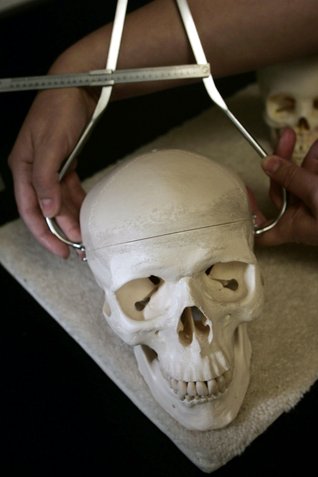
Calipers are used to measure a plastic model of a skull in a lab at UNLV. Although school officials say accrediting the program is essential, Metro Police doesn’t require forensic personnel come from accredited schools.
Saturday, June 7, 2008 | 2 a.m.
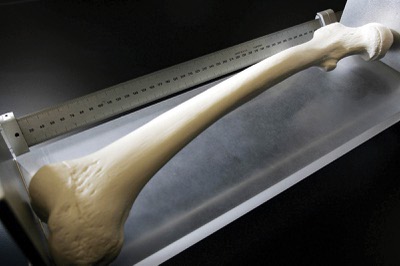
A plastic model of a femur is a teaching tool in the forensic science program at UNLV, which is less than five years old and is being phased out.
A post-mortem would reveal that the victim had been starved intentionally.
The executioners were the caretakers, who could no longer bear the expense of supporting the youngster who had long been ill.
UNLV administrators say they had good reason for killing their fledgling forensic science program, leaving the city that gave birth to the “CSI” craze without a CSI program at its only public university.
UNLV unveiled the program less than five years ago, hoping to capitalize on the popularity of a field glamorized by several TV series, including “CSI: Crime Scene Investigation,” created by UNLV alum Anthony Zuiker.
But now the school, struggling financially, doesn’t have the money to hire a director and faculty members to move the program toward accreditation, said Michael Bowers, vice provost for academic affairs at UNLV.
“In terms of forensic science, to get a good job or to move into a graduate program, you need to come from an accredited program,” said Carl Reiber, associate dean of the College of Sciences, who took over the forensic science program in 2007. “It’s like anything else. If you come from an accredited program, the entity that hires you knows that you’ve been trained appropriately.”
So UNLV is in the process of phasing out forensic science, which still has about 80 students enrolled.
The demise of the program, which generated good publicity for the university, pains students and others who saw it as a great fit for Las Vegas. Offerings included classes with Daniel Holstein, a Metro Police senior crime scene analyst who inspired a main character in Zuiker’s show.
“It’s unfortunate,” said Randy McLaughlin, Metro’s acting director of crime scene investigation. “We want to train our own and recruit our own from our area ... People that grew up here, people that were raised here, are more likely to stay around and contribute to the community.”
McLaughlin’s and Holstein’s other statements call into question administrators’ rationale for axing the program.
Holstein, who taught forensic science classes including the science of fingerprints, said former students had landed jobs investigating crime scenes. And McLaughlin said his unit does not mandate that new hires come from accredited forensic science programs.
The standards of the Forensic Science Education Programs Accreditation Commission, which accredits college forensic science programs, are geared toward preparing students for work in police and other science labs, according to the commission’s chairman, Max Houck.
But UNLV, Holstein said, gave students the option of focusing on field work — gathering and interpreting evidence at a crime scene, not analyzing it in a lab.
Lisa Ford, a UNLV forensic science student who graduated in December, is investigating crime scenes for a local law enforcement agency she prefers not to name. She had no prior experience in that line of work and said the skills she picked up at UNLV were the “main reason” she landed her job, which pays more than $40,000 a year.
“I actually respond to the field and process crime scenes for physical evidence, latent fingerprints,” she said. “I speak to witnesses and victims, and I use all that information to write a report.”
Bowers acknowledged that students could find field work without coming from an accredited program but said aspiring laboratory employees would have a difficult time.
Still, even for students eyeing the lab, a degree from an accredited forensic science program isn’t a must. Linda Krueger, Metro’s director of laboratory service, said although she looks for workers with strong science backgrounds, “you don’t have to come from an accredited forensic program to have a job here.”
But accredited programs give students a leg up, Krueger said. Though the commission began offering accreditation only in 2003, about 20 programs have earned that designation and nine are applying, Houck said.
At UNLV, forensic science was approved in late 2003 as a “concentration” under the bachelor’s degree program in multidisciplinary studies, which lets students craft individualized programs of study in fields in which UNLV does not offer a degree.
Course catalogs show the program required students to take 78 or more credits in forensic-science-related courses. But administrators said because forensic science was not a major, it did not have to pass muster with the Board of Regents, which requires colleges introducing majors to submit proposals detailing plans for growth, new hires and curricular changes.
Whether accreditation was a goal for forensic science from the get-go is unclear; a proposal selling the program to a UNLV curriculum committee made no mention of it.
“At the time that that program was created, we had a different president and a different dean and a different department chair,” Bowers said. “I don’t even know if they knew that such programs were accredited.”
The Sun was unable to reach Jennifer Thompson, the faculty member who built the program, for comment.
Accreditation aside, it appears that forensic science was simply an ambitious program that demanded more time, planning and money than administrators were willing to invest.
Students complained that some required courses were rarely offered. At the same time, officials were reluctant to expend resources on low-enrollment classes, canceling one in crime scene investigation in fall 2007 after just four people signed up.
In the brief time forensic science was taking new students, its lineup of courses changed substantially.
A 2004-06 course catalog said students entering forensic science could specialize in one of three areas: legal systems, scientific techniques or the human body. A 2006-08 catalog listed just two specializations: scientific techniques and crime scene investigation, which had evolved from the human body branch but differed considerably.
Legal systems, Bowers said, was redundant with UNLV’s existing criminal justice major.
For faculty members including Thompson, finding time for forensic science while meeting other commitments was a challenge, Bowers said.
By spring 2007, administrators who believed accreditation was necessary had concluded the program was no longer viable. Pursuing that recognition would have cost at least $400,000 a year, more than UNLV, facing falling enrollment, could afford, Bowers said.
“The decision needed to be made,” he said, “whether we were going to allow it to continue to limp along in its present state or whether we were going to phase it out or sink the resources into it to make it the robust program that it needed to be.”
Holstein’s fingerprints class and one other course required for students specializing in crime scene investigation will no longer be offered, administrators said. But a College of Southern Nevada class covers similar material, and students can also replace canceled offerings with approved UNLV coursework.
“Every student currently in the forensic science concentration will have the opportunity to graduate,” Bowers said in an e-mail.
Of 80 students in forensic science, about 20 have taken courses putting them on track to graduate from the program, he said.
UNLV staff notified students about the program’s status through calls and through academic advising appointments, Bowers said.
Still, word reached some stakeholders through hearsay. Holstein, who helped develop coursework for the program, learned of its death by phoning UNLV late in spring semester 2008.
Senior Jennifer Hornback, who is struggling to complete her studies in forensic science, said she found out about the concentration’s unhappy destiny through a friend who had read the news in the school paper.
“I understand that the program was new, but it’s kind of like they threw the program on there because it was popular, but they didn’t really have the backing and they didn’t really want to put the time and effort into it,” said Hornback, who has had to find substitutions for several of the program’s required courses she said had not been offered since she entered the program a few years ago, or were rarely offered or canceled.
“It’s been a big pain,” Hornback said. “There’s been plenty of times where I’ve cried to my husband about how I’m never going to graduate and he’s going to make all the money because I’m never going to leave school.”

Join the Discussion:
Check this out for a full explanation of our conversion to the LiveFyre commenting system and instructions on how to sign up for an account.
Full comments policy