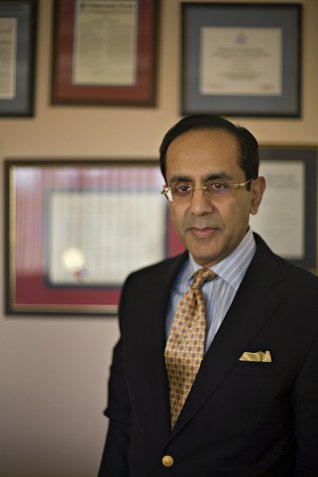
“When the uninsured receive care in the hospital, someone is paying for it … Indirectly we are all paying for that,” says Dr. Ikram Khan, a retired surgeon.
Thursday, Jan. 31, 2008 | 2 a.m.
Audio Clip
- Dr. Ikram Khan talks about problems with indigent care.
-
Audio Clip
- Khan talks about the mental health issue.
-
Audio Clip
- Khan discusses universal health care.
-
Sun Archives
- Fallout over foreign doctors (10-05-2007)
- Helping hand lent to quake victim (1-11-2006)
- Attorneys decry loss of work with tort reform (4-04-2006)
- Law may not prevent doctors’ exodus (1-17-2003)
Beyond the Sun
About 450,000 Nevadans — 18 percent of the state’s population — do not have health insurance, according to some estimates. Often they’re working-class people who can’t keep up with the rising premiums, the homeless or undocumented immigrants.
Their circumstances affect all Nevadans, said Dr. Ikram Khan, a retired surgeon and president of Quality Care Consultants, a company that specializes in strategy and policy development for employers and health care organizations.
Khan was recently named special adviser on health care to Gov. Jim Gibbons. It’s a position he’s comfortable with. He was an adviser to Gov. Kenny Guinn and to members of Congress and has served on the Nevada State Board of Medical Examiners.
Gibbons said he selected Khan for his 25 years of exceptional leadership in health care policy and strategy, in the public and the private sectors.
Khan says state legislators need to address the large number of uninsured people by working toward some form of universal health care system.
Gibbons, a Republican, would not seem to be one to advocate universal health care. But his spokeswoman, Melissa Subbotin, said the governor believes all Nevadans need health care and is looking for advisers with creative solutions.
Khan will consult for Gibbons as the governor prepares for the 2009 legislative session.
We sat down with Khan for some questions and answers. Here’s a sampling.
What are Nevada’s most dire health care needs?
The state’s health care climate reflects the national climate. We have the greatest quality of health care available in the world. Unfortunately we do not have that care available to every citizen. Nationally, 47 million people do not have health care insurance. That is something we can’t be very proud of as a nation.
One of the areas of concern in Nevada is the issue of health care access for all people. The indigent care directly affects all of us who consider ourselves taxpayers. When people don’t have insurance, they can’t get routine checkups and well-being assistance. They can be sick with diabetes, high blood pressure, breathing problems or asthma and not be seeing a doctor for routine care. When they really get into complications with these illnesses they land in the emergency room. Now they’re twice as sick, maybe more, and twice as many resources are consumed in their care in the hospital. They stay in the hospital longer than an average patient, and when they are discharged there’s nowhere for them to follow up. So they come back in the hospital again. It’s a revolving door.
When the uninsured receive care in the hospital, someone is paying for it, whether it’s a private or county hospital. That cost for those people is transferred to those who have insurance or can afford to pay. Their premiums go up. Their rates go up. So indirectly we are all paying for that.
What are your other concerns?
We’re confronting issues with mental health. There’s a lack of mental health beds in the community. Mental health patients arrive in the emergency rooms, where they are medically stable but not mentally stable, so they can’t be released. Since there are no mental health beds available, they end up using emergency room beds or regular hospital beds — and they may stay for two to six weeks. It increases the burden on the emergency rooms. The cost is being borne by the hospitals, and it takes away the bed from a genuinely sick patient who needs to be in the hospital. This is putting pressure on all hospitals in the community.
So what do we do?
We badly need some form of universal health care system. I want to emphasize the fact that I mean “universal,” not “government sponsored.” They’re two different things. Government sponsored means something like Medicare or Medicaid, subsidized and run by the government. But I believe there are various creative ways of putting together a program involving the private sector, so the government component is minimal. It doesn’t have to be run by the government.
Several states have tried to address that by creative solutions with public-private scenarios. None of them is perfect, but one could pick up the appropriate ones that apply to Nevada and start working that through the legislative process. We have to study the many approaches and determine which one is ideally suited. The government alone cannot solve the problem.
This would be complicated and politically charged. How can politicians make it work?
It will take time. It won’t happen in a year or two. But at least we need to go in that direction. In the long run it will become more economical for all concerned. Keep in mind that those who can’t afford it or don’t have insurance do not need to have the Cadillac of health insurance coverage. They can have the basics, enough to get them from point A to point B, and that would change the dynamics. The economic side would translate down the road into lower premiums for those who can actually afford health care insurance.
This is such a huge issue for our country as a whole, and for our state, that all political leadership needs to go beyond the philosophical, ideological or political divides that we all rightly have. In health care one has to go beyond politics to find a pragmatic solution to a real problem.

Join the Discussion:
Check this out for a full explanation of our conversion to the LiveFyre commenting system and instructions on how to sign up for an account.
Full comments policy