Sunday, Feb. 24, 2008 | 2 a.m.
When President Bush called for less pork last month in his State of the Union address, Rep. Jon Porter joined other Republicans in applause.
He even went so far as to endorse his Republican House colleagues who are calling for a moratorium on the extra spending for home districts that’s known more politely as congressional earmarks.
But those efforts have not stopped Porter from seeking federal dollars for his constituents in Southern Nevada.
In fact, Porter made it even easier this year for locals to request earmarks. Just go to his Web site and, with three clicks of the mouse, download the form asking for money. (Hurry, the deadline is Friday.)
Porter says he’s all for a moratorium while Congress tries to clean up the earmarking game, but until then he will continue to bring home the bacon. The federal government’s funding formulas, Porter says, fail to keep pace with the rapid growth in his district, where 100,000 new residents arrive each year. Earmarks allow him to get what’s owed to Southern Nevada taxpayers.
“I’m still going to argue that some of these projects should be funded because I don’t call that earmarks when we’re underfunded by the federal government,” Porter said in a brief hallway interview the day after Bush’s speech. “We certainly are still going to listen to the community, and listen to what (the people’s) needs are.”
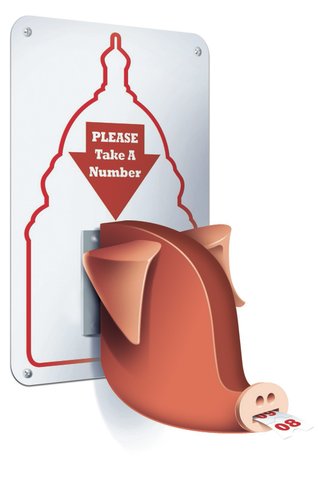
Indeed, as federal appropriations season opens in Washington, reform rhetoric is coming face to face with the reality of pork.
Constituents, both public and private entities, come knocking on lawmakers’ doors seeking cash for a range of needs. In Nevada, it tends toward the big-ticket infrastructure projects such as roads and water delivery and sewer systems the state can ill-afford.
Lawmakers try to deliver as much aid as possible to show they are responsive to their constituents’ needs and have the clout it takes to get the job done — good talking points heading into the fall election.
But Republicans in the House have taken a strong stance against earmarking this year as they try to regain the mantle of fiscal conservatism. The party wants to return to its roots after losing control of Congress in 2006, partly because of spending excesses. But party leaders are meeting pushback from Porter and others within their ranks.
On the other side of the aisle, Democrats face their own complications when it comes to pork.
Democrats were elected to power in 2006 partly on their promise to “drain the swamp” of corruption that had flourished under Republican rule. Although Democrats have reduced earmarks by more than 20 percent, and made the process less prone to corruption with new rules, there is no appetite for abolishing the practice.
Deadlines are approaching to submit spending requests by March 19 (most Nevada offices have earlier deadlines) and public and private groups are arriving in Washington jockeying for attention.
Henderson Mayor Jim Gibson led his entire City Council on a whirlwind tour of the Nevada delegation’s Washington offices this month, requests in hand.
“I don’t know if I’d be so brazen to say everything is business as usual, but the members of the Nevada delegation recognize these small dollars are so significant. They understand we can’t do without them,” Gibson said from Henderson last week. And, he noted: “We don’t find people back there pushing back, saying, ‘No, no, no.’ ”
Henderson has an eight-item wish list, similar in size to past years’. The city’s requests total $65 million and include items to help build a freeway interchange, develop a solar energy project and provide crime-fighting technology for the Police Department.
Las Vegas officials helped land Democratic Rep. Shelley Berkley on an embarrassing anti-pork list last year after they requested $200,000 to help turn the old post office into a museum.
This year, the city was back knocking on doors with five items — including a freeway interchange and several green sustainability initiatives — valued at $14 million.
Ted Olivas, the city’s director of government and community affairs, said, “It’s business as usual until someone tells me otherwise.”
One Nevada lobbyist pledged to continue sendingmoney-seekers to Washington until the lawmakers say no. “Until they say, ‘We ain’t doing it,’ we’re pursuing it.”
Earmarking developed as a cottage industry during the recent Republican-dominated era in Congress, and partly led to the party’s downfall in the 2006 election.
The number of earmarks rose dramatically over the past decade, from a few thousand in the mid-1990s to a peak that some estimates put as high as 16,000 in 2005, according to congressional researchers and government watchdogs.
But a few celebrated earmarks left the public soured on the whole business — the $200 million “Bridge to Nowhere” in Alaska and the bribes for earmarks that landed former Republican Rep. Randy “Duke” Cunningham behind bars. Disgraced former lobbyist Jack Abramoff became synonymous with the earmark game.
Yet earmarks still flowed in the fiscal 2008 spending bills under Democratic control, but at a much reduced pace. The number of earmarks is down 23 percent to 12,800 compared with 2005, according to Taxpayers for Common Sense. By other estimates the value of earmarks has fallen from $29 billion to $18 billion.
Berkley scoffs at House Republicans’ attempt to put a moratorium on earmarks, calling it “nonsense.”
The easiest way to achieve a moratorium on earmarks is simple, she says: “Don’t submit any.”
“I don’t want a moratorium. I want a VA hospital in Las Vegas; I want that $340 million,” she said about the funding she helped secure last year to build Southern Nevada’s first veterans hospital. “I don’t believe earmarks are the root of all evil. This directs the money where it needs to go.”
As for last year’s postal museum earmark, she said she seeks the priority projects submitted by those from her district. If constituents think Las Vegas’ request for the postal museum was out of line, she said, they should call her and say, “We don’t want that money.”
Senate Majority Leader Harry Reid, too, has famously stood by his earmarks. He delivers more bacon than the other Nevada lawmakers combined.
Porter isn’t the only one who has entered the modern era by allowing residents to apply for funds online a practice noted recently by The New York Times.
Although Porter’s Web site is unique for offering money seekers direct access to the earmarks request form, Berkley and Reid direct applicants to an undisclosed Web site where they can access the forms with a password issued by their offices.
Anti-earmark crusaders see an impersonal mechanization of the process.
Keith Ashdown, chief investigator at Taxpayers for Common Sense, worries “it turns Congress into a cash machine without much oversight.
“What we’re concerned about is when you go out and say, ‘Hey, Nevada, I have the keys to the treasury. Here, whatever you need, I want to hear from you,’ ” he said. “It just blows the number of earmarks into the next orbit.”
He and other watchdogs say the bigger problem is the lawmakers’ refusal to disclose the requests they are receiving.
Porter, Berkley and Reid refuse to disclose them. (The offices of Sen. John Ensign and Rep. Dean Heller did not return requests for comment for this story.) The lawmakers say they don’t want to disclose proprietary information, and only when a funding request makes it into a bill do rules require the disclosure.
But critics say the lawmakers simply want to shield the tough decisions they are making about priorities. Critics also believe lawmakers want to avoid looking ineffective if they are able to secure funds for only a small fraction of the requests being made.
Ashdown says the online solicitations fuel this cycle.
“It’s a great PR tool. Even if you don’t deliver, it makes them think that you’re listening,” he said. “It makes the system more efficient, but it doesn’t make it more transparent.”

Join the Discussion:
Check this out for a full explanation of our conversion to the LiveFyre commenting system and instructions on how to sign up for an account.
Full comments policy