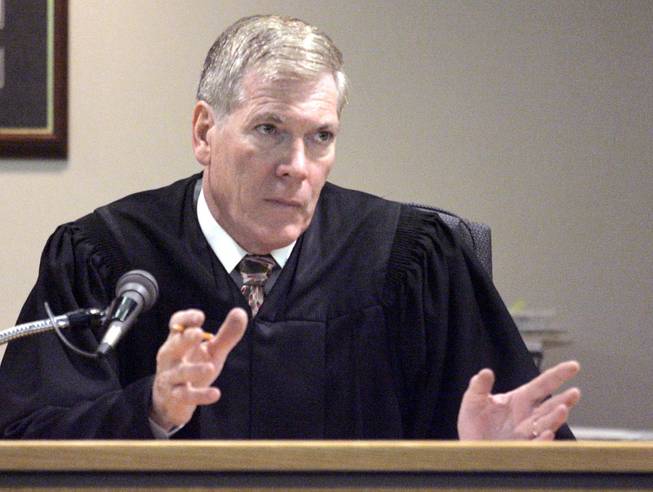
District Judge Donald Mosley says $10,000 in campaign cash he provided his then-girlfriend in 1990 was a short-term loan and not a violation of law. She said the money was a gift.
Saturday, Feb. 2, 2008 | 2 a.m.
Sun Archives
- Boggs' spending will get second look (1-31-2008)
- Boggs' lawyer: What does residence mean (12-12-2007)
One of the charges filed against former County Commissioner Lynette Boggs is that she misused campaign funds — the same accusation previously leveled against the judge presiding over her criminal case.
In 1990, District Judge Donald Mosley provided $10,000 of his campaign money to his then-girlfriend. Mosley called the transaction a “brief loan,” but the woman who received the money told the Los Angeles Times in 2006 it was a gift. Mosley said the money was restored to his campaign fund, but the woman said she did not repay it, the Times reported.
In a 1999 deposition, the Times reported, Mosley said he didn’t know whether it was a direct violation to borrow campaign funds and then return the money plus interest.
“I’m not too concerned about that as an infraction of ethics,” Mosley testified.
Eight years later, he stands by that quote: “There’s been no ethics charge” brought about the matter, “and rightfully so.”
Now Mosley has before him the case against Boggs. One of the allegations against her is that she illegally spent $1,200 in campaign money to employ a nanny.
State law mandates that such money be used only for campaign expenses.
In a sworn statement, the nanny said she received several payments from Boggs’ campaign committee but had never performed any political work for the former commissioner. Boggs told the grand jury that later indicted her that she thought the payments to the baby sitter were legitimate campaign expenses because it was campaigning that was keeping Boggs away from home.
Some court observers have speculated that Mosley, who projects a tough-on-crime machismo, could hold Boggs to a higher standard to overcompensate for his own history with campaign money.
That appears unlikely. During a December hearing, Mosley said he wasn’t sure whether spending campaign funds on babysitting violated the law. That law, he also surmised, could be easily misinterpreted.
“What kind of society do we live in where you make a false statement on a situation that arguably can be one way or another, and you make a mistake, and you have a ... felony? Holy cow,” Mosley told the attorneys in court.
Mosley could decide Friday whether the district attorney’s office has sufficient evidence to take the case to trial. Boggs is seeking a dismissal of all four counts.
Mosley said he “certainly” never considered recusing himself from the case, as Judge Ken Cory did before him. Cory has acknowledged he and Boggs were social acquaintances.
Mosley is not obligated to follow Cory’s lead, said former federal prosecutor Jean Rosenbluth, now a professor at the University of Southern California’s law school.
“Can a judge who has a drunken driver charge preside over a drinking and driving case? Yes,” she said.
But, Rosenbluth added, there is a key distinction between obligation and public perception: Whether an actual bias exists or not, judges should “always want to take those extra steps to preserve even the appearance of impartiality.”
That view is shared by some at the Regional Justice Center.
“In any case where there could be a fact that creates a perception of bias, I always encourage the judge to disclose and create a public record prior to proceeding,” said Chuck Short, administrator for the courts.
Mosley has yet to take as much as a baby step in that direction. And he says he won’t. He said the public “absolutely” does not perceive him as biased in the matter.
Prosecutors have not asked that Mosley be removed from the case, which was assigned to him randomly by a computer. Nor has anyone associated with the Nevada judicial system accused him of being partial to Boggs.
But Mosley is still a target.
Some judges are running unopposed in November’s election, but not Mosley: Two valley residents are seeking the seat he has held for about a quarter-century.
“We need a fresh perspective and a new outlook,” said Laurie Diefenbach, an attorney with the public defender’s office who is running against the veteran judge. (Mosley’s other opponent is Chris Davis, a North Las Vegas deputy city attorney.)
“Judge Mosley’s record speaks for itself,” Diefenbach said.
Mosley wouldn’t be facing this particular question of bias if not for the fact that Nevada’s judges have to raise campaign cash and win votes the same way other elected officials must. Nevada’s system essentially requires judges to fill dual roles of jurist and politician.
Faced with the many problems that can crop up within Nevada’s system, as highlighted by the Los Angeles Times in 2006, legislators and the state Supreme Court were prompted to examine ways to improve Nevada’s courts.
The 2007 Legislature approved a proposed constitutional amendment to change the way Nevada Supreme Court justices and district judges are selected.It is aimed at removing, or at least reducing, the political and fundraising aspects of judicial races by the use of retention elections, in which voters would decide whether to keep judges, who would initially be appointed, by voting yes or no. So, theoretically, judges would be running against their records rather than against opponents, and judges wouldn’t be competing against an opponent to raise as much campaign cash as possible, particularly from lawyers who wind up before them in court.
If the proposed change gets a second approval from the 2009 Legislature, it will go on the ballot for voters to have the final say.

Join the Discussion:
Check this out for a full explanation of our conversion to the LiveFyre commenting system and instructions on how to sign up for an account.
Full comments policy