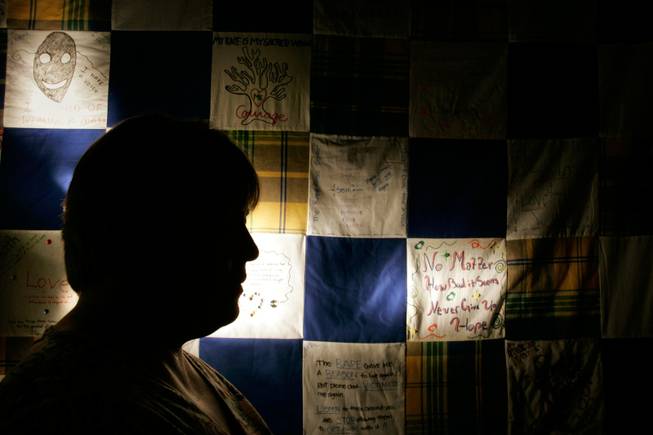
An anonymous rape victim sits in the Rape Crisis Center at the College of Southern Nevada’s Charleston campus Aug. 8. She is backed by a quilt made by other rape victims.
Sunday, Aug. 17, 2008 | 2 a.m.
Reader poll
Susan woke up with this guy all over her like an animal. By the time she realized what was happening, he had stopped. He let go of her shorts, looked at her and said, “I messed up real bad, didn’t I?” Then he told her to make him breakfast.
Susan has no idea what she cooked. She had no idea what to tell the officer who said, “But you don’t look like someone that’s been raped.” She had no idea what to say when, several weeks later, she got a letter from a state program that helps victims of crime pay medical bills stating she’d been denied funding because of “contributory conduct.”
Susan was denied, the logic goes, because she was partly responsible for her own rape. She’d used methamphetamine 30 hours before the attack — this was her “contributory conduct.” She is one of nine sexual assault victims confirmed to have been denied assistance from Nevada’s Victims of Crime Compensation Program because of contributory conduct. Eight of the nine were teens.
Many advocates for victims think there have been more than nine such denials. They say records do not reveal the true extent of the problem. But in any case, they say, denying assistance to even one rape victim on these grounds would be an outrage.
For many, it cuts too close to antiquated notions that women can invite or encourage rape, and are therefore responsible if it occurs. And, advocates for victims emphasize, alcohol and drugs are often instruments of sexual assault. “No” means “no,” they say, no matter what.
The “no” that victims are hearing from the compensation program officials may be driven as much by fiscal concerns as by philosophy, however. Ever-growing numbers of victims are asking for assistance from a program that doesn’t have enough money to help them all, asking for help from a program that may be looking for reasons to deny them so that it can stretch its budget.
That’s how Attorney General Catherine Cortez Masto sees it. She leads a committee that in January began a careful survey of the victim compensation program and its policies.
Last month, percolating concerns about contributory conduct boiled over. At a July 7 meeting of the committee that oversees Masto’s smaller group, several attendees sat in quiet shock as Bryan Nix, coordinator of the compensation program, explained the contributory conduct policy.
Speaking of intoxicated sexual assault victims, Nix told commission members, “You know, their behavior alone oftentimes excludes them from participation in this program because they’re not, under our guidelines, innocent victims of crime. They participated in the crime on some level.”
Since that July meeting, the compensation program has come under fire from victim and civil rights advocates who feel the troubles run deeper than poorly written policy. The real issue here is the fundamental differences of opinion about whether a rape or sexual assault victim should ever share the burden of blame. Nevada’s contributory conduct clause is a small step, many fear, into a dark hole where women in short skirts or low-cut blouses are blamed for attracting negative attention, for “asking for it.”
Of the criticism, Nix says, “I think it’s a little misguided. Someone goes to a bar, slams down numerous cocktails, ends up with someone in the bar, goes to their hotel room to ‘watch TV’ in a very drunken, intoxicated state and ends up ‘waking up raped.’ ”
The rationale behind Nevada’s contributory conduct policy is simple — prevent drunken people who pick bar fights from getting compensation, keep burglars who break their ankles kicking in a door from having their medical bills paid with state money. These matters are pretty black and white. It’s when contributory conduct falls into the gray area of sexual assault and rape that the problems start.
Statewide, 2,017, or 27 percent, of the 7,357 compensation claims accepted from January 2005 to January 2007 were submitted by victims of rape and sexual assault who, in turn, had more than $1.28 million in medical or counseling expenses paid by the program. It’s a considerable sum, but less than the $34 million paid for 2,750 general assault victims, or the $5.5 million in compensation allocated to 1,065 domestic violence victims.
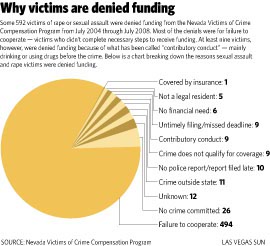
In the past four years, 592 rape and sexual assault victims have been denied compensation program funding for a variety of reasons. The vast majority of these victims, 494, were denied for “failure to cooperate,” meaning the victim didn’t complete required paperwork, follow up with compensation officers or keep appointments. For at least 12 rape and sexual assault victims, the reason for denial is unknown. Program records are incomplete. The records also do not indicate how many victims appealed their denials and were awarded funding after a fight.
Most victims don’t challenge the rejection. This has more to do with emotional exhaustion than laziness: Some victims would rather forget than put themselves through a detailed application process, let alone argue over the outcome, according to Rape Crisis Center Executive Director Louise Torres. The average victim gives her account of the crime 57 times to various officials before the case even lands in court, Torres says.
The nine victims who were denied for contributory conduct, which Nix says doesn’t necessarily mean intoxication, represent such a small percentage of all denials that “it’s hardly worth a lot of discussion,” he said. Nix is quick to insist that the disqualifying factor is not the presence of drugs or alcohol, but the resulting behavior; not merely being intoxicated, but being intoxicated and making a bad decision as a result.
Some scoff at this distinction.
“Being violently assaulted by someone, inebriated or not, is a violation of your personhood,” said Andrea Sundburg, director of the Nevada Coalition Against Sexual Violence. Whether the victim had been drinking is irrelevant, she added.
Those who question the policy also note that it is not applied consistently, so while one intoxicated victim gets funding, another does not. Nix points to this case-by-case approach as an example of the program’s success. Compensation officers consider the nuances of each case, interview victims and read police reports before reaching determinations. In fact, Nix noted, a considerable number of sexual assault and rape victims applying for compensation report being intoxicated at the time of the crime, and the program regularly provides them assistance regardless of the fact.
In some cases, Nix noted, the compensation officer thinks a line has been crossed. Where that line lies, however, is unclear. For some, this is extremely problematic.
“The idea that you are going to sit around and figure out what percentage of the blame you are going to ascribe to the victim themselves is just completely misguided and improper,” said Gary Peck, executive director of the Nevada American Civil Liberties Union.
Lee Rowland, Nevada ACLU northern coordinator, added: “A case-by-case review is only as good as the rules that govern that review. Discretion vested in officials should not turn into a character assassination of the victim, or be used to play out archaic gender stereotypes.”
Masto’s committee is studying whether changes must be made to compensation program policy. The contributory conduct rules were adopted years ago by the state Board of Examiners, composed of the governor, the attorney general and the secretary of state. The rules mandate that claims for compensation must be denied if the victim “used poor judgment because of intoxication or drugs.”
Whether compensation officers should be determining what is and isn’t poor judgment, Masto said, is also up for consideration. Masto’s committee has been asked to provide Supreme Court Justice James Hardesty, chairman of the Advisory Commission on the Administration of Justice, with recommendations for changes to the program, legislative or otherwise.
If the committee looks to neighboring states, it will find that compensation officers in Utah, California and New Mexico, among others, do not consider intoxication a contributory factor in sexual assault or rape cases. Members of New Mexico’s Crime Victims Reparation Commission decided 10 years ago that they “just would not look at drugs and alcohol on sexual assault cases,” according to current Commission Director Larry Tackman. Victims who undergo a sexual assault forensic exam from the hospital — like every Nevada victim must to be eligible for assistance — demonstrate by action alone that no matter how inebriated they were, something serious enough to warrant assistance likely occurred, Tackman said.
If the committee looks around the globe, it will see that England’s Criminal Injuries Compensation Authority has been under fire for cutting the standard $20,516 crime compensation payment for 14 rape victims by as much as 25 percent in the past year alone. All of these victims were told the deduction was because of contributory conduct — alcohol consumption. This revelation sparked furious condemnation from citizens and politicians.
The British compensation authority has since issued a statement acknowledging the deductions should not have been made. A 25-year-old victim who challenged the reduced compensation recently got the full award, and the government has called the compensation authority to review the other cases in question.
Many of the best arguments against contributory conduct flip the policy on its head. If victims can be penalized for becoming intoxicated before they were raped, does that mean the rapist on trial should have his sentence mitigated because he had a partner in crime?
Justice Hardesty extends the argument: Does this mean someone under the influence of alcohol who is shot by a robber cannot qualify for assistance? There is a disconnect between the criminal law that makes a perpetrator guilty and the policies of the victims compensation program, Hardesty says.
At least part of the problem with the compensation program can be traced back to financial strain. Despite laws indicating it is the policy of Nevada to provide care to victims of crime, the program does not receive any money from the state’s general fund. Instead, the program gets its money from criminal fines, restitution paid by convicts, government grants and a handful of other sources. The result: The compensation program received more than $8.8 million in funding during the 2006-07 fiscal year, the most recent data available.
The income is hard to reconcile with the costs. From January 2005 through January 2008, the compensation program was billed almost $50 million on behalf of victims.
In a presentation to Hardesty and the advisory committee of which he is chairman, Masto said, “due to limited crime compensation funding, it appears that (compensation officers) are forced to look for reasons not to provide funds rather than reasons to provide funds.”
Nevada has three compensation officers. A fourth position is open, but because of a government hiring freeze, it has gone unfilled for three months. The program has a backlog of roughly 1,000 cases, applications on hold because additional information is needed. Nix thinks he can solve the problem by handing much of the paperwork back to victims’ advocates, such as counselors at rape crisis centers. To achieve this goal, he is revamping the application process. Traditionally, victims have been asked to submit one sheet of information to state compensation officers, who would seek out additional information on their behalf. Now Nix wants victims to fill out an 11-page application, full of information compensation officers will no longer have to get on their own. This will speed up the process, Nix says.
But the new application is still just a proposal, and not every victim’s advocate is excited at the prospect of more work.
This is where things would get nasty, if things weren’t so politely political.
Delicately, Nix notes that his nine denials for contributory conduct are nothing compared with the almost 500 sexual assault and rape victims who were denied for failure to cooperate. These people have slipped through the cracks, Nix subtly suggested in an e-mail to the Sun, because advocates didn’t take enough time to help victims through the process. “The elephant in the room is not the issue of denial because of contributory conduct,” Nix wrote.
This implication, not surprisingly, makes victim’s advocates a little angry.
“When you start putting blame on other people, without looking at your own internal procedures, there is a problem,” Sundburg said. “Advocates are just as busy as victims of crime compensation. We all need to work together to make sure victims are getting the help they need.”
Susan had to be persuaded to file for victim’s assistance, convinced that revisiting the crime in interviews and applications was worth the stress. After the rape, scared to stay at her home, she landed in a series of women’s shelters. She had nightmares, was always looking over her shoulder, and suffered from that free-floating, endless and almost sourceless anxiety that haunts some victims. Susan was raped by a man she thought she knew. He invited her and some other friends over to do meth. She crashed at his house, in a guest bedroom.
Later, in a hospital gown, naked from the waist down, she told police the whole story, even admitting she had been an addict off and on for about two years. When she left the hospital, she drove around for hours in a daze, and finally, at the age of 39, called her parents and asked if she could go stay with them.
So when the rejection letter came, Susan was furious. “’Cause I used meth, it’s OK for someone to rape me,” she said. “That’s how I felt.”
Susan decided she would fight the rejection. In May, she appealed the decision. The denial was upheld, so she took it to the next level. In June, Susan made her case before an appeals officer, an attorney appointed by the governor.
Eleven months after she got her first letter of rejection, Susan’s application for assistance was approved. She was awarded $3,000 for counseling, so now therapists and psychiatrists — the people writing Susan’s new prescriptions for depression and anxiety — can bill their services directly to the compensation program.
In light of everything that led up to this, its hard to know whether Susan should celebrate.

Join the Discussion:
Check this out for a full explanation of our conversion to the LiveFyre commenting system and instructions on how to sign up for an account.
Full comments policy