Las Vegas Sun

July 24, 2008

Shooting justified, inquest determines

Decision follows one hour of deliberation, two days of testimony

Image

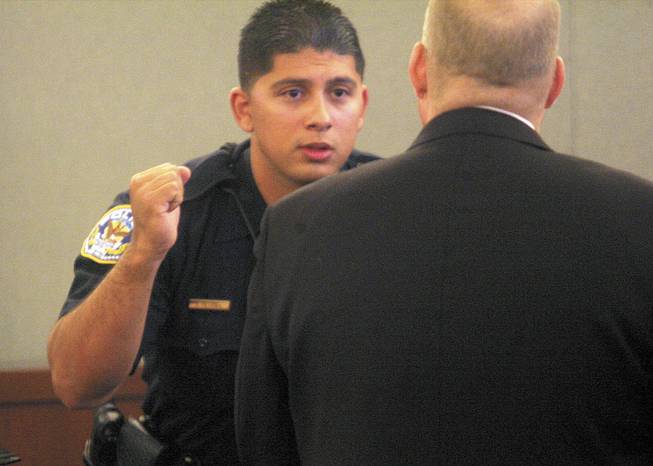
HEATHER CORY / HOME NEWS

Officer Alan Olvera demonstrates during the inquest to prosecutor Christopher Laurent how, he said, Deshira Selimaj lunged at police. / Home News

Sat, Apr 12, 2008 (2 a.m.)

One Officer's Testimony

You need to upgrade your Flash Player
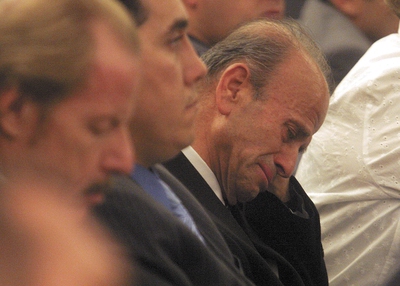
Zyber Selimaj breaks down as the circumstances surrounding the death of his wife, Deshira, are discussed Friday during the coroner's inquest into the killing by a Henderson police officer of the ice cream truck driver and mother of three.

Zyber Selimaj breaks down as the circumstances surrounding the death of his wife, Deshira, are discussed Friday during the coroner's inquest into the killing by a Henderson police officer of the ice cream truck driver and mother of three.

The air conditioning in courtroom 16D is set on a timer, and by 8 p.m. Friday, when Henderson Police Officer Luke Morrison started his coroner’s inquest testimony about the day he shot ice cream truck driver Deshira Selimaj, that timer had long since clicked off, and the room was very, very warm.

Jurors sat slumped. The courtroom smelled stale, and a court bailiff whispered “I’m dying,” in the heat. Morrison, pinking up in the cheeks, spent 45 minutes on the stand.

He told the jury that he was “extremely, extremely scared” in the moments before he shot Selimaj. He said he was certain that if he had not shot the 42-year-old mother of three, she would have stabbed or killed an officer with the knife she was holding. He said Selimaj appeared “disturbed,” beyond the point of being talked down. He said he didn’t know how long he spent trying to get her to drop the knife or calm down — maybe one or two minutes — but it felt so slow. He said he had no choice but to shoot her and that “there was nothing else anybody could have done.”

After about an hour of deliberation late Friday, the seven jurors unanimously agreed. They found the shooting was justified.

Earlier, in hour 12 of the second day of testimony, a juror had thanked Morrison for his time in the Army, his service to the country and his 343 days in Iraq, and asked, “How many Iraqi enemies have you shot?” Morrison responded, “I can’t answer that. I just can’t answer that,” and slightly shook his head. Henderson Justice of the Peace Rodney Burr, presiding over the inquest, said Morrison didn’t have to — that it wasn’t relevant.

The family of Selimaj, her husband, Zyber and his attorney, looked as if they were ready to swallow their tongues to keep from screaming.

• • •

When the officers descended on the Henderson street where Selimaj was shot on Feb. 12, they were responding to a “444” call — officer needs help. It’s an extremely rare call. Officer Mitchell Wilson testified he hadn’t heard more than five such calls in his six years with the department. Officer Anthony Pecorella said officers get those calls “almost never.” Morrison said it was the first time, in his two years with the department, he had ever heard the emergency call.

The that day was that a woman — Deshira Selimaj — was holding her children, Arber, 5, and Alban, 11, hostage, with a knife.

Pecorella, fourth to arrive at the scene, said he found the woman screaming and threatening the lives of other officers, trainee officer Alan Olvera and Officer Jeffrey Wiener.

Pecorella drew his firearm and focused it at Selimaj, and yet after telling her to drop her knife several times, decided to holster his gun and pull out a Taser instead.

“I thought I could end the situation without deadly force,” he said. He told the jury he had been in a similar situation in which another officer had used a Taser to disarm a suspect wielding a knife.

He got within 10 feet of Selimaj and waited for a clear Taser shot. It was the first time he ever shot his Taser in the field, and he missed. One probe flew past her shoulder, and the device didn’t work. Pecorella then said Deshira lunged at him with the knife over her head.

“My hand went to my handgun,” Pecorella said, “and I never got it out.”

By then, officers Christopher Cyr and Morrison were on the scene. At the same time, both officers fired, Cyr with a Taser and Morrison with his handgun. Selimaj went down. Another officer, Wilson, then ran up to the woman. She was belly down on the cement, and he put his boot on her back, near her neck, to hold her down.

Then another officer, Camille Tsitsinakis, then put Selimaj in handcuffs, because the Albanian woman was squirming and trying to sit up, police testified. The officers placed her sitting on the side of the road, and waited for the ambulance to arrive.

She died at the hospital. Her husband was taken to jail and her children were put into county care, but first they gave police recorded statements about what happened. The jury learned all of this on Thursday. It was the Friday testimony of rookie cop Olvera that cast a new light on the officer-involved shooting, though the picture didn’t get much clearer.

It was Olvera, a few months out of the academy, who had decided Zyber should be taken to the hospital. It was Olvera who took the lead, at least for a few moments, when officers were approaching Deshira with their guns drawn.

These were among the handful of absolute facts that floated to the surface of hours of testimony that was, at times, as complicated and confusing as the afternoon of the shooting, to hear police describe it.

Some of the police officers said they didn’t even know Deshira had been shot, even as they stood over her body. Wilson told the jury that officers were just focusing on restraining a combative Deshira, “not really knowing exactly what just occurred.” Wilson even put a call out over the radio stating she hadn’t been shot — only stunned with a Taser. He realized he was wrong when Wiener looked at him with wide eyes and said, “No, she’s shot.”

Then Wilson realized the blood he saw coming from the ice cream lady — who was handcuffed and lying on her back, squinting and asking, “Why did you guys do this to me?” — wasn’t from the knife she was carrying, but the bullet that had flown through her abdomen and exited on the other side.

• • •

The bullet might have cut clean through Selimaj, but it did not fly through the inquest so easily. Forensic pathologist Piotr Kubiczek performed Selimaj’s autopsy and gave the kind of clinical description of his findings that only a doctor who deals with the dead can: Selimaj had three puncture wounds, consistent with the Taser prongs that hit her. She suffered a shot to the abdomen, the bullet exiting through her back. She also had markings on her arm to indicate the bullet grazed her forearm before it entered the stomach.

Kubiczek also explained, however, that the bullet had a downward trajectory through the body. This information set off the Selimaj family attorney and a medical examiner they hired to do a second autopsy. When it was their turn to submit questions to Kubiczek, at least five times, phrased a little differently each time, they attempted to get Kubiczek to acknowledge the same point: If the bullet’s path was downward, didn’t that also mean that Morrison, who stands 5-foot-6, shot downward? Didn’t it mean that Selimaj must have been low to the ground when she was shot?

Kubiczek said he could not answer the question.

So they fired back, submitting more questions: Didn’t the fact that her arm was injured indicate she might have been raising it when she was shot — to block herself or indicate she was ready to comply with police? Ready to drop her knife?

Kubiczek said he could not answer the question.

Assistant District Attorney Christopher Lalli, sensing where this line of questioning was going, interjected with one of his own: Can the path of a bullet really tell you what position a person was in when they were shot?

This one Kubiczek could answer: No.

Selimaj’s attorney, Jim Jimmerson, and Zyber Selimaj looked like people just punched in the gut.

• • •

Seven Henderson officers testified during the second day of the inquest. While each presented a slightly different version of events, their testimony was uniform on one point: how a person wielding a knife and moving toward a police officer should be handled. The answer, the officers agreed, is that they should be shot. They were following policy.

More specifically, Olvera said they should be shot if they’re within 21 feet of an officer or another person, per Henderson Police policy. This meant that the officers’ responses to questions about the knives were mechanical as a police manual.

Wasn’t Deshira a small person? Did she have to be shot? Chief Deputy District Attorney Christopher Laurent asked Olvera.

“She has a deadly weapon sir, it’s still a deadly weapon sir.”

But with so many officers against one woman, couldn’t you have tackled her?

“The size of the weapon doesn’t matter when the person has a deadly weapon.”

Then a juror asked, could you have fought her instead of shot her?

“She has a knife sir, there’s no knowing what she could have done with that knife.”

Laurent then asked Olvera whether or not he is routinely reminded that knives are deadly weapons — “How often is that pounded into your head?” he asked.

“Every single day,” Olvera said. “Every chance they get.”

Officer Wilson testified that he called over the radio for a bean bag rifle, a nonlethal weapon that shoots small bean bags to incapacitate a suspect. The nearest patrol unit with such a rifle, however, was too far away to respond — 6 or 7 miles, Wilson said.

Laurent frequently asked witnesses if their opinion of the shooting would change if the event hadn’t happened as they remembered. When Astrid Bean testified, she said she felt police should have been able to overpower Selimaj without killing her.

Laurent then asked whether she would have felt the same way if she knew Selimaj had a knife. Bean said no.

Laurent then asked if she would have felt the same way if she knew that police were trained not to physically engage people with knives.

Bean said no.

Laurent then asked whether Bean would have felt the same way if her son became a police officer, and encountered someone with a knife.

Bean said no.

It was similar to a line of questioning Laurent ran past Olvera, asking the officer to speculate about what would have happened if Selimaj didn’t have a knife, if Selimaj didn’t hold the knife to herself, or if Selimaj had listened when officers asked her to drop the knife. Olvera gave an answer to each question, though they were, at best, educated guesses.

And it was similar to the question Laurent asked of witnesses who did not see Selimaj with a knife. Laurent asked these witnesses, many of whom were critical of the shooting, whether they would feel differently about the incident if they knew other witnesses actually saw the knife. Some said it would change their opinions, others stuck to their initial opinion — that it was excessive force.

In a back row of the courtroom, Gary Peck seethed. The executive director of the American Civil Liberties Union of Nevada was outraged to see the prosecutor ask witnesses to respond to hypotheticals, particularly when Laurent asked Bean to reconsider how she would feel if her son were a police officer.

Not only is the question not relevant, Peck said, it was an attempt to get the answer Laurent wanted out of a woman who didn’t want to give it.

“This latest turn towards supposed hypotheticals that are little more than arguments designed to support the ‘official story’ masquerading as ‘questions’ puts the lie to any claim that the D.A.’s office functions as an objective fact-finder during inquest proceedings,” Peck said.

When officer Pecorella testified, Assistant District Attorney Lalli asked the officer what would have happened if Morrison did not shoot Selimaj.

The officer said he could guarantee another officer would have been stabbed.

Discussion: 14 comments so far…

  1. Gee, what a surprise.

  2. THOUGH SHALL NOT KILL!!!
    Words of wisdom for the HPD to LIVE by... unfortunately, they are a cowardly troop.

    "Extremely, extremely scared"... What happens when they chance upon REAL CRIMINALS i.e. other HPD officers?

    Did anyone actually believe justice would take place at this farce of a court hearing??!!

  3. I believe what Luke Harrison is saying. I believe he was "extremely, extremely scared," that he believed Deshira Selimaj was disturbed, that time seemed to pass very slowly for him. What I don't believe is that he correctly assessed the situation; I believe a more experienced, wiser, cooler head would have assessed it differently.

    I didn't know Mrs. Selimaj, but I spoke to her many times. She used to bring her ice cream truck to the HBA baseball games at Mission Park. I used to stop by and say hello during breaks in my son's games; she sometimes talked about her boys. She gave me and others her phone number, and asked us to call if ever she wasn't at a game. She said she didn't want to miss any opportunity to make a little more money. Her English was fine; I never had any trouble understanding what she was saying.

    This mother of three young boys was feeling desperate that day. I'm sure $717 in fines sounded impossible to her; I'm sure she was terrified that her husband was getting into trouble with the police. I'm sure she felt scared and hopeless and up against more than she could handle.

    But she shouldn't have died for that. And her boys should not be motherless for that. Three boys who don't even speak Albanian, to their father who doesn't understand much of the only language they speak, because they spoke only English with their mother.

    I'm sorry for Luke Harrison, but I am much more sorry for the Selimaj family. In fact, I can hardly bear the sadness in this story. And it is someone's responsibility. There is profound power in a badge and a gun, and as a society, we are responsible for deciding who holds that power, who has a gun on the day everything goes wrong. I don't expect police officers to be perfect, I honor and appreciate all the things they do for us every day, but this police officer was not ready for this situation, and he should not have had the power of a gun and a badge on that day.

  4. Well there will still be a civil lawsuit and the city will end up paying several million dollars to the husband and children, at least. I guess no more ice cream truck driving for them.

  5. mikeg, even if the family does get 'several million dollars,' that doesn't bring back the life of a person who was unjustly shot.

    I agree with Peck. That line of questioning was completely out of line.

  6. It was obvious from the beginning that the outcome of the inquest was already determined. The jurists had knowledge of the witnesses and asked questions that were meant to discredit the testimony. The District attorney never pressed the issues concerning wrongdoing by the officers. Just because the policy of HPD is to kill anyone with a dangerous (steak knife?) weapon doesn't automatically make it right or legal. Hopefully the people of Henderson will demand a new head of their police department, one that doesn't train his men and women to be cold blooded killers. And as residents and tax payers of Clark Couny we need to take the inquests out of the hands of the proven one sided coroners and district attorney offices'.

    If this had been a preliminary hearing in front of a district court judge there would have been plenty of evidence to hold this case over for a jury trial. This flawed system only looks for reasons to permit officers to escape responsabilty for their actions. We can only hope that the FBI or a Grand Jury will take a look at this travesty of justice.

    If the HPD doesn't find anything wrong with what happened in this case what in the world would be wrong? Could the answer be nothing? Is the HPD just a rogue paramilitary organization that is only responsible for the protection of its officers? The fine people of Henderson deserve a better department for the money they are paying, one that protects and serves the citizens and not just the force. And the members of HPD who want to do their job in the right way for the right reasons desrve a better boss. They understand that failure to comply immeadiatley to the orders of one of Henderson's finest is not a capital crime with execution to be carried out at the scene.

    And I know that you have not asked for my advice Office Harrison so I am breaking my own rule of never giving unwanted advice, BUT, I have been in high pressure situations many times, often at the risk of life and limb and seen how people have reacted. If this scared you so badly that your best judgement led to this outcome you should get out of the force now! You are not cut out for for work in pressure situations. You are not going to be happy with your career and more people will probably get hurt needlessly.

  7. They aren't getting millions folks, it was a justified shoot. The familly doesn't deserve a dime from anyone. If it is so clear cut, it would have took longer than an hour for the jury to come back justified, which is better than excusable. That means there is no doubt it was a justified shoot. Sorry MikeG you will be 0 for 2 with your predictions.

  8. All the dude had to do was sign his ticket and his wife would be alive and we would not have had this whole mess.

  9. It seems apparent that "seslew" has no real understanding of the reality of modern law enforcement. Unless you have undergone law enforcement training (i.e. police academy, citizens academy, etc.), you are not in a position to speak authoritatively on what police procedure should or should not be relative to dealing with someone armed with a knife. Knives are a deadly weapon, even in the hands of "untrained" users. Tactical training studies have proven that when a knife-wielding person is 21 feet away from an armed officer only 20% of the officers involved in the drill could pull their firearm and hit the knife-wielding person as they ran at the officer. Even military training confirms this reality that a knife-wielding person can close a gap of 21 feet in a matter of seconds, filleting their target and slicing major arteries. Reality is that most people don't die from gunshot wounds. However, a person that knows how to handle a knife can slice arteries and cause their target to bleed to death quickly.

    You forget that officers have families - spouses, kids, etc. - to go home to at the end of their day. I really doubt the anti-shooting people would comment with such passion if an officer died due to being stabbed by a suspect because he thought once the suspect heard him say "Drop the knife!" for the 843rd time it would be the magical number, causing the suspect to experience an epiphany, drop the knife, and apologize profusely for his inconsiderate behavior. Wake up folks, reality isn't as cute, orderly, and understandable as you wish it was!

  10. What kind of crazy person waves a knife at someone with a gun?

    And six foot should be the minimum height for any police officer (male or female). Any smaller than that and you are physically dominated by too high a percentage of the population.

  11. Whatever happened to nightsticks or batons. It seems somewhat disturbing that the escalation of force goes from shouting at someone to shooting them.
    Why don't more Henderson police cruisers have a bean bag weapon? If the closest bean bag gun was "6-7" miles away and this was a "5 in 6 years" event you would hope the one guy with the needed weapon would show up; have they got more than one weapon that will deliver less than lethal force in Henderson?
    Well at least the police chief is recognizing this tragedy for what it is and lightening up on calling this guy a 'hero' for shooting the ice cream lady.

  12. The Coroner Inquest is a joke. You couldn't get a conviction of John Wayne Gacy under this process. The civil court is where the real test will be. Luke Morrison and his trigger-happy pals will have to pay the price of their stupidity.

    Under the Henderson Police Dept textbook guidelines, They are justified to shoot you if you carry a knife, are within 20 feet and refuse to immediately drop it. So if you are deaf or don't speak English, better get rid of your steak knives now.

  13. The policeman that shot ms. Selimaj testified that he was "really really scared" at the time he fired his weapon. Here's a man that recently served in Iraq, was surrounded, in one corner, by gun wielding, bullet proof vest wearing, young, able bodied henderson police officers. And he was pitted against two children whose ages combined do not add to adulthood, a diminutive, 42 year old woman holding a knife that you and i use to peel a potato, and was also assisted by her cornered, meek, scrawny husband. The officer was really really scared.
    How in the world did he act in Iraq when he had to jump off a humvee. My guess is that he probably served his country with pride and courage. So what happens when he returns to the land that he fought for so that people like the selimajs can sell ice cream.
    He now manuevers within an institution that is galvanized by a process known as the coroner's inquest, and all those that look to the process for sustinence, from the uniformed cop all the way to the Clark County District Attorney's office, are clad in battle gear sewed with cowardice.
    Do not bore readers with comments concerning the daily rigors and dangers of police work for the reason that every civilized person accepts and commends the fact, but no civilized society accepts the existence of police aggression that is undetered by a sham system offered as our consitutional check and balance protection.
    Our community is sadly, in the very deepest sense of the word, distinguished as one that allows police to "shoot first and ask meaningless coroner's inquest questions later." Society exists only as people and the people of our community cannot be expected to respect police organizatiuons that hide behind an institutionalized veil whenever it makes a mistake. And consistently repeated mistakes by an otherwise intelligent group are no mistakes at all.

  14. Crappy deal for both sides of this. I don't believe there is some conspiracy. I think from the officers perspective she was dangerous and had that knife in hand. It sucks because the kids are now without a mother. But the unfortunate reality is that she made the choice to wield a knife in front of cops. Even if she didn't make any threatening moves that's a real stupid thing to do. And around kids? My kids are my number one concern I assume that every loving parent is the same. I can't imagine why her kids wasn't hers. Maybe I don't understand her culture and background but that seems like a situation she caused.

    I have a feeling though, that unless the officer is 100% certain he did the right thing this is going to tear him up. It seems pretty clear to me they followed policy. The use of deadly force is always up to the officer once criteria have been met. It isn't required, from what I understand. I put myself in his shoes and based on what I have heard so far I can see myself making the same decision. I can also see myself second guessing that decision for a lifetime.

    Moral of the story? emotion and weapons around kids should be a great big no no as a parent unless you are protecting the kids. I feel bad for both families involved here. I support the ice cream family and the officers family. It's just a sad situation.

Post a comment

Commenting requires registration.

Comments are moderated by Las Vegas Sun editors. Our goal is not to limit the discussion, but rather to elevate it. Comments should be relevant and contain no abusive language. Full comments policy.

Username:
Password: (Forgotten your password?)

OR Create an account (It's free)

  • Most Read
  • Discussed
  • Editors’ Picks

Calendar

Craig Ferguson

Craig Ferguson

Comedy with a Scottish accent. (9 p.m. MGM Grand)