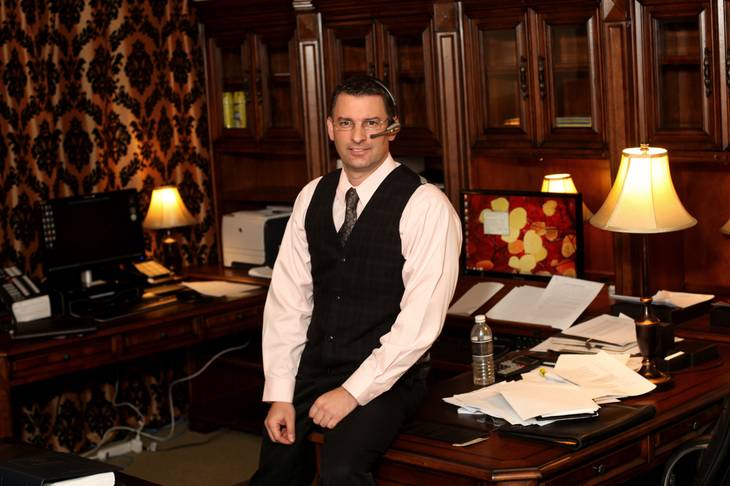
Righthaven CEO defends company during roundtable discussion
Steven Gibson is CEO of Righthaven, which buys copyrights from the Las Vegas Review-Journal, then sues people who have violated those copyrights.
Thursday, Sept. 9, 2010 | 2:05 a.m.
Sun archives
- Righthaven’s suit against Sharron Angle draws increased attention (9-8-2010)
- Defendant accuses Righthaven of misusing legal system (9-5-2010)
- Sharron Angle hit with R-J copyright infringement lawsuit (9-3-2010)
- Righthaven wins key ruling as new criticism leveled over suits (9-3-2010)
- Righthaven sues D.C.-based group over R-J editorial posting (9-2-2010)
- PR firm Kirvin Doak sued by Righthaven over Celine Dion story it promoted (9-1-2010)
- Why we are writing about the R-J copyright lawsuits (9-1-2010)
- Settlement reached after judge refuses to dismiss copyright suit (8-31-2010)
- Judge questions Righthaven over R-J copyright suit costs (8-26-2010)
- Consumer group offers help to defendants over R-J copyright suits (8-25-2010)
- Righthaven CEO’s law firm in merger (8-24-2010)
- R-J accused of entrapment over copyright enforcement (8-23-2010)
- Blogger asks to pay $200 to close R-J copyright suit (8-20-2010)
- 2 lawsuits over R-J copyrights lift total to 100 (8-19-2010)
- Website operators use new defenses to fight R-J copyright suits (8-18-2010)
- Righthaven reaches settlements in 2 cases over R-J copyrights (8-12-2010)
- Righthaven sues Democratic Underground website over R-J posting (8-11-2010)
- 5 more websites sued over R-J story copyrights (8-10-2010)
American legal and media insiders seem to agree the unauthorized online re-posting of newspaper content is an issue.
Some agree it’s a problem.
But uncertainties abound in quantifying how it may be affecting newspaper revenue.
The issue was discussed Wednesday during a telephone roundtable sponsored by the international law firm Bryan Cave.
Participating were Barbara Wall, vice president and senior associate general counsel at Gannett Co., the nation’s largest newspaper company; Eric Goldman, copyright scholar and associate professor at the Santa Clara University School of Law; and Steven Gibson, CEO at Las Vegas copyright enforcement company Righthaven LLC.
The topic: “Can Large-Scale Copyright Enforcement Save the Newspaper Business?”
Gibson said Righthaven — best known for filing at least 117 copyright infringement lawsuits since March, generally without warning, over Las Vegas
Review-Journal material — is offering a viable solution to what he called the problem of online infringements.
Gibson said the lawsuits with their stiff claims for statutory damages — damages in which economic loss need not be shown — can serve as a deterrent to infringements. Righthaven typically seeks $75,000 or $150,000 in its lawsuits.
This approach, he said, is preferable to newspapers having to hire hundreds of people to send millions of takedown notices to infringers.
But Gibson said there’s more to Righthaven than its lawsuits. The Las Vegas startup generally wants to help copyright owners monetize — or derive value from — their copyrights over time and may get involved in licensing arrangements.
“I don’t want Righthaven to be seen as a company only finding infringements and filing lawsuits,” Gibson said.
Gibson dismissed a suggestion from Goldman that in many of its lawsuits, Righthaven seemed to be suing people who thought they were friends of the Review-Journal’s.
Copyright infringement “is an unfriendly act,” Gibson said.
Gibson and Goldman traded arguments during the call over whether unauthorized online postings of newspaper material help, or hurt, newspapers.
In most of the Righthaven lawsuits, the defendants are special-interest websites or blogsites. Righthaven is not suing the Review-Journal’s direct general news competitors in Las Vegas and it’s not suing news aggregators like Google and Yahoo.
Typical Righthaven defendants are political bloggers, sports betting websites and super-specialized sites like that of a former prosecutor who documents “no-body” murder prosecutions — murders in which the victim’s body hasn’t been located.
Goldman noted viewers of a re-posted newspaper story on a special-interest website likely otherwise would never have seen the story since they previously had no interest in going to the source newspaper website for news.
In this instance, the unauthorized re-posting, or infringement, may drive traffic to and bring publicity to the source newspaper, particularly with a link.
Gibson, however, disputed whether these types of postings actually drive traffic to source newspapers.
He noted someone doing a Google search for a specific story may be directed to an infringing version of the story rather than the source newspaper.
Righthaven has argued in its lawsuits that copyright infringement of the type it sues over has harmed the newspaper industry’s finances.
But no one, including Righthaven and including Gibson on Wednesday’s call, has produced hard data on how these types of infringements have affected newspaper finances.
Wall said that while Gannett has no plans to start suing infringers on a mass basis, unauthorized use of newspaper content online is a problem that the industry needs to find a joint solution for.
She noted Gannett incurs substantial costs in generating news. “Giving it away for free is not a sustainable business model,” Wall said.
While Gibson frequently says newspapers would have to hire large staffs to deal with all copyright infringers by sending them takedown notices, Wall said that task is currently handled by editors already in place at Gannett properties around the country.
Having editors contact infringers and demand or request material be taken down and/or be replaced with links is a common practice in the newspaper industry.
It’s how the Las Vegas Sun deals with infringement, as well as other papers such as the Seattle Times.
The journalism site Poynter Online reported Aug. 31: “Executives at other newspapers say take-down notices can easily resolve most copyright conflicts without litigation.
“Generally we don’t even do it through lawyers,” Seattle Times Executive Editor David Boardman, an officer of the American Society of News Editors, told Poynter Online. “Normally all it takes is a call or note or e-mail or letter to somebody just saying, ‘Hey, you’re in violation of our copyright. Please take it down.’ More often than not, they do.”
Discussion: 4 comments so far…
Comments are moderated by Las Vegas Sun editors. Our goal is not to limit the discussion, but rather to elevate it. Comments should be relevant and contain no abusive language. Comments that are off-topic, vulgar, profane or include personal attacks will be removed. Full comments policy. Additionally, we now display comments from trusted commenters by default. Those wishing to become a trusted commenter need to verify their identity or sign in with Facebook Connect to tie their Facebook account to their Las Vegas Sun account. For more on this change, read our story about how it works and why we did it.
Only trusted comments are displayed on this page. Untrusted comments have expired from this story.
Post a comment
Most Popular
- Viewed
- Discussed
- E-mailed
- Photos: Olivia Culpo, 20, of Rhode Island is crowned 2012 Miss USA at Planet Hollywood
- US Navy hopes stealth ship answers a rising China
- Learning about Electric Daisy Carnival fans will help Las Vegas court them
- On the horizon: A quick look at projects poised to shape downtown
- Clark PG Kentrell Washington heading to Hofstra basketball


Comment removed by moderator. Comment was in all caps.
"Generally we don't even do it through lawyers," Seattle Times Executive Editor David Boardman, an officer of the American Society of News Editors, told Poynter Online. "Normally all it takes is a call or note or e-mail or letter to somebody just saying, 'Hey, you're in violation of our copyright. Please take it down.' More often than not, they do."------GET A CLUE RJ AND RIGHTHAVEN ALL YOU WOULD HAVE TO DO IS ASK ME AND I WOULD TAKE DOWN THE STORY AND REPLACE IT WITH A LINK. OH I FORGOT YOU BOTH DON'T CARE ABOUT ASKING NICELY YOU JUST WANT THE QUICK DOLLAR. ALTHOUGH THE TWO OF YOU ARE NOTHING MORE THAN THE MOB IN FANCY SUITS AND HIDING UNDER LEGAL BLANKETS OF BUSINESS.
"It's how the Las Vegas Sun deals with infringement, as well as other papers such as the Seattle Times."
This is not a truthful statement.
Vegas Sun and the Seattle Times do not have a process to find infringement.
So once in a blue moon they send a take-down notice because once in a blue moon somebody accidently stumbles over a infringement case.
A truthful statement would be, "The industry standard is not to have an active program of defending copyright material. It is very rare that copyright infringement is found because there is no attempt to look for it. When it is found by sheer luck then a take-down notice sometimes is sent."
How about speaking the truth then just shading the truth to fit the anti-LVRJ agenda that you are pushing?
Steven Gibson is a Stage IV tumor.
Right now, http://www.harryreid.com/index.php/blog/... is posting Sun copyright material. It is more than 10% and that violates Sun's copyright policy.
There are two possible reasons.
One is that the Sun has given permission to Harry Reid to steal Sun copyright material.
That makes no business sense. That is stealing traffic from the Sun. I guess it makes political sense. The Sun oftens makes decisions based on politcial reasons.
The 2nd reason is the Sun just doesn't care. It has zero copyright defendment policy. It just lets whoever steal whatever.
Except for Stephens Media and their Arkansas partners Wehco Media, no American media company sees this as an effective way to get eyeballs to their advertising. Why doesn't Stephens release internet viewership numbers comparing the pre and post lawsuit periods?
I have removed the RJ from my bookmarks and will boycott their advertisers in protest.
Doesn't Britney Spears have a copyright on the outfit that Mr. Gibson is wearing??
Chunky says:
There's probably nothing Chunky can say here regarding Mr. Gibson and Righthaven that has not already been said or that would not be deleted by staff.
In this regard you can't publish what Chunky really thinks!
I think I've seen Gibson running the drive through window at Wendys.
> There are two possible reasons.
If I wanted Sherman's opinion I'd read his swill on the RJ. why do you wish to pollute the Sun with his twisted views?
> One is that the Sun has given permission to Harry Reid to steal Sun copyright material.
well, if they've given him permission it's not stealing, is it?
You have no idea what arrangements the Sun has with Reid --- but we do know that Angle has nothing in place with the RJ. Seems silly, doesn't it?
And lets give the Sun some credit --- they let blowhards like you, Mr. Mitchell express their views here --- no matter how toxic or repulsive they are. You can't say that at the RJ, who will 86 those who don't walk in lockstep with the publishers.
lmao. you're pathetic, Mitchell.
I wholeheartedly agree with what Chunky really thinks.
My questions are: What is the End Game for the RJ? Is it for no one to post anything from the RJ? Do they honestly think sites will post only links? Do they think sites will purchase the right to post RJ stories? Why would these type of sites bother with either of those?
Instead of easily finding copyright infringements, how will the RJ find sites that simply plagerize the contents of reports without giving the RJ any credit? Does Righthaven intend to review every page of every site that mentions the word "Las Vegas" (BTW, according to Google, that is 173 MILLION pages)?
The RJ website sucks anyway, so now even fewer people will visit it. Makes a great sales pitch to potential advertisers, doesn't it???
What a d*bag lawyer.
so Sgt Rock works for the Sun now? He seems to know all the inner workings he must be on the payroll right?
Righthaven and Steven Gibson are why lawyers are so hated and scorned. Nice going Steven, way to fuel the fire of lawyer contempt.
ScottLv: "What is the End Game for the RJ?" That really is the question, isn't it? At this point, it doesn't seem profitable, though it does seem like the RJ thinks litigation is the way to increased revenues.
JLOKC: Another smart statement -- We haven't seen any numbers that might support the loss of revenues for the RJ. It's all supposition. I understand statutory damages don't need that sort of support, but Federal Judges can do pretty much what they want.
Sarge: Just read the statement by the Seattle Times editor. It's clear that that newspaper has been successful with letters. And, by the way, it has a larger readership than the RJ. Also, newspapers are going online these days anyway so the "enclosure" issue you continually refer to is near meaningless.
In general, I wonder the following:
Why hasn't the RJ covered its own story?
What do the reporters there think of this issue?
How many sources have they lost because of this?
Just another dirt bag lawyer. Not good for much at all. I have no idea how scum like this guy sleep at night going after cat bloggers.
SgtRock, the power of google is amazing. One could copy and paste an entire URL and find results to all sorts of blogs and messageboards. Furthermore, they can copy and paste a portion/all of the contents of an article and see even more results.
The older the story, the better chance that it's on multiple websites and archived/cached all through the google search pages.
That's just one prehistoric way to protect oneself. An hour a day job for one intern.
SgtRock,
You do post some interesting things but would be interested in where you came up with the "10% rule".
Most newspapers have no problem with anyone using the Headline and the first paragraph of an article with a link back to the story.
It appears on "Harry's" site that is what he is doing.
"Most newspapers have no problem with anyone using the Headline and the first paragraph of an article with a link back to the story."
Neither does the LVRJ. None of their lawsuits are best on a case like that. They have a few cases where it is 3 paragraphs.
The example that I gave on the Reid site was more than 1 paragraph. Like here, it is 8 paragraphs. http://www.harryreid.com/index.php/news/...
The 10% comes from the reader agreement. http://www.lasvegassun.com/about/useragr...
"Text from our stories can be quoted when linking to our content, but it must not be more than one-tenth of the total word count of the story or 100 words, whichever is lesser. "
"SgtRock, the power of google is amazing. One could copy and paste an entire URL and find results to all sorts of blogs and messageboards. Furthermore, they can copy and paste a portion/all of the contents of an article and see even more results."
I am not sure what you are talking about.
A website owner or staff can list the headline, have a description, list a paragraph or two, and have a link. That is not copyright infringement.
If a website owner or staff copies and pastes a significant portion or all another sites material then the website owner can be sue for statutory (don't have to show economic loss) damages up to $150,000 for copyright infringement.
Google caches web pages. The court has ruled that is not copyright infringement. Google provides a means for websites to prevent caching of web pages.
I was referring to your statement "Vegas Sun and the Seattle Times do not have a process to find infringement."
-------------
The means of finding infringement doesn't take much effort. A simple google search nets you thousands of potential lawsuits. I shouldn't be saying this, as Righthaven is likely reading this, but it takes the brains of a 2nd grader to find infringement online. Now I guess that isn't saying a whole lot about those who are infringing, as they aren't getting past anyone. It's easier to find infringement than to find a story to infringe, if that makes any sense.
Then how come they send out so few take-down notices each year.
It still takes labor. Somebody has to go through all the google searches and determine which is copyright infringement. Somebody has to inventory the copyright infringement. Somebody has to track down the owner and address of the website owner. Somebody has to sent a letter to the owner listing the exact copyright infringement cases. Somebody has to follow-up to see if the infringer is in compliance with the take-down notice. One has to react to the returning correpsondence to those who challenge the take-down notice.
All that labor is not free. It does not grow in the back yard.
The Sun and the Times don't want to spend any money on all that labor.
The LVRJ does not have to spend one dime on it's program to deter copyright infringement. It is paid for by the people who are stealing the copyright.
Sgt Rock, I agree. However, how do you justify 150k? You must be reasonable and agree that that is above and beyond the realm of reasonable law.
You are a lawyer. You are supposed to be ethical. I am trying to speak reasonably. Why didn't you sue in small claims? Really? 150k? You MUST know that is wrong on every level.
Please answer why you want such big bucks?
Just as a side note, I received an offer from Wynn today to come on out on the house. However, RightHaven has left such a bad taste in my mouth I no longer desire to go to Vegas.
Righthaven is hurting Vegas on so many levels.
My last oh two.
How does it feel to be the most hated newspaper and the most hated lawyer in cahoots?
I'm a 77 year old man and I thank god I'm not you.
"Why didn't you sue in small claims? Really? 150k? You MUST know that is wrong on every level."
Yes, stealing copyright material is wrong on every level.
The reason they don't sue in small claims because copyright law is both Federal law and an actual clause in the US Constitution. There is no such thing as a Federal small claims court. That is state or local courts.
Righthaven has been offering settlements in the range of $1,500 to $5,000.
The cases are not getting dismissed because they have merit.
The cases are getting settled because most of the defendents have no chance in court because they have been caught red-handed stealing copyright material.
"The cases are getting settled because most of the defendents have no chance in court because they have been caught red-handed stealing copyright material."
No, the cases are settled because it costs $30,000 or more to get a case to trial--where the damages are likely to be $750 or perhaps $200 (the unintentional infringement penalty). It's a great scam, for those with no morals. But we are discussing lawyers, aren't we?
"It still takes labor. Somebody has to go through all the google searches and determine which is copyright infringement. Somebody has to inventory the copyright infringement. Somebody has to track down the owner and address of the website owner."
In just about every case, an email to the owner would cause an immediate takedown. (About five minutes, if that.) In fact, you could write a small program to do this: search for stories that exceeded 100 words (or whatever limit you chose), search the website for contact information, and email the request. About 99% of all infringements would be immediately taken down, because there's no money being made by the infringers, and no one wants a lawsuit.
Shermy, you must be a really hate-filled person to think that forcing bankruptcy is the right way to do anything.
"Why didn't you sue in small claims? Really? 150k? You MUST know that is wrong on every level."
There is no small claims court at the federal level. Photographers have made requests in the past for a federal small claims court specifically for copyright infringement. On the other hand, a prefiling demand letter to take down the infringements and pay $500 per article infringed would have caused immediate compliance, and probably most infringers would have coughed up a check pretty darn quick. But when you have to chance to destroy people--and drive some into bankruptcy, why not? That's the psychic income that lawyers enjoy.
"[W]rong on every level" only applies to people with a sense of morality.
"Please answer why you want such big bucks?"
Because for people with no notion of right and wrong, money is what they worship.
"The LVRJ does not have to spend one dime on it's program to deter copyright infringement. It is paid for by the people who are stealing the copyright."
And the complete destruction of any good will that the Review-Journal enjoyed.
In the long run, you will discover, Shermy, that all you have done is make people unwilling to even read your paper online, much less link to it.