Neal Chapman/Lockheed Martin / AP
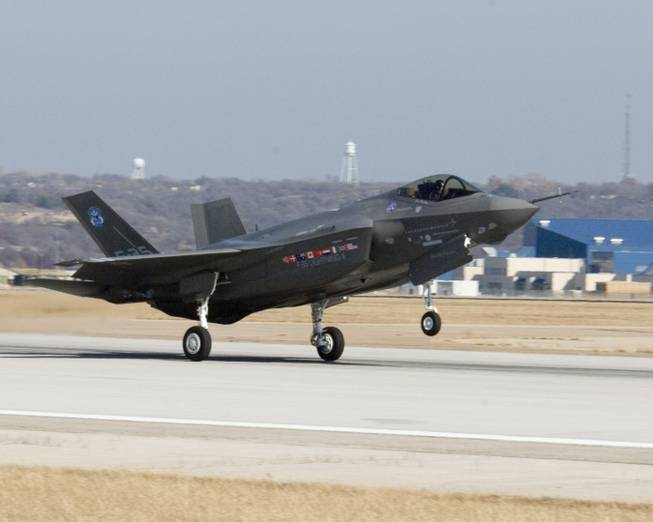
In this 2006 file photo, the first F-35 Lightning II Joint Strike Fighter takes off on its initial test flight from Lockheed Martin in Fort Worth, Texas.
Saturday, March 9, 2013 | 2 a.m.
Sun coverage
A fighter jet with a controversial past and an uncertain future has arrived in Nevada for testing to determine whether it performs as advertised in combat situations.
The F-35 Lightning II, developed in the most expensive program in military history, will undergo three to five years of testing at Nellis Air Force Base. The base received its first F-35 this week and is scheduled to draw a total of 12 of the stealthy, high-tech jets by the end of the month.
During the testing period, Nellis airmen and military tacticians will write the manual on how the F-35 will be deployed in the Air Force.
“We’re doing all the leg work and interoperability with all the fighters and weapon systems to get the jet to where a combat commander can say, ‘I need 12 F-35s to do this mission,’ and we can say, ‘Yes, boss, it's ready to go,’” said Lt. Col. Kevin Wilson, 53rd Wing chief of joint strike fighter integration. “We’re part of that transition to get it up to speed.”
The F-35 was created as part of the Defense Department's Joint Strike Fighter program with nine allied nations. The JSF touts the Lightning II as the aircraft of the future, thanks to its advanced airframe design and technology.
But the jet has been plagued by cost overruns and delays. The Pentagon is projected to spend up to $396 billion to buy nearly 2,500 F-35s over the next three decades, but budget cutters could easily put the aircraft in their sights. It didn’t help the plane’s prospects that the Pentagon grounded all of its F-35s in February after a crack turned up in a turbine blade in one of the planes’ engines.
The single-seat, single-engine jet is designed to be both lethal and stealthy. Variations of the plane are tailored for different military branches, and each different type is made from similar parts to make it affordable to service and repair. One version is capable of taking off and landing vertically.
The jet is intended to replace aging military jets like the A-10 attack plane and F-16 fighter in the Air Force, along with other jets in the Navy and Marines. Before that, Wilson and his team are assigned to make sure the jets are ready for missions.
Wilson said he was excited for the arrival of the jet, not only for the chance to explore a brand-new aircraft, but because of the jobs the aircraft would create. He said 412 military jobs would be added through the course of the testing at Nellis. Other testing for the F-35 is being conducted at Edwards Air Force Base in California.
“This will really help our air power for the future because it is a long-term program on the books to be around for 50 years,” Wilson said. “It certainly keeps Nellis thriving as it always has.”
Wilson said airmen would start by putting the plane through low-risk development tests, which aren't being done at Edwards. Those include seeing how it performs at high speeds or handles in various maneuvers.
Then the plane will go through force development tests, which consist of scenarios of combat missions. The tests determine how a plane will perform while evading another aircraft, or if a piece of technology operates at a specific speed.
Any glitches or bugs in the jet’s system are reported to support staff to fix.
“What we are looking for is, ‘Can a new guy who doesn’t have thousands of flight hours … jump in the jet for the first time and execute the mission he’s sent to do?’” Wilson said.
Eventually, the 422nd Test and Evaluation Squadron will design practice tactical missions for the F-35 to go on to determine how it meshes with other Air Force aircraft. Wilson estimates that the plane will be ready for action by 2018.
Not all are enthused for the aircraft, however. Winslow Wheeler, director of the Straus Military Reform Project for the Center for Defense Information, is skeptical. Wheeler formerly conducted work on national defense issues for 31 years for members of the U.S. Senate.
He said the aircraft is more a technological dream than a functional combat aircraft. He said many of its design concepts are contradictory, such as trying to be both supersonic and a short takeoff and vertical-landing aircraft. One requires it to be long and sleek, the other short and stumpy.
“The airplane has these problems in its DNA,” Wheeler said. “It cannot be fixed.”
Only time and tests at Nellis will tell if the aircraft will operate in missions as JSF officials say it will. Until then, Wilson is looking forward to the aircraft’s arrival.
“We’ve been waiting a long time. There were program delays, but it’s back on track,” Wilson said. “We’re happy to get the F-35 here because we get to wring out the jet in operational fashion, which the program and airplane needs.”

Join the Discussion:
Check this out for a full explanation of our conversion to the LiveFyre commenting system and instructions on how to sign up for an account.
Full comments policy