
Gwen Sharp, an assistant professor of sociology at Nevada State College, checks an online class bulletin board in her office before leaving to teach a class. Sharp teaches two classes online and two classes in person. She says students often contribute long, thoughtful comments online.
Friday, March 1, 2013 | 6:30 p.m.
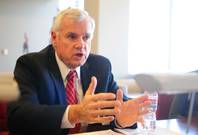
Nevada System of Higher Education Chancellor Dan Klaich discusses his legislative agenda, including the new funding formula, during a Las Vegas Sun editorial board meeting on Tuesday, Jan. 15, 2013.
Nevada's higher education leaders are planning a systemwide expansion of its online course offerings in response to rising competition from low-cost, e-learning alternatives nationwide.
The Nevada System of Higher Education Board of Regents voted Friday to create a working group that will advise regents and Chancellor Dan Klaich on how to expand digital learning for Nevada students.
The committee comes on the heels of a new report released Friday that found Nevada's seven colleges and universities could be doing more to improve its online course offerings. The 105-page report was completed by Richard Katz and Associates, and cost the higher education system $90,000.
Before becoming a consultant, Katz was the former vice president of Educause, a higher education technology company and longtime administrator in the California State University System. The 23-college system recently launched Cal State Online at Katz's recommendation.
The report found that Nevada students are "willing and eager to study online" but were limited by the Nevada system's fragmented implementation of online courses. Nevada must establish a seamless e-learning system to meet the increasing student demand for online courses.
Nevada students, many of whom are nontraditional students juggling work and family commitments, are seeking cheaper, on-demand educational options, Katz said.
With the advent of Massive Open Online Courses — or MOOCs — more and more students across the nation are taking courses from various institutions and cobbling together an online degree. MOOCs such as Coursera, EdX and Udacity, which have attracted support from some of the top universities in the country, have enrolled upwards of 2 million students.
In Nevada, the transition from brick-and-mortar classrooms to one in the digital cloud is already afoot.
Distance education courses through Nevada colleges and universities grew five-fold between 2001 and 2009. Currently, 33,213 students — or 32 percent of all Nevada students — are enrolled in one or more distance education courses.
However, the online courses offered at Nevada colleges and universities exist in silos, making it difficult for students to enroll at different institutions, Katz said.
Katz contends that cuts to higher education has hindered the development of a systemwide and integrated e-learning program, but urged Nevada's higher education leaders to invest in new technologies to remain competitive in the new era of digital learning.
"The game has changed," Katz told regents.
Katz recommended that Nevada establish a new director to oversee a proposed system-wide e-learning program, which will help integrate the various online course offerings from different Nevada colleges.
The new program office would create a student learning portal that would be a sort of course catalog for all online courses across the state. The portal would also facilitate transfers between e-learning institutions and create a digital transcript for online students, Katz said.
Katz also recommended that Nevada invest in a "learning analytics" program, which would analyze student data to determine which online courses have a demonstrated track record for success.
In additional, Nevada should pilot a systemwide e-textbook program and try to improve broadband networks to accommodate students in rural Nevada.
More research is necessary to determine how best to train faculty for this digital transition and its ultimate cost, Katz said.
Faculty members at the meeting expressed concerns about how Nevada plans to expand online education. They were worried about increased class sizes and the impersonal nature of virtual classrooms. They also argued that community college students have different needs than traditional college students and continuing education students.
Regents were mostly supportive of the new digital direction set out by Katz's report. They warned of increasing competition from national and state level MOOCs, such as the State University of New York Online and Cal State Online.
"There are people who want to steal our students and revenue and leave us with nothing," said Regent Ron Knecht. "We better do this so that 50 years from now, we're not U.S. Steel."

Join the Discussion:
Check this out for a full explanation of our conversion to the LiveFyre commenting system and instructions on how to sign up for an account.
Full comments policy