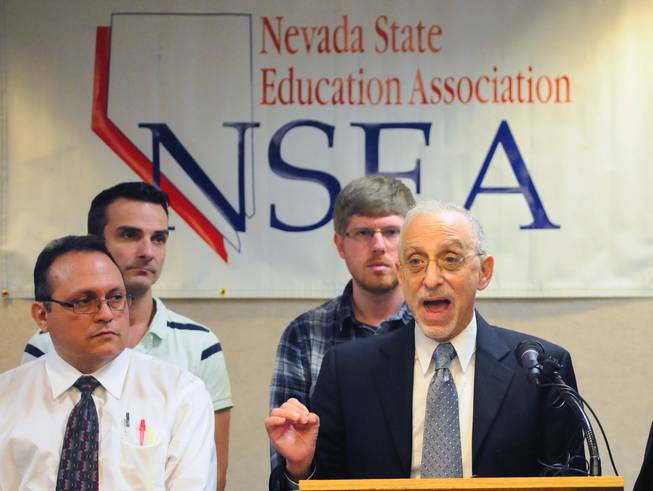
Gary Peck, the executive director for the Nevada State Education Association, argued for a 2 percent margins tax on businesses making more than $1 million during a press conference on Thursday, Jan. 31, 2013. Earlier in the morning, the Nevada Supreme Court overturned a lower court decision that invalidated the petition initiative.
Thursday, Jan. 31, 2013 | 5:05 p.m.
Nevada's teachers union rejoiced in the Supreme Court's decision Thursday to uphold a margins tax proposal to fund education.
The state teachers union has been pushing for a 2 percent tax on businesses that make more than $1 million a year after deductions, such as for payroll and cost of goods sold. The union estimates the tax could raise about $800 million in additional funding for K-12 education.
Thursday's unanimous Supreme Court ruling overturned a lower court's decision last year that invalidated the initiative on the grounds that the petition's 200-word summary was vague, misleading and incomplete.
"We are thrilled that the court saw fit to not thwart the obvious will of the people," said Gary Peck, executive director of the Nevada State Education Association. "That the courts said unequivocally there was nothing misleading, nothing confusing, nothing argumentative about the description of effects of this initiative."
The business tax now heads to the Legislature, which has 40 days from Monday to decide whether to enact it, according to the state constitution. If lawmakers decide not to approve the initiative, it will go to voters in 2014.
Peck argued the business tax would ensure that large corporations "pay their fair share," and would create "a dedicated stable source of funding for K-12 education so that every kid in our state genuinely has an opportunity to learn and succeed."
"That's just not a civil rights issue, that's an economic issue," Peck said. "The failure to invest in our public education system adequately carries with it very real fiscal costs, because kids who don't succeed academically are less likely to be employed, more likely to need public health assistance and are more likely to be incarcerated."
The union's initiative petition — which garnered more than 147,000 signatures — has been opposed by a coalition of business interests. The Committee to Protect Nevada Jobs argued the tax would hurt companies recovering from the recession.
Committee spokesman Paul Enos said his constituents were disappointed by the Supreme Court ruling. The committee had argued the petition was vague because it didn't outline how businesses not making a profit would be subjected to the tax, and that "not one dime is guaranteed to go to education."
Enos said he was worried the business tax would raise living costs for ordinary Nevadans and hamper job growth in Nevada. Business groups are now planning to take the tax fight to the Legislature and the public, Enos said.
"We think (the margins tax is) unfair because it affects every single Nevadan," Enos said. "This tax will hit everyone."
Gov. Brian Sandoval also maintained his opposition to the margins tax, pointing to his biennial budget that calls for $135 million in additional education funding.
"I believe that raising taxes at this time is the wrong thing to do because businesses are still struggling, unemployment is still unacceptably high and raising taxes would harm our fragile economic recovery," Sandoval said, echoing his comments on the tax during his State of the State address earlier this month.
Peck applauded the governor's plans to increase spending for full-day kindergarten and English-language learners. However, Peck said $135 million in additional funding "doesn't make up for the hundreds of millions of dollars that have been cut from the education budget" since the recession.
Peck pointed to studies that recommended that Nevada spend $135 to $150 million per year on English-language learners. Sandoval has proposed to spend $14-20 million in funding over the next biennium.
"That is inadequate; that is too meager," Peck said, calling Sandoval's proposed budget worse than that of former Gov. Jim Gibbons. "It will leave too many kids behind."
Peck remained optimistic that the Legislature will enact the margins tax within the 40-day timeframe set by the state constitution. The union has spoken with many lawmakers, none of whom has outright rejected the proposal, Peck said.
If the Legislature doesn't approve the margins tax, Peck said he is confident about its chances in the voting booth.
"We have no doubt that it will be passed by the people of the state of Nevada," Peck said.



After all the fees, taxes, rents, payments, payroll, utilities and cost of goods sold there is about 5-6% left over as possible profit. I say possible because I had to weather 25-30% losses the past few years to get back to 5%. So if almost 50% of the possible profit gets stolen from my business (2% off the top is 40% of the 5% profit) - Guess what? Yup you guessed it. Everyone gets fired and I chill at home.
Who do you think is gonna have a bigger problem?, The paycheck to paycheck employees I fire - or me? because I wont go to work without getting paid either!
More than ever it is imperative that the State Legislature pass SRJ15 the repeal of Article 10, Section 5 of the State Constitution this session so it will go to the voters for final approval.
Why should mining not be required to pay this tax like any other business?
boftx agreed. Mining has gotten away with not paying enough in taxes far to long.
tbvegas I hear you. The people that decide to raise taxes generally for the most part haven't walked in your shoes as a business owner.
If the teachers' union supports this then I'm against it. That bunch of thugs has done nothing positive in a long time. This tax will cripple the private sector and take us back in time economically. It is the business community - many of whom are just now starting to make progress again - who will bear the burden here. Small to medium sized businesses will feel it the most! One million dollars in revenue isn't that much - and this tax will come from ALL revenue and not just profit! A business with $1 million in revenue, even if it had no other expenses, could support only 22 employees getting paid $45,000 annually (do the math). Even if a business is losing money or simply breaking even they will still have to pay the tax. How many jobs will be lost from this initiative? LOTS. Many small businesses will have to fire people just so they can pay the tax. The tax is poorly written and doesn't even guarantee extra funding for public education! Double taxation is what is happening here - don't let the teachers' union pull the wool over your eyes. The teachers' union doesn't care about the community at large, they only care about their own interests. The make their money off the backs of the teachers, so why should they care if YOU stay employed?
It is nothing wrong demanding 2-3 percent tax growth. Quite a contrary wind. If you suppose your 5-10 percent customers are changing supplies; no tax growth adds plus figures to these estimates. This supplication is out of questions then.
Oh great, all the "come to Nevada" ad campaigns targeting businesses in California and other states can now be changed to "Nevada, we'll never change our business friendly policies...well almost never...trust us."
Public schools are terrible in just about every state. And just about every state gets various things passed to fix them, including lotteries, special taxes, etc. And after those things are done, the schools are still terrible and admin calls for yet more new taxes and revenue. It never ends.
The problems aren't with the teachers. They are with the system. Fix the system and then see what you've got. Most countries do a better job of educating their kids, but with less budget per student.
I'm asking for new state legislation requiring that all teachers union positions are filled only by those with current teaching credentials and receive the same pay they would receive if in the classroom performing normal teaching duties.
All teachers taking union jobs must be nominated and voted on by the teacher population whether union or non union members.
It should require that all (teachers) union positions be filled by an active teacher with at least 5 consecutive years full time teaching experience taking a leave of absence from the classroom to fill any union job and returning to the classroom no more than three years from date of last day in classroom. No administrators or non classroom positions would be eligible for union jobs.
In other words all union positions come from qualified certified classroom teachers and return to the classroom, receiving the same pay and benefits the entire time, no more, no less, no extra or special pays other than travel related expenses for away from home base (more than 25 miles) duties.
The point is to keep professional union types out and insure the teachers are represented by one of their own who will return to them and be accountable to them. Then when we hear or read union demands we can be sure they are what those teaching our children truly want. No outside influence, no consultants paid or not, no temp positions, no nonsense.
When the taxpayers are told that the teachers union wants or demands something they should have confidence and some guarantee that those wants and demands truly come from the folks in the classroom, career teachers. No desk jockeys, professional agitators, organizers or outsiders. We want to do business with permanent members of the community with a vested interest in the whole process and all the results. I have no desire to work with or trust anyone who can pick up and go and is insulated from their actions and words. Full time accountability and full time responsibility. Integrity, fidelity and commitment are the goals and the method of reaching them.
@Brass. Sorry to break this to you, but all of the elected leaders of teachers unions already meet those requirements. They are elected by members of the union, and are teachers. In CCEA, only two elected positions are full time. The president and vice-president are released from teaching duties and are paid the normal pay for teachers. All other positions are part time positions and the office holders are still in the classroom. These positions are NOT paid positions.