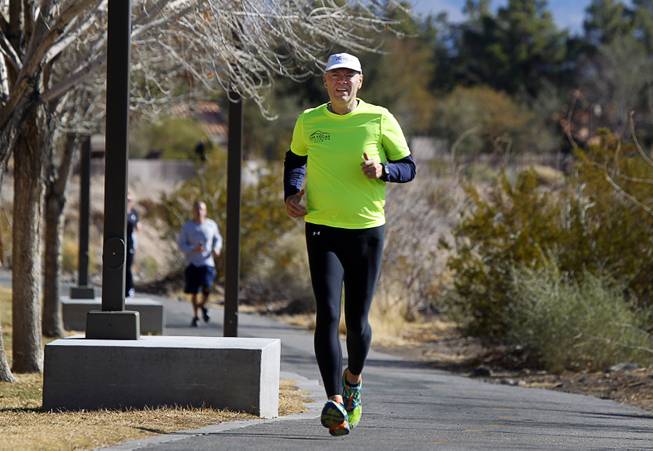
Mark Noel trains along the Pittman Wash in Henderson on Sunday, Jan. 27, 2013. Noel at one time weighed more than 400 pounds but now weighs 185 pounds and is running in the Surf City USA Marathon in California on Feb. 3.
Monday, Jan. 28, 2013 | 2 a.m.
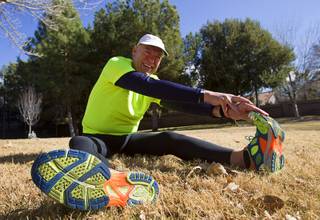
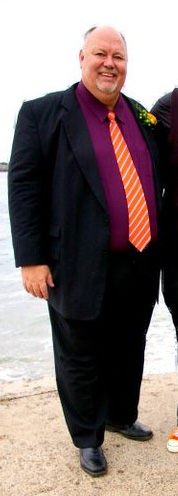
Mark Noel before his weight loss.
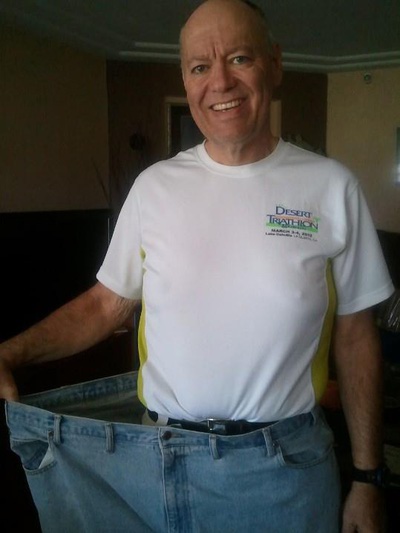
Mark Noel after his weight loss.
If there’s one thing Mark Noel knows about himself, it’s that he has an addictive personality.
Everything he develops an interest in, he does to the point of excess. He is a voracious reader, he constantly tinkers on his cellphone to the point where it annoys his wife, and he once had a streak of 2,500 consecutive wins in a solitaire-like card game.
Yet none of those addictions ruled his life, and threatened it, quite like his addiction to food.
Three years ago, at age 53, Noel weighed 437 pounds. He wore 5XL shirts and jeans with a 58-inch waist, and he traveled with two seat-belt extenders. His knees, which he had 11 surgeries on, were shot from absorbing his weight, and his blood pressure was getting worse.
His days often revolved around eating to the point where, after a breakfast with 10 strips of bacon, a pile of eggs, pancakes and hash browns, he’d plan his next meal. He ate when he was stressed and ate when he was depressed; the more weight he gained, the more depressed he became.
“It’s a cycle you just can’t break,” said Noel, 56. “You get depressed, it fuels the food you’re eating, so your addiction just gets worse.”
But now, with the help of a vertical sleeve gastrectomy procedure in which 85 percent of his stomach was removed in 2011, he has figured out how to break that circle. At a svelte 185 pounds, he has harnessed his addictive personality and channeled it toward exercising.
“He’s gone from a man who was depressed, and because of his weight not willing to do anything physical … (and) he’s become this man that is high-energy, wants to take on the world and ready to do everything again,” said Isabel Noel, his wife of 36 years.
Most days, Mark Noel — down to pants with a 32-inch waist — tries to run three to eight miles. On weekends, he’ll do two- to four-hour blocks of running and bike riding. Ever since the surgery, he’s latched on to the Las Vegas Triathlon Club and competed in four half-marathons, four sprint triathlons and two century bike races.
If he had his way, he’d run a race every week, though he says his wife is helping to temper that impulse.
“He likes being crazy with exercising, too,” Isabel Noel said. “I’m the one who puts the brakes on, saying, ‘Hey let’s do some other things rather than just exercise.’”
In the past, Mark Noel would come up with excuses to avoid doing things, his wife said. He also avoided photos and was embarrassed about his size. It wasn’t until around his 53rd birthday that he finally looked at how out of control his diet was.
He gained 20 pounds in the two months his wife was out of town. He could barely make it up the three flights of stairs to their Henderson apartment without gasping for air, and the way people judged him for his size only added to his depression.
“In 2009, I said ‘This has gotta change, or I’m gonna die,’” Mark Noel said. “… It wasn’t a good life.”
For years, he had tried losing weight through more diets than he could remember. There were Atkins, Jenny Craig and other fad diets that always ended the same way: He’d break the routine during a work trip and fall back into old habits.
The surgery has provided Mark Noel the tool he’s needed to overcome his food addiction. It forced him to watch how much and the type of food he ate; if he eats too much, he says, he’ll become unbearably nauseous. Now he snacks on beef jerky and air-popped popcorn rather than ice cream and buttery popcorn.
Yet it still requires work. He battles food cravings every day and knows a lot of people who have relapsed and face diabetes despite the surgery.
“There’s a mourning period, almost like a 12-step (recovery),” Mark Noel said. “It’s really hard because you have so much attached to (foods). Things you think you might not be able to eat again.”
That’s where exercising has come in. It began with a goal to walk a mile and a half on a treadmill, then to finish a 5K race and now to finish an Ironman race. These goals have given Mark Noel a purpose to exercise, and the endorphins from working out have replaced the role food once played.
“He looks forward to the races. He needs those races, too, because they’re what keeps him exercising,” Isabel Noel said. “It’s for him more than anybody else.”
On Feb. 3, Noel will run in the Surf City USA Marathon, his first full marathon, to fulfill a promise he made to raise money for the Make-a-Wish Foundation's 5K race the day before.
He had told his family that for every $50 they donated, he’d run an extra 5K, expecting that he might get $100. Instead, he received $600, forcing him to enroll in the marathon at Huntington Beach, Calif., to fulfill his promise.
He knows he won’t be one of the faster runners at the race, but that doesn’t matter. Finishing will be enough to satisfy his addiction for another day.

Join the Discussion:
Check this out for a full explanation of our conversion to the LiveFyre commenting system and instructions on how to sign up for an account.
Full comments policy