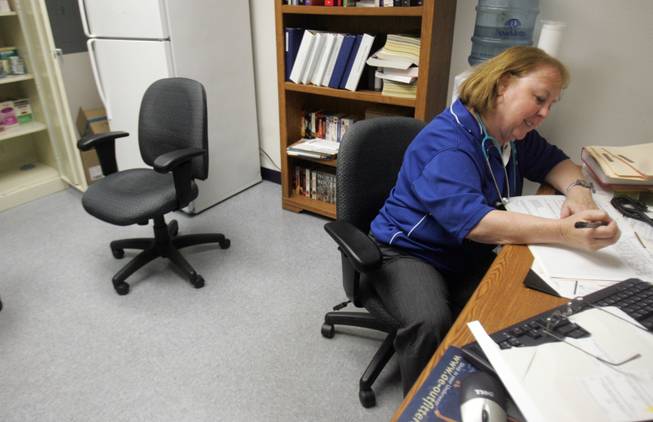
After a busy morning at the student health clinic, pediatric nurse practitioner Susan Brooks fills out paperwork in her office on Oct. 22. Basic and Nevada State College have a partnership to operate the clinic, which is opened to students of all ages from anywhere in Henderson.
Thursday, Feb. 28, 2013 | 2 a.m.
Sun coverage
It's possible Nevada families won't see a doctor when they visit a clinic if a bill in the Legislature passes into law. Instead, a nurse practitioner may be running the show.
The bill would remove the requirement that nurse practitioners must work under the supervision of a doctor.
Nurses say the bill is an important step to improve access to medical care in Nevada at a time when federal health care laws will soon mean hundreds of thousands of newly insured Nevadans may be seeking health care or a health clinic.
“For the average family, it’s going to increase access for people to get care,” said Matthew Khan, a family practice nurse practitioner in Reno and president of the Nevada Advance Practice Nurses Association. “We are removing a barrier.”
He said the bill would mean families would continue to visit clinics, but they might see a clinic owned and operated by nurse practitioners rather than a doctor.
Doctors, however, said this potentially reduces patient safety by removing physician oversight and accountability.
Doctors have more training and education and should lead medical care teams, said Dr. Robin Titus with the Nevada Academy of Family Physicians.
“Nevada physician assistants, nurses and other health care professionals have long worked together to meet patients' needs,” Titus said. “This has been led by a team approach with a physician at the head of the team.”
The bill does not mean nurse practitioners — a subset of nurses who have met a training and certification requirement — will perform procedures they aren’t already doing in accordance with their training.
“I’m going to see pediatrics to geriatrics,” Khan said. “Am I going to do brain surgery? No.”
It also would not stop nurses from working in the physician-led teams doctors advocate.
Nevada would join 17 other states in allowing nurse practitioners to practice independently of physicians.
“Every state that has done this, that has allowed this practice to go forward, it has worked as advertised,” said John Griffin, lobbyist for the Nevada Advanced Practice Nurses Association.
He said no state has repealed the legislation.
An Assembly committee peppered doctors and nurses with questions, trying to discern what was best for the safety of patients.
Doctors said repeatedly that a “team approach” is the best way to deliver medical care.
Griffin argued doctors have a financial incentive to preserve the law that mandates nurses to contract with doctors.
Nurses who operate without direct physician supervision must maintain a financial relationship with a doctor.
“They see a monetary gain,” Khan said. “Of course they do not want to get rid of this.”
This statement spurred a further line of questioning from legislators who became increasingly frustrated with a panel of doctors testifying before the committee.
“If this is about money, neither side wins because my constituents do not win,” said Assembly Speaker Marilyn Kirkpatrick, D-North Las Vegas.
Doctors said nurses could end up doing procedures they’re not trained to administer, and independent, nurse-led practices could “fragment” medical care in Nevada.
Assembly Majority Leader William Horne, D-Las Vegas, argued that nothing stops a “rogue nurse” from doing something illegal now, and nothing in the bill stops doctors and nurses from continuing to work together.
“I have not heard anything that this is going to make health care delivery worse,” he said to the panel of doctors. “I think it's subjective opinion on your part that it is not going to solve anything. It actually might. I haven't heard anything compelling that it will make it worse.”
Responding to concerns from doctors that independent nurse practitioners would not refer patients to doctors, Assemblyman David Bobzien, D-Reno, looked up state regulations and said nurses already have the responsibility to refer patients to physicians.
The Nevada State Board of Nursing supports the bill and has no concerns that patients will suffer any adverse effects if the 790 nurse practitioners it regulates were to practice independently of doctors, said Deborah Scott, director of the board.



"Doctors said repeatedly that a 'team approach' is the best way to deliver medical care."
They are trying to protect their paycheck. They get a cut of reimbursement (with minimal time and responsiblity) that keeps them relevent.
"Doctors said nurses could end up doing procedures they're not trained to administer, and independent, nurse-led practices could 'fragment' medical care in Nevada."
Nonsense. I wish I had a nickle for every doctor I have met who was doing procedures they were not trained for. PLASTIC SURGERY COMES TO MIND. What is the NAFP doing about that? Nothing. In their minds, a doctor is fully capable of "knowing their limits". Everything falls within their scope of practice. But APN's are unsafe? Pfft!
Half the people who are against this are the two-faced, politically active physicians who whine the loudest about having no "family life" because they have no time away from work. The other half are those consumers who B*TCH endlessly about the cost of healthcare, yet want a "real doctor" to see them everytime they come in with an itchy undercarriage or runny nose>
Do you want to see some efficiency in healthcare? Then MIDLEVEL PROVIDERS are the answer.
A small step in a good direction. Practitioners can provide common sense, reassurance, guidance, referrals, info on where to/how to....
This is just plain nuts.Reading the article makes me worry about the state of heatlh care in Nevada, reading the two older posts makes me nauseated. Dislosure: I am a physician for more than a decade and have employed a couple of midlevel providers, currently I have one. I also have two sisters who are both nurse practioners. SO take my comments below as it is. First everyone involved hasf financial interest, from the insurances/HMO's as their cost of hiring mid level will be considerably less, same with doctors and the mid levels who want to get the "share" of the doctor and want to do it on their own. Ask yourself who among them is benefitting the most if this is passed? I happen to think that indeed there is a place for a midlevel provider in healthcare, I just happened to think that they dont have experience and proper training to be UnSUPERVISED, PERIOD. A new midlevel graduate(physician assistance and nurse practitioners) without any experience can see any patient from 1 year old to 101 year olds, now please tell me which school and how much time they spent there so I can send my daughter on that same school. I finished medical school with honors and went to three year residency and more than a decade of experience and there are still cases that surprises me. Sure they can see uncomplicated cases, but the problem is, medicine is not an exact science. Those coughs will be nothing most of the time, or it could be an early heart symptom, those "sorethroat" and hoarse voice for 2 months can be a cancer in the throat and please NOT everything can be cured with antibiotics! And believe me they will not screen patients to see only at their level of "expertise/experience". I usually gets disgusted when I refer a patient to be seen by a subspecialist and seen by a midlevel working there and come back with weird diagnosis, way off that its not even funny, its frustrating as now who are we to refer to? I dont think this is a good idea, at most maybe they can allow this only on those who have at least 10 years experience of their field of choice, and introdue themselves as "Hi im nurse practioner so and so" so the patient does know who they are dealing with. And if it just the financial aspect, why several of my collegues doesnt want to hire midlevel for their "peace of mind"--their words not mine. Again I reiterate, there is a place for midlevels in health care,not just UNSUPERIVSED. P.S. This has been written with consent with my two sisters.
Physicians don't like this, just like like Obstericians do not like MidWives
My wife has been seeing Nurse Practitioners and Physicians Assistants for years. My limited exposure to the medical profession has been that no matter who a patient sees, the attending medical person usually lets the patient self-diagnose, and goes from there. I guess that's why they call is "practicing medicine". For routine primary health care visits, an NP or PA is qualified to handle most issues. Doctors can make "mistakes" like anyone else: see Deepak Desai and his criminal enterprise of a colonoscopy clinic. Medical care in the state of Nevada is basically a crapshoot anyway.
I wholehearted support this legislation, having been under the care of NPs and PAs for years, without any adverse affects. This action will lead to better access, clearing up the bottleneck that currently exists in trying to immediately seek medical care. Most of us cannot WAIT a few weeks for a doctor's appointment!
Blessings and Peace,
Star
This a bad trend and bad for healthcare. here is
a better solution
1) train more primary care doctors
2) increase pay for primary care doctors to attract more people
3) increase number of residency spots for primary
care
NO most of NP and PAs I have worked with should NOT be practicing independently. The knowledge
and level of training is NOT comparible.
There's monetary gain for the physicians, sure. But there's monetary gain for the nurse practitioners if they can practice independently without sharing the $ with a doctor. So?? This is not about the $. It's about patient safety.
The fact is doctors do have more training and education. Doctors get a bachelors then go to medical school for 4 years. THEN they do at LEAST a one year residency in a specialty area. Some do 3 year residencies and more. Nurses don't have anywhere near this level of training and education. They could require extended training so that it would be the equivalent of medical school and residency training. Why don't they? I reckon because there wouldn't be any reason to. If you were willing to spend 4-7 years in training, you'd go to medical school-- not be a nurse practitioner.
So you know when you've got that persistent cough... that could turn out to be lung cancer... wouldn't you prefer the comfort of knowing that somebody with that level of training and experience is at least on the team? Or do you want the individual who wanted the quickest and cheapest way out of their training?
P.S. I am NOT a doctor or a nurse.
Physicians always fall back on "patient safety" as the excuse as to why advanced practice registered nurses should not practice independently but there is no evidence to support this claim. Study after study has shown APRN's provide quality healthcare services with good outcomes! APRN's are providing independent, quality healthcare services in more than 15 states currently. There is mounting evidence that independent practice for APRN's does work. Allowing APRN's to practice to the full extent of their education and licensure opens up access to healthcare services for more Americans. Physicians balking about this issue has more to do with money, power, and protecting their turf than it does about quality and access. If APRN's don't provide quality healthcare services .... where is the evidence to support this concern. The truth of the matter is that no such evidence exits.