Published Wednesday, Oct. 3, 2012 | 2 a.m.
Updated Wednesday, Oct. 3, 2012 | 8:16 a.m.
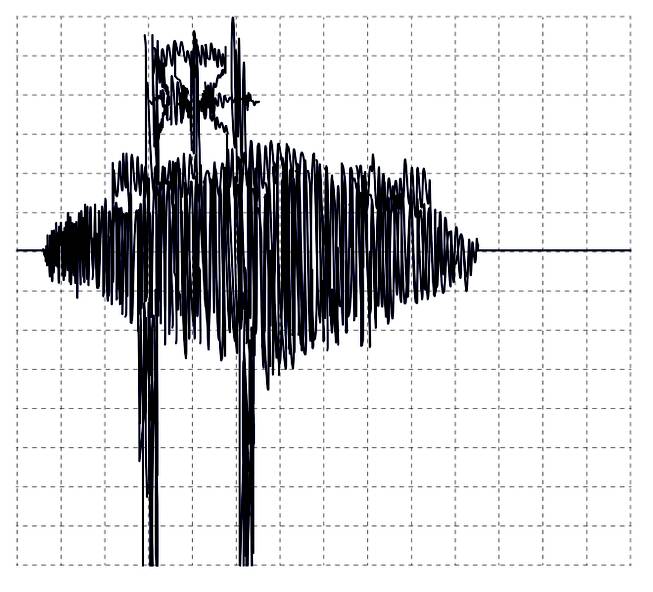
It would start with a rumble.
A subtle vibration felt underfoot spreads and intensifies until everything around is shaking.
Windows rattle; book shelves and cabinets tumble.
Outside, the ground pitches and buildings rock back and forth on their foundations.
It would last less than a minute but in its wake would leave billions of dollars of damage.
Since 2011, there have been unexpected earthquakes in Washington, D.C., Kansas City, near Dallas and in Ohio.
The largest recorded earthquake in Nevada history shook the north-central part of the state on Oct. 2, 1915, destroying several adobe houses, a stone chicken house and a hog pen, and collapsing a mine tunnel.
The magnitude 7.1 earthquake was centered in a largely uninhabited area, but its seismic energy still reached 50 miles away, damaging several towns, including Winnemucca, Battle Mountain and Lovelock.
Despite several other large earthquakes striking the state in the past century, none has threatened Las Vegas.
But that doesn’t mean a large earthquake can’t hit here. And if one were to strike, it could cause extensive damage to thousands of buildings, force tens of thousands of people into public shelters and cause upwards of 100 fatalities, experts forecast.
The likelihood of an earthquake of this magnitude hitting Las Vegas is slim: seismologists say there is a roughly 1 in 10 chance that a magnitude 6.0 earthquake — one large enough to cause significant damage — will strike the valley in the next 50 years.
Wells, Nev., is an even more unlikely place than Las Vegas to be struck by such an earthquake. But in 2008, a magnitude 6.0 earthquake hit the town and caused $9 million in damage, emphasizing the fact that despite advances in technology, earthquakes are unpredictable and can strike most anywhere in a state as seismically active as Nevada.
Local governments, engineers and builders are well aware of the threat earthquakes pose. Disaster readiness plans are in place and building codes have been updated to ensure Las Vegas won’t be reduced to rubble in case of a powerful quake.
High-rises around town and along the Strip are built to withstand heavy shaking and aren’t expected to come tumbling down during an earthquake, except, possibly, for the Harmon tower, whose seismic readiness has been hotly contested.
Geological activity in Nevada is tracked by UNR’s Seismology Lab, which operates a statewide network of seismometers that are monitored remotely by researchers at the college.
Nevada is the third most seismically active state in the country — behind California and Alaska — but most of the activity is concentrated in two regions: along the state’s western edge near the Sierra Mountains in an area called Walker Lane, and in the basins and ranges that occupy central Nevada, said Graham Kent, director of the UNR Seismology Lab.
“Most of the activity is tucked along the border between California and Nevada on the east side of the Sierra Mountains,” he said.
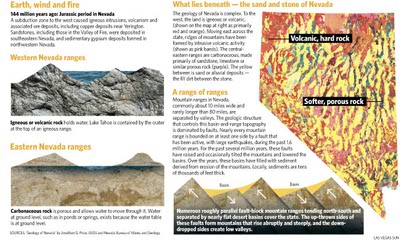
Nevada is crisscrossed by fault lines hundreds of thousands of years old, and a number of factors, including the sliding of tectonic plates and the slow outward expansion of the area’s crust, contribute to the earthquakes, said Jim Faulds, director of the Nevada Bureau of Mines and Geology and a professor at UNR.
The state’s geology means Reno and Carson City are more than five times as likely as Las Vegas to experience a serious earthquake.
“Let’s say a large magnitude 6 or low 7 earthquake (hits) in the Reno basin somewhere; that’s going to be a real disruptor,” Kent said. “Lots of unreinforced masonry buildings would be unoccupiable. There would be damage to roads, bridges and other infrastructure.”
Simulations from the Nevada Bureau of Mines and Geology show that a large earthquake affecting Washoe County could cause between $1.9 billion and $5.2 billion in economic losses, including damage to buildings and infrastructure and decreased business activity.
But in a city like Las Vegas, where a disruption to the flow of tourists into the state would be devastating, a large earthquake could cause economic damage ranging between $7.2 billion and $25 billion.
Building codes in the valley are designed to ensure the survivability of people inside the structure. Still, many buildings could suffer damage that renders them uninhabitable after an earthquake, said Ron Lynn, director of the Clark County Building Department.
“The structure could suffer damage, but if everybody gets out OK, that meets the requirements of the code,” Lynn said.
Builders use a variety of techniques to mitigate effects of a potential earthquake, Lynn said, including varying the depth of the foundation of a building and using reinforcing columns and beams.
High-rises, especially casinos, tend to far exceed the minimum requirements for earthquake resistance because a break in operations of even a few days would lead to a large financial loss, Lynn said.
In homes, some walls and chimneys may crumble in an earthquake, but the greater concern are unsecured furnishings, like hot water heaters, shelves, cabinets and other things hung on the walls, which can dislodge and injure people, he said.
Planning for an earthquake in Las Vegas is especially difficult because of the tens of thousands of tourists in the city at any given time, said Irene Navis, Clark County’s planning manager.
Clark County and other local governments have disaster management plans ready for any variety of natural calamities, including earthquakes, she said.
The widespread nature of an earthquake, which could cause damage throughout the valley, would stretch local government’s resources to the point where federal assistance would be needed, Navis said.
Government officials have coordinated with casinos, utilities and other businesses to be prepared in case of a major earthquake, but residents also can do their parts to be ready, she said.
Knowing how to “Drop, Cover and Hold” — the focus of the upcoming Great Nevada ShakeOut — can help protect people from falling furniture or debris during an earthquake, Navis said.
Other steps include fastening potential hazards in the home to the wall or ground and compiling an emergency supply kit containing food and household items. For businesses, preparing crisis management plans can help reduce chaos and confusion during a disaster.
“You can’t prevent an earthquake, but you can help shape how people react,” Navis said.

Join the Discussion:
Check this out for a full explanation of our conversion to the LiveFyre commenting system and instructions on how to sign up for an account.
Full comments policy