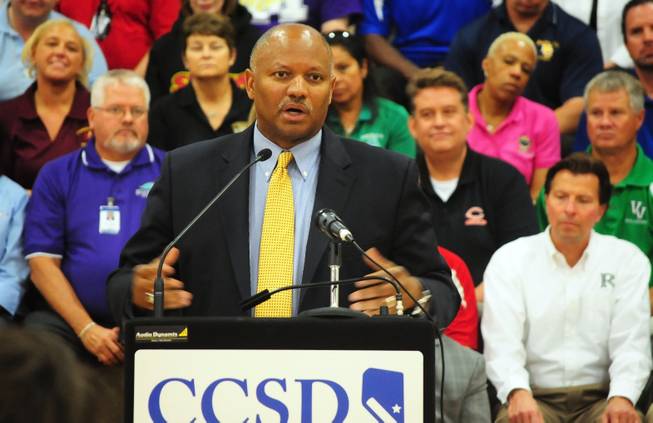
Clark County Schools Superintendent Dwight Jones unveils a new ranking system for the School District’s 48 high schools at Cimarron-Memorial High School on Thursday, May 24, 2012. Fourteen of the 48 ranked high schools were rated five-stars; however, all but three of these top-performing schools were either magnet or Career and Technical Academies.
Published Thursday, May 24, 2012 | 10 a.m.
Updated Thursday, May 24, 2012 | 9:10 p.m.

High school rankings
Related stories
- Clark County School District announces rankings of top- and lowest-performing elementary, middle schools (2-23-2012)
- New school rankings unveiled with much fanfare, but some teachers grumble (2-24-2012)
- Top-rated schools found in wealthier areas, but School District vows change coming (3-12-2012)
- 10 surprising facts about the School District’s new school ranking system (3-12-2012)
- School finds measurable ways to help students achieve success (3-12-2012)
The Clark County School District released its high school rankings Thursday at Cimarron-Memorial High School.
But unlike earlier this year, when elementary and middle school rankings were unveiled at a top-ranked, five-star school, the high school rankings were released at a one-star school.
The lower status came as a surprise to Cimarron-Memorial, a well-regarded school and home to a robotics team that recently won second place in an international competition.
The one-star ranking is hard to swallow, but the northwest valley high school is ready to take ownership of its ranking, said Principal Joe Caruso, a 12-year veteran at Cimarron-Memorial. Despite the school’s changing demographics, Cimarron-Memorial is determined to improve, he added.
“Cimarron-Memorial is a one-star school,” Caruso said, letting that fact slowly sink in among the handful of students and the nearly 50 principals gathered in the auditorium. “Our faculty and staff understands this and we acknowledge the hard work ahead. We are a family, and we will emerge from this stronger.”
Adding to the elementary and middle school rankings released in February, the School District rated 49 public high schools on a five-tier scale, assigning five stars for the highest-performing schools to one star for the lowest-performing schools.
Clark County is the first school district in Nevada to implement a school ranking system popularized by major urban districts in New York City, Los Angeles, Denver and Miami.
“The School Performance Frameworks gives us a way to define success in terms of academic success for all students,” Clark County Schools Superintendent Dwight Jones said. “This is not a beauty contest. … It’s a way for us to learn how to get better faster.”
Under the high school ranking system, Clark County high schools each were assigned a numerical score out of 100 points based on a number of categories. Although academic growth – how much a student improves on standardized tests year over year – figured prominently in elementary and middle school rankings, meeting academic goals such as graduation was of greater importance in the high school rankings, officials said.
Scores were broken down as follows:
• Graduation (35 percent): Graduation rate, first-time pass rates on the high school proficiency exam and the percentage of credit-sufficient students.
• College and career readiness (35 percent): Advanced Placement and International Baccalaureate enrollment and performance, passing rates on 70 career and technical courses offered by CSN and four years of math and three years of science completion by 12th grade – a widely-accepted indicator of college success
• Academic growth (20 percent): Improvement on test scores between eighth and 10th grades.
• School climate (10 percent): Attendance rates, student achievement among non-English-speaking and special education students, and survey results of staff, students and parents.
To account for the diversity of Clark County schools – urban and rural, magnet and comprehensive, affluent and poor student populations – disadvantaged schools were given a “multiplier” to make comparing schools fair.
Comprehensive high schools – open access schools that pull students from their attendance zone – received a 10 percent multiplier. Magnet schools – which serve students from their attendance zone as well as select students for technical programs – will receive a 5 percent multiplier.
All high schools could receive 5 “extra credit” points toward their score for meeting school-specific goals set by school administrators.
The high schools were then ranked, and rated from one to five stars. The top-performing five-star schools must score at least 80 points and meet the “adequate yearly progress” status under the federal No Child Left Behind.
The numerical scores for each school will not be made public, although school administrators will be allowed to view them and appeal their rankings between May 25 and June 25. Charter and alternative school rankings are expected to be released over the summer.
Of the 48 high schools in the district, there are 14 schools that achieved the five-star status this school year. Only three of these five-star schools are comprehensive high schools: Boulder City, Indian Springs and Moapa Valley – schools that have small student enrollments. The rest are magnet or Career and Technical Academies.
In fact, no large, urban comprehensive high school made the five-star list this year. However, four-star comprehensive high schools Green Valley and Coronado would be ranked five stars if the federal government grants Nevada's waiver application to No Child Left Behind, officials said.
By identifying schools’ rankings, the district can better focus on improving lower-performing schools by giving them additional support, such as first preference on hiring, officials said.
About 8,000 teachers – the majority from lower-performing schools – are scheduled to receive professional development (funded by federal Title 1 dollars) this summer, officials said. Further, principals and teachers from lower-performing schools can learn from the best practices in place at the five-star schools, officials said.
The new ranking system for high schools – part of the district’s School Performance Framework – has been in the works since the fall. A 36-member special advisory panel made up of seven teachers, six principals, two parents and other community members developed the ranking system, meeting once a month since the fall.
The School District also conducted four focus groups with about half of the high schools participating. Opinions from principals were sought and included in the rankings’ development, officials said.
Although the rankings will not be used to evaluate school administrator or teachers this school year, they were developed to comply with a new state law mandating academic achievement be used in teacher evaluations. The Teachers and Leaders Council is expected to release recommendations on forming a new teacher evaluation system in this summer. The new law goes into effect in July 2013.
Principals had mixed emotions about the new high school ranking system, but generally seemed to support it.
Liberty High School Principal Jeff Geihs – the president-elect of the administrators union – said the rankings were in the students and educators’ best interest because it is a transparent way for the public to hold the School District accountable. Liberty is a four-star school.
“We are 100 percent behind (the rankings),” he said, as students and principals held up signs that read, “We’re all in.”
Mojave High School Principal Antonio Rael said the rankings weren’t perfect but represented a great improvement over the previous “Annual Yearly Progress” measure, which penalized schools across the nation for not meeting increasingly difficult and exceedingly unattainable standards. Eventually, Nevada hopes to implement a similar school ranking system to replace No Child Left Behind's standards for improvement.
The leader of the North Las Vegas turnaround school – ranked one-star – said he was worried, however, that the rankings were not completely reflective of the unique challenges of a turnaround school. Mojave has one of the lowest test scores and graduation rates in the valley, and it will take time for the school to improve its score under this ranking system.
Rael said he liked how lower-performing schools will receive additional support but contends It is far easier for schools with more affluent students and the ability to select its students to reach that coveted five-star rating.
A number of five-star principals were treated to an indoor skydive this afternoon, courtesy of Vegas Indoor Skydiving. The School Board unanimously adopted the high school ranking system at its meeting Thursday night.
Rankings will be released annually in the late summer, before school starts. Next year’s rankings – using data collected from the 2011-12 school year – are expected to be released in August.
See an interactive list to find all the school rankings here.

Join the Discussion:
Check this out for a full explanation of our conversion to the LiveFyre commenting system and instructions on how to sign up for an account.
Full comments policy