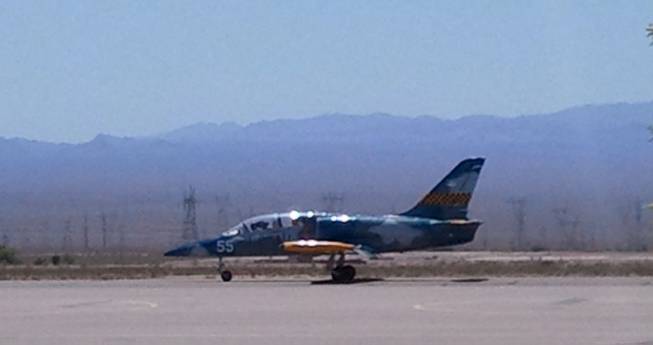
Charles Nevel / Special to the Las Vegas Sun
An Aero Vodochody L39 jet taxis for takeoff at the Boulder City Airport just before crashing into the desert about a half mile west of the airstrip.
Published Saturday, May 19, 2012 | 5:46 p.m.
Updated Saturday, May 19, 2012 | 11:39 p.m.
Pilot of jet crash once lost license
Viewing video requires the latest version of Adobe's Flash Player
KSNV coverage of jet crash pilot's history in the air, May 19, 2012.
Related content
Jet crashes near Boulder City
Viewing video requires the latest version of Adobe's Flash Player
KSNV coverage of a jet crashing after taking off at the Boulder City Airport, May 18, 2012.
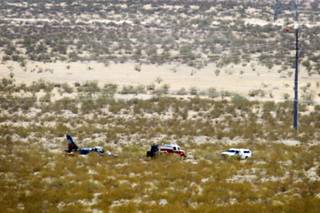
The pilot of a jet fighter plane that crashed near Boulder City on Friday, identified early Saturday as Douglas Gilliss by members of the Red Steel Jet Team and later by the Clark County Coroner's Office, once had his license removed for falsely certifying another pilot.
The NBC affiliate in Bakersfield, Calif., in 2010 reported that Gilliss falsely certified a pilot in a similar jet in 2009 and lost his license as a result. Two people died when that aircraft crashed. Later, Gilliss regained his license.
A note posted on Red Steel’s Facebook page Saturday morning stated “Yesterday just outside of Boulder City, NV we lost Doug in an air plane crash on his way to Van Nuys, California…Doug's aviation resume is and will remain one of the most respected in the industry.”
The accident occurred Friday around 12:30 p.m. about a half-mile west of the Boulder City Airport.
According to Federal Aviation Administration, a Czech-made Aero Vodochody L39 jet crashed for unknown reasons in a mostly barren desert area near a string of power lines.
The Clark County coroner's office confirmed that Gilliss, of Solano Beach, Calif., and passenger Richard A. Winslow, 65, of Palm Desert, Calif., were killed in the wreck.
According to his profile on Red Steel’s website, Gilliss was a former United States Air Force Pilot who flew more than 5,800 hours during his 30-year career. He was a certified FAA safety counselor and had developed and taught curriculum for the L-39.
A second L39 jet that took off alongside Gillis’s jet Friday circled the airport and landed safely, witnesses said.
Charles Nevel, a custodian at the airport, said he saw the planes take off in tandem. The jet that crashed peeled off and slowly descended before it went out of sight behind a building, he said. The same plane had safely taken off and landed earlier in the day, he said.
According to employees at various businesses at the airport, some of whom monitor aircraft radio chatter, the jet experienced some sort of difficulty when taking off. Moments after a puff of smoke appeared, the pilot radioed “mayday!” before the aircraft crashed.
The National Transportation Safety Board is the lead investigator in the accident, and will release a report of its findings in the coming weeks.
The L-39 Albatross is a jet trainer aircraft developed in the former Czechoslovakia in the 1960s. It has a single turbofan jet engine and a top speed of 485 mph, according to Hopper Flight, an L-39 jet enthusiast group.
One website, L-39 Enthusiasts, lists 19 crashes of the aircraft since July 3, 1998; there was most recently a crash Jan. 20 in Rainbow City, Ala.



Sounds like a flameout.
I knew Doug Gilliss and speak highly about him to my colleagues. This is a tragic loss to the families of Mr. Winslow, passenger, and Mr. Gilliss. I choose to write here not to elaborate on the details of Doug's flying or this fatal accident. I simply want the readers to get a brief understanding of the honor that it is to fly this bird. Its length is an impressive 40 feet and the wingspan is 31 feet. It flies up to 407 knots = 470 mph. The book says it flies up to 36,000 feet but the reality is that the pilot flies at less than 25,000 feet most of the time. This plane is capable of flying vertical with the proper circumstances and it appears in airshows throughout the USA. The purchase price for a used model is in the range of $400,000. The training to fly this plane is rather significant for less experienced pilots. Most of the instructors are former USAF instructor pilots. This is not a plane that you can easily take home to Mama. It has certain places it can fly and certain ways to do that safely. It is quite humorous that there are B-747 pilots who take three times longer than me to steer the plane on the ground....It's just like when I went out ice skating for the first time. I was going from one end of the runway to the other end just prior to full throttle.
The fun and exciting part is when the pilot is just flying around locally with the transponder on and the nearby flight service center calls and says good morning, you're booking just under Mach 0.9 and we got a Southwest coming around three thousand feet under your rear in about three minutes, where do you plan to fly? (use of language a little less formal here). The controller knew it was you because no one else is out there without a flight plan and flying Mach 0.9. The controllers are having a ball just watching you on the radar screens and looking for any reason to call you up on the radio again. The feeling that your entire country is behind you and cheering you on is overwhelming. A complete stranger from the FAA is not only telling me what is going on in the air around me, but this stranger is my wing man - he is there in a second to help me if I am lost or confused or frustrated. After all, there is an atomic lab just 20 miles away and I better not cross the river boundry in my map or else two F-16's will be scrambled to check out this fighter jet and its two bright yellow tip tanks. Hate to be morning news in the New York Times when it comes to flying too close to a heavily protected DHS site.
So sad to see the "Buy-Line" for this article.
Does the Las Vegas Sun do the same for car crashes?
"Driver of car that crashed once went to traffic school for a speeding ticket"
Doug Gilliss was a great pilot with decades of experience, and the go-to guy for the FAA in his local area (San Diego). He was also the object of a "witch hunt" by the Van Nuys FSDO (Flight Standards District Office: for you non-flyers) following the crash of an L-29 near Tehachapi that killed two fully qualified pilots.
The link above refers to the KGET article which is yet another glowing example of thoroughly pathetic
reporting.
Regarding the L-29 crash in Tehachapi:
The so-called "smoking gun" used by the FAA was a pre-printed (neatly typed) endorsement sticker that Doug made at his house/office before the intended Biennial Flight Review, and was found among some random paperwork during the post-crash investigation. Typing these "stickers" in advance is a common practice by Instructors to preclude a bunch of scribbling in a pilot's logbook, and allows a clear/concise explanation of the event. The sticker was never actually placed the pilot's logbook because, at the last minute, another Instructor had actually accomplished the checkout.
Both articles fail to properly identify the key points of either incident:
The L-29 crash was most likely caused by an inadvertent roll, induced by the wake of another airplane in the formation, that was unrecoverable.
The L-39 crash was caused by an engine failure that did not allow the pilot to return to the runway. What caused the power loss will be determined by the NTSB as a result of their investigation.
If I were a reporter I would want to "get it right",
Apparently that doesn't happen much as regards aviation related stories due to a severe lack of education