Sunday, March 25, 2012 | 2:01 a.m.

J. Patrick Coolican
It isn’t what it could be. But it isn’t what it used to be.
That’s former planning commissioner Steve Evans talking about downtown and its new public buildings.
Given everything that’s happening — the new City Hall, the Smith Center for the Performing Arts, the Mob Museum — I decided to take a tour of downtown with some architects and neighborhood activists. Joining me were Evans; Suzanne Couture of the Friedmutter Group, a firm that has done work on the Strip and around the world and also donated significant time to the Neon Museum; Eric Strain, an award-winning local architect; longtime Vegas architect and urban planner Robert Fielden; and, with an outsider’s perspective, Miriam Neet, a professor at the UNLV School of Architecture who recently arrived from Chicago.
Start with the bad. We’re on Martin Luther King Jr. Boulevard, and no one is particularly fond of the new Metro Police headquarters, which looks like a typical corporate office building. It’s fronted by a big parking lot, destroying any potential relationship to the street.
“We’re in Summerlin, right?” Strain says to laughter.
Now we’re headed to the Mob Museum and old City Hall, which Zappos will eventually inhabit, and we pass under the railroad tracks on Ogden Avenue, a key connector between downtown and Symphony Park. Will pedestrians want to go from one to the other?
“It’s such a wonderful pedestrian environment,” Fielden quips. Everyone laughs because it’s not.
To make walking more popular, we need narrower streets and wider sidewalks for comfort and safety. We need more benches for resting, plus interesting stuff to look at. As is, we have too many pedestrian “dead zones,” as Evans calls them.
Professor Neet says our climate and the hot sun should impel us to use innovative designs to create pleasant outdoor environments, especially shade structures. Using her iPhone, she shows us a very cool, massive wooden shade device in Spain.
We stand in the curious courtyard of the old City Hall, which Couture says is “like a fortress,” noting its dated, brutalist design. “Where’s the front door?” Neet asks.
“Who knows?” Couture responds.
Perhaps Zappos will open up the building and give it some air, establishing a connection to the street and its surroundings.
The old transit center behind old City Hall is shuttered, replaced by a new one near the new City Hall. A pocket park has also been torn up, presumably to keep the homeless away from the new Mob Museum. The panel agrees that we need to rethink this; downtown needs pocket parks, plus a grocery store and a school so that it can be a place for families and not just scenesters. Plenty of cities have achieved a nice mix that allows everyone to enjoy urbanism.
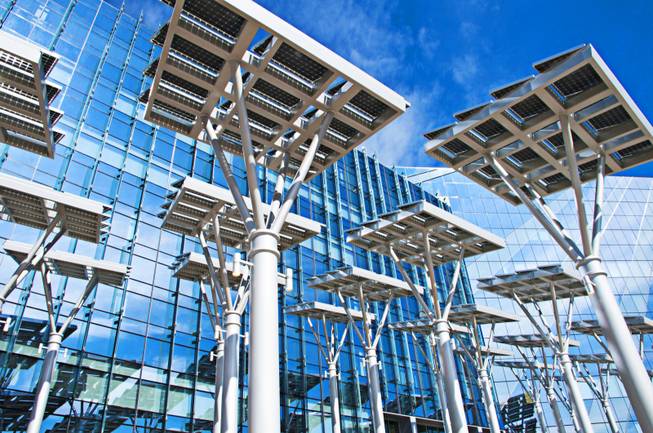
At the new City Hall, most everyone likes the interior lobby, though Fielden and Strain question the architect’s decision to use so much west-facing glass, given our climate. “I don’t care how much insulated glass you use, it’s going to be hot,” Fielden says.
“Yeah,” Strain quips, “but those solar panels will create energy for more air-conditioning.”
Now we’re at the new Smith Center, which has been done in architect David Schwarz’s signature 1930s art deco style. It may not be the favorite of other architects, but as Strain says, “It’s been embraced by the public, and that’s what matters.”
What’s missing among all these new civic and cultural structures? Imagine if all the rides of an amusement park were separated by railroad tracks and vast empty parking lots that required you to traverse dull, narrow walkways or get in your car.
On the Strip, Couture has designed cities within the city, so she knows what’s she talking about: “There’s all the components,” she says of downtown, “but there’s no connectivity yet.”
Ultimately, we’re still suffering the consequences of decades spent trying to re-create Los Angeles. As D’Angelo Barksdale says in The Wire, “The past is always with us. ... You can give yourself a whole new story. But what came first is what you really are.”
But we wouldn’t be Americans, or Las Vegans, if we didn’t think we could prove him wrong. And so, Evans says, “I have nothing but optimism.”
A version of this story first appeared in Las Vegas Weekly, a sister publication of the Sun.

Join the Discussion:
Check this out for a full explanation of our conversion to the LiveFyre commenting system and instructions on how to sign up for an account.
Full comments policy