
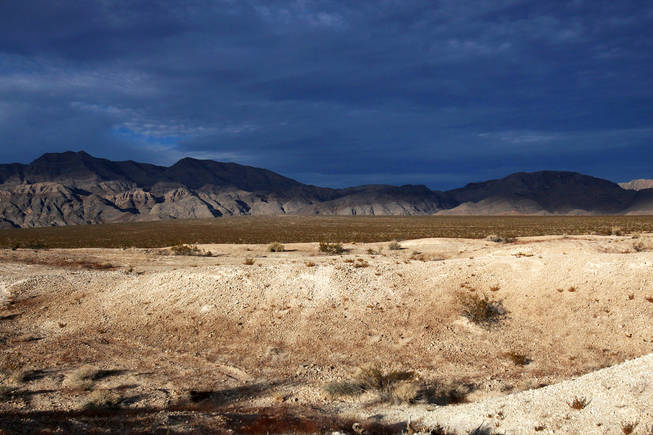
A look at the proposed Tule Springs National Monument area located in the northern part of the Las Vegas Valley.
Wednesday, July 4, 2012 | 2 a.m.
Sun Archives
- Nevada congressional leaders uniting in national monument push (06-27-2012)
- Legislation to create national monument at Tule Springs introduced in Congress (06-27-2012)
- Legislation preserving fossil-rich area north of Las Vegas as national monument expected this year (3-20-2012)
- Tule Springs tours offer vistas into the past (5-11-2005)
- Valley residents get chance to protect Las Vegas Wash (4-29-3005)
- Researchers hoping to protect fossil sites (12-8-2004)
- More ancient treasures found (10-1-2003)
- Revisiting Tule Springs' 'Big Dig' (11-1-2002)
A settlement announced Tuesday might prevent new power lines and pipelines from going through a fossil-rich, 23,000-acre parcel in the north valley proposed as a national monument.
The agreement between a coalition of conservation groups and numerous federal agencies revises a Bush-era plan that laid out 6,000 miles of corridors for the transmission of renewable energy throughout the West.
One of those nearly mile-wide corridors, named “223-224” on a federal map, runs through a 23,000-acre area that Sen. Harry Reid and Nevada’s congressional delegation want to turn into a national monument. They introduced legislation last week to designate the area as the Tule Springs Fossil Beds National Monument.
In a new map, the “223-224” corridor is identified as “no-go.” That means energy developers will need to go through a more onerous, difficult process to gain approval to lay down electrical or gas lines.
“Now, it doesn’t mean it can never be built there, but it has to go through an intensive environmental review that includes those groups that were party to the lawsuit,” said Rob Mrowka, conservation advocate for the Center for Biological Diversity. “It certainly does throw a kink into any plans for a corridor there.”
The case against using the 223-224 corridor for any power lines is strengthened, Mrowka added, because another corridor exists on the west side of Spring Mountain that could be used instead.
The agreement, which awaits federal court approval, creates a process for the agencies to periodically review corridors and assess whether to revise, delete or add corridors on a region-by-region basis.
In a news release issued to announce the agreement, Kristen Brengel of the National Parks Conservation Association mentioned plans for the national monument.
“We are pleased the Interior and Energy departments agreed to consider removing a transmission corridor on the northern outskirts of Las Vegas through a scientifically significant Ice Age fossil site known as Tule Springs,” she said. “This area is worthy of a national park designation.”
The lawsuit was filed on grounds that “the original corridor designations did not focus on or facilitate access to renewable energy development,” said a press release from the Wilderness Society, one of the plaintiffs. “Further, because of failures to consider the actual impacts of the corridors and to engage the public and state and local governments, the currently-designated West-wide Energy Corridors would adversely affect National Park Service areas, National Monuments, National Wildlife Refuges, habitat for threatened and endangered species, and proposed wilderness, among other special places and values, and miss opportunities to minimize impacts and designate preferable locations.”
The agreement does nothing, Mrowka noted, to the existing power lines that run east-west through the area. Supporters of the national monument designation bemoan those lines as an environmental blight.
NV Energy could not immediately be reached for comment.
It is partly because digging took place to put power lines through that area decades ago that the Ice Age fossils were ever discovered. Today, some 10,000 of the area’s fossils are stored in climate-controlled cases in the San Bernardino County Museum in California.
 Explore Las Vegas’ past and present
 Boomtown: The Story Behind Sin City
 Neon Boneyard: A 360° look
 Mob Ties: See the connections
 Implosions: Classic casinos crumble
Join the Discussion:
Check this out for a full explanation of our conversion to the LiveFyre commenting system and instructions on how to sign up for an account.
Full comments policy