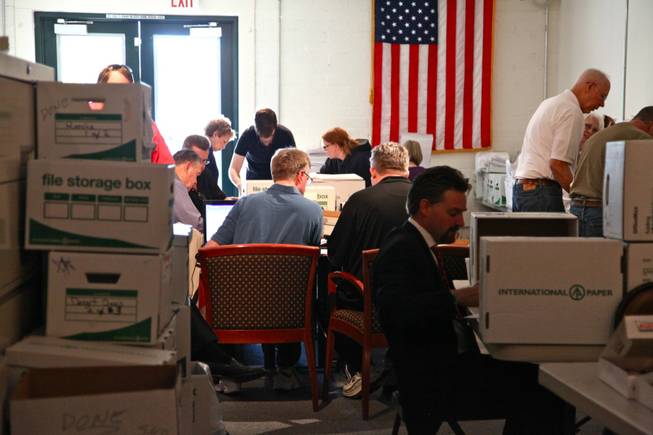
Volunteers count and record caucus totals at Clark County GOP headquarters Sunday morning.
Tuesday, Feb. 7, 2012 | 2 a.m.
Caucus vote count in question
KSNV coverage of the Republican Party Caucus vote counting process being questioned, Feb. 7, 2012.
Sun coverage
The caucus is a civic process that involves talking politics with neighbors, benefits from being run by well-oiled institutions and asks citizens to set aside part of a weekend that might otherwise be spent with family or stocking up for the big game.
A straightforward primary election is easier to conduct, and after Saturday’s troubled Republican caucuses, the state’s political leaders are now suggesting they’re ready to switch.
Final results from Saturday’s caucuses weren’t released until Monday, and turnout fell well below expectations, with more than 10,000 fewer Republican voters than showed up in 2008.
Republican lawmakers are talking of submitting bills for the next legislative session to switch to a primary.
Carol Howell, a member of the state Republican Party’s executive board, said she collected hundreds of signatures from caucusgoers who want to switch to a primary process.
“There are too many voters who can’t make a three-hour window,” she said.
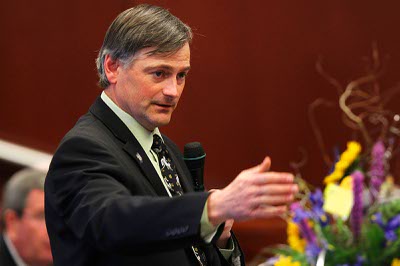
Sen. James Settelmeyer speaks during the first day of the 2011 legislative session Monday, February 7, 2011 in Carson City.
She has the support of Republican Sen. James Settelmeyer of Minden and of a number of Assembly lawmakers, including Pete Livermore, R-Carson City, she said.
Republican political consultant Greg Ferraro blamed the low turnout on the caucus process and predicted that there would be a number of bills to change the process at the Legislature.
Settelmeyer, a rancher, said the caucus “disenfranchises voters. There are people who have to work, are serving in the military and the elderly.”
He cited 90-year-old constituents in his district who couldn’t make it.
Settelmeyer wants to move the states’ primary elections for other offices from June to February, even if that means “people will be setting up campaign signs while you’re setting up Christmas decorations.”
Other political leaders want to hold a special presidential-only elections early in the year, which would cost $1 million to $2 million, according to the Nevada secretary of state.
But there will be opposition.
State Sen. Sheila Leslie, D-Reno, noted that much of the grousing right now is coming from anti-government Republicans.
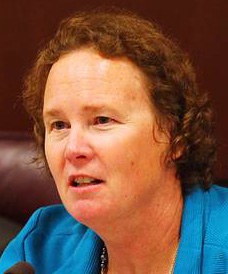
Sheila Leslie
“I find it very ironic that the very same people who complain government is not efficient at running anything now want government to take over the presidential choice,” Leslie said. “These are the same people who will not raise taxes to fund public education. ... Talk to me when we adequately fund education and a social safety net.”
Moving the entire primary process to February — with the general election in November — would burn out voters and candidates, she said.
The Nevada Democratic Party, meanwhile, is like the kid in a footrace who just watched his opponent sprawl out on the pavement. The machine sees no problems with the current rules of the game.
Democrats had 12,000 people show up for their caucus in January — which, with President Barack Obama running for reelection, was not competitive.
A better comparison, party officials said, is to their turnout in 2008, when 116,000 people participated.
“The caucuses are democracy in action. It’s a way for people to come together and have open and energetic discussions on who should be leader of country,” said Zac Petkanas, spokesman for the state party.
The state party in 2008 had 30,000 people register on its caucus day and signed up 4,000 volunteers.
“When done correctly, they can be very effective,” he said. “It demonstrate the very best democracy can offer. But they have to be done well.”
Switching from a caucus to a primary could jeopardize Nevada’s early status, which would almost certainly mute any attention and voice the state has in the process.
So why no vote-and-go, election machines in our grocery stores and convenient absentee ballots to be mailed in?
The simple answer is that it has almost always been done this way in Nevada, and Senate Majority Leader Harry Reid and Democrats cemented that status in 2006.
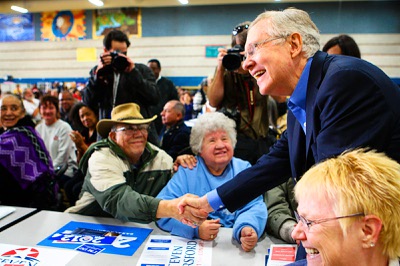
Sen. Harry Reid shakes hands with Bob Carsten as he greets community members following his speech during the 2012 Democratic Caucus Saturday, Jan. 21, 2012, at Cheyenne High School.
From 1952 to 1972, Nevada picked a slate of “presidential electors,” similar to caucuses, according to a history compiled by the nonpartisan staff of the Legislature.
Nevada took a break from that and held “presidential preference primary elections” in 1976 and 1980 but stopped because of cost, low turnout and the “fact that presidential nominees had been determined by earlier primary elections in other states,” according to the history.
Since 1984, the Silver State has been holding caucuses, but many people didn’t notice or care because the political process has let party elites, farmers in Iowa and whoever decides to live in New Hampshire mostly determine the process.
That changed in 2006, when Reid lobbied the Democratic National Committee to get Nevada into the early slot. National Democrats had been looking for a Western state, with a labor presence and Hispanic voters, as a way to diversify their early states. The fact that Nevada was a caucus state also helped, since New Hampshire is protective about its slot as the first primary state.
The Republican Party, afraid of being out-organized in Nevada — which is one of a handful of swing states in presidential elections — also moved up its caucus.
But the party has not had Reid as the all-powerful wizard behind the curtain to help them organize. So leadership has been mostly disjointed, and underfunded.
Some Democrats also have advocated for a primary election instead of a caucus.
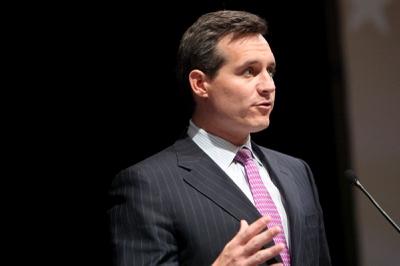
Secretary of State Ross Miller addresses the Nevada State Democratic Party Convention on June 26, 2010, at the Flamingo.
Dina Titus, at the time a state senator, submitted a bill draft after the 2008 caucus to switch the process, citing complaints from her constituents. She was elected to Congress and did not return to the Legislature. The bill never gained traction in the Legislature.
Secretary of State Ross Miller, also a Democrat, said he supports a one-day primary where the only question is who should be a party’s presidential nominee.
“I think everyone acknowledges, political parties are not in the business of running elections,” he said, noting that Lewis Carroll in “Alice in Wonderland” mocked caucuses. “I think elections are best run by professionals.”
Miller, said as long as Nevada can maintain its early status, the state should run its nomination process “in a manner which withstands national scrutiny.”

Join the Discussion:
Check this out for a full explanation of our conversion to the LiveFyre commenting system and instructions on how to sign up for an account.
Full comments policy