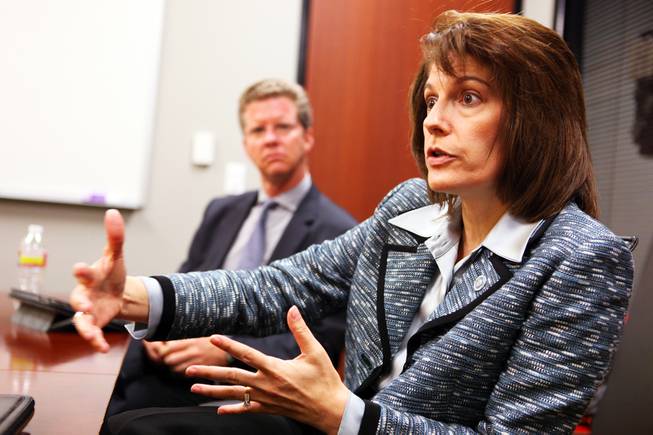
U.S. Housing and Urban Development Secretary Shaun Donovan, left, and Nevada Attorney General Catherine Cortez Masto speak to an editorial board at the Las Vegas Sun offices in Henderson on Monday, September 24, 2012.
Sunday, Dec. 9, 2012 | 2 a.m.
Sun coverage
Foreclosures in Nevada could spike next year if lawmakers and banks roll back a bill passed in 2011 that played a large role in stymieing banks’ attempts to retake homes from Nevadans, according to the state’s banking association president and housing analysts.
But more foreclosures aren’t necessarily a bad thing for Nevada’s housing market, at least in the long term, according to housing analysts.
Banks are in talks with Attorney General Catherine Cortez Masto and lawmakers about how to amend the state law that slowed foreclosures to a trickle in fall 2011.
Although foreclosures since have risen, they’re still about a quarter of where they were before the law went into effect.
At issue is Assembly Bill 284, a measure passed by the Nevada Legislature in 2011 and signed by Gov. Brian Sandoval that forces banks to prove they have the legal right to foreclose on a particular home before they take action. Most important, the law requires bank workers to sign an affidavit that they have personal knowledge of a property’s document history, or they will face criminal or civil penalties.
Democratic lawmakers and Cortez Masto, a Democrat, who helped pass the bill, said the law was intended to uphold the integrity of the legal process and protect homeowners from banks wrongfully foreclosing on homeowners without having necessary paperwork.
Cortez Masto has said it was never intended to prevent legitimate foreclosures.
But after the law took effect in late 2011, foreclosures in Nevada — which previously led the nation in foreclosures — ground to a halt.
In August 2011, banks issued 5,350 foreclosure notices in the state, according to the Nevada Foreclosure Mediation Program. In September, there were 4,684 “notices of default.”
In October 2011, when the law went into effect, the number dropped to 80.
Since then, the foreclosure filings per month have crept upward, reaching 1,417 in November.
That is proof, according to some consumer advocates, that banks are figuring out the paperwork behind home loans that had been sliced and diced into various investment instruments at the height of the housing boom. That slicing and dicing is what made it so difficult to determine which entity could legally foreclose on a home.
Many housing analysts believe the law is stalling legitimate foreclosures and creating an artificial, short-term boost in housing prices.
Cortez Masto has created a working group involving the state’s largest banks to discuss possible changes to the law in the next legislative session.
That group includes bankers, servicers, title and other real estate interests, as well as consumer representatives and lawmakers.
“We do not anticipate recommending repeal of any of the current provisions of the law,” she said in the statement. “The working group is attempting to clarify some of the terms in the law.”
She said it’s still unclear what recommendations the group will make to lawmakers.
Bill Uffelman, president and CEO of the Nevada Bankers Association, which lobbies the Legislature, said banks were not looking to repeal the entire law.
“The Attorney General’s Office and affected parties are working to change the affidavits so it’s workable, without fear of criminal or civil liability,” Uffelman said.
“Just amend it,” he said. “The notion behind AB284 wasn’t bad. The policy’s fine. Let’s fix the application.”
Some housing analysts say the law has allowed some Nevadans to live in their homes without paying a mortgage. Banks, confounded by their own shoddy paperwork and the state law, aren’t able to foreclose for months or years. Economics analyst Jeremy Aguero this fall labeled them “strategic squatters.”
This shadow inventory — of homes headed for almost certain foreclosure — has loomed over the seemingly positive news of slightly increasing home values and the rise of new housing construction.
John Restrepo, principal of RCG Economics in Las Vegas, called it “a bit of an artificial spike not likely to be sustained as it is today, depending on how the law is changed.”
The politics of easing restrictions for banks are dicey and likely to face opposition.
Sen. Tick Segerblom, D-Las Vegas, chairman of the Senate Judiciary Committee, said he’d listen to Cortez Masto, a fellow Democrat.
But, he said, “I’m extremely reluctant to change anything that everyone agrees has raised property values in the state of Nevada.”
He said if banks can’t foreclose, it’s their own fault for losing track of the paperwork.
“If it comes down to a homeowner who had a mortgage, or a bank — who has the right to be there? I’ll go with the homeowner,” he said. “I’m not worried about the banks. They made their beds. They can sleep in it.”
Uffelman, the banking association president, said banks have been focused on meeting the terms of the National Mortgage Settlement — the $26 billion settlement that requires banks to take such actions as principal reductions, short sales and forgiveness of second loans. But soon, their focus is going to turn back to foreclosures.
“The reality is foreclosures are going to start again, probably sooner rather than later,” he said.



We need to go back to the idea that real estate is a taxable commodity in our state. How do we make sure a property is viable to our economy?
We have houses that cant bring in tax dollars because no one will say I own them. A home owner in default would say, I'm in foreclosure it's the banks issue. The bank/lender will say, we're unable to get through the paper work to legally foreclose on the home so it's technically still the homeowners asset (even if upside down).
Yes, this law is great in not letting lenders get off the hook for bad banking practices, but in the mean time we've got lots of properties that are no longer assets to our state. Maybe a solution would be to give a timed deadline to the banking institution. Example: Once you send a foreclosure notice you have 6 months to finalize your paper work, if you dont or are unable these are your penalties.
As it stands now we have houses that are not occupied, or foreclosed on for a year or so, maybe longer. If these entities writing mortgages could write it all out to have multiple lenders, let's give them a time line to clean it up.
One thing not addressed in this article is what happens when a bank/lender refuses to go through with the paper work? And by refusing they're just not doing it. Who would, you might be held responsible?
And now we've created a bubble again, and when the paper work does start going through our housing market will again burst and deflate.
The regular person has to have all their paper work in order to do anything.
Yet, banks, don't want to have to do this. It was a doubt standard, that the new law put a stop to. Keep the law as it is.
Why the banks have problems in proving they own the property is because the mortgages were sold to rich people who have "trusts", off shore accounts and other ways to hide their money.
Trying to prove who really owns this invisible money is why banks have a problem. The rich people don't want to expose that they are cheating on their taxes.
BANKS NEVER LOSE!!!!
If foreclosure means the State/City,etc verify the ownership/mortgate owner of the home and the reasons for the foreclosure are legit according the current law...then leave the law alone...
No need to fix something because the forclosing parties have problems with their records...fix your problem first...
Businesses and governments always want to make their jobs easier because of their errors in the beginning...in many instances that leaves the problem on the homeowner...
"The Attorney General's Office and affected parties are working to change the affidavits so it's workable, without fear of criminal or civil liability"
So then what would be the consequence of them foreclosing on the wrong house? If they want to escape criminal and civil liability, what other types of penalties are left on the table?
I bet there are hundreds of thousands of Americans who are living mortgage and rent free because of legislation that was passed to delay foreclosure, these same people are not paying property tax either.
One would think the creditors, banks and all, could use the statutes that were in effect when the loans were made. Slowing a foreclosure doesn't help unless the owner/occupant has a reasonable chance of maintaining that property. Let the actions proceed.
The Las Vegas economy will take a hit when the people living free in these houses don't have loads of money to spend on consumer items. I know I would be living it up if I didn't pay a mortgage and taxes.
Let's Review:
(A) First the Banks wrote mortgages, Created an exchange (not approved at law) to facilitate trading of these mortgages.
(B) Took them, repackaged them and used them as collateral to create a shadow currency to profit by BILLIONS of dollars
(C) The banks were so careless that they probably used the same mortgage MORE THAN ONCE as collateral for different loans. And...
(D) When Lehman Bros. folded, the banks suddenly wanted the "full faith and Credit" of the US Government to back up their shadow 'currencies'. At the cost of over a trillion dollars to US TAXPAYERS, we did. Unfortunately, without conditions or reasonable restrictions.
(E) With the sudden injection of money without control in the 'crisis', the banks then proceeded to grant themselves lavish bonuses, perks, and proceeded to use their flawed systems to foreclose on the rest of the Nation.
(F) When they were called out and caught with their flawed system, the Legislature demanded that they stand behind their statements, just like anyone else who signs a contract.
(G) Now, they want to "amend" and "clarify" the law so that thy are not responsible for their actions.
Really?
In my opinion, these guys deserve to be more highly regulated than the medical profession, which is currently the most regulated industry in the US.
Another point. Remember the Mortgage repackaging from (C) above, this is the other side of that sword. Those were sold to a whole lot of investors, who are looking for some money back, the Banks are currently liable when it's discovered that a single mortgage was syndicated to say ten different investors. It's a good thing that the State is making the banks back up what they are saying. It's been like watching a bad replay of "The Producers" in slow motion, without the laughs.
I wouldn't worry about the economic spike that is talked about in the article, Foreclosures are accelerating but I don't think that the banks will move forward with the ones they 'over syndicated' and will stop paying taxes on them, that will keep the market from being flooded.
Tax liens take first position, so when the property is sold for taxes, all underlying obligations are wiped out.
It would be ironic justice to see those people who are still hanging on able to purchase the property outright for taxes due.
This bill put Nevada behind at least a couple years in the housing crash. While consumer rights are a good thing those who signed a mortgage then do not pay for years is a bad thing, many HOAs are hurting becuase of these squaters. Every mortgage is transferable, you signed that document when the bank gave you the money for your home. The price to pay for this protection will be huge, it was a blunder. Get people who will pay taxes, insurance and HOA fees in control of these properties. Values will rise becuase of that. Kick these deadbeat squater homeowners out.
You can artificially manipulate an inventory for so long in this housing recovery. Banks can't hold on to all that bad paper forever , the election is over. Unless the jobs and credit pictures improve don't expect anything to fundamentally change going forward
AB 284 should never have been passed. While it's amusing to see the banks squirm for their "misplaced" paperwork, the result is that Las Vegas' recovery has been slowed and extended due to this statute.
At least they have become very efficient at getting accurate and precise appraisals now. Six years ago it would take a week to ten days and be presented with photos, comparable property and eyewitness verification. Today all B of A requires is zip code.
I think it would be wrong to remove the penalties from the law, and suggest that anyone who votes to do so should be closely looked at come next election.
That said, it is equally wrong for squatters to take advantage of something that is not theirs.
There is no easy solution to this as long as the banks/lenders can bundle and shuffle, the paper trail will always be a mess.
This reader could not find substance to the request for modification since there were no cases provided which indicated any successful prosecutions as a result of AB-284.
: {
These are some great, insightful comments that reflect an understanding of the reality of the markets. I know some of these politicians that push these bills through are well intentioned, but we really need to pay attention and ensure we not only vote OUT politicians that sponsor bills like this and think they need to pass and push through laws to fix and control every little aspect of our lives, but also to elect politicians that understand as much as the readers of this article.