Sunday, Sept. 11, 2011 | 2:01 a.m.
Nation marks 10-year anniversary of Sept. 11 terrorist attacks
KSNV coverage of commemoration of the Sept. 11, 2001, terror attacks, Sept. 10, 2011.
Remembering 9/11
- Reflecting on how Sept. 11 has changed our lives
- 9/11 memorial T-shirts fashioned into art at UNLV
- Reporter forced to face his own fears at Ground Zero
- Jon Ralston: What we’ve lost since Sept. 11
- Sun Editorial: Sobering anniversary brings memories, reminders of what’s important
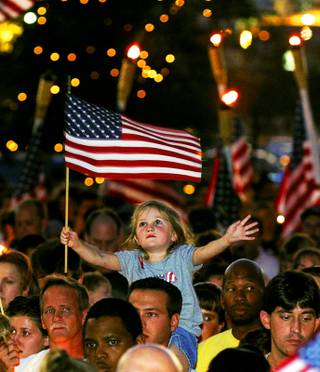
- 10 years later, Las Vegas Sun photo of girl with flag still resonates
- Palo Verde students preserve 9/11 tradition — and teacher’s legacy
Sun archives
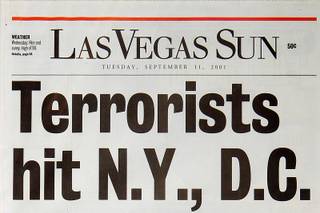
Read the stories that ran in the Las Vegas Sun on the following dates:
When anti-Muslim, right-wing extremist Anders Breivik set off a fertilizer bomb in Oslo and then went on a shooting rampage that killed 76 people, law enforcement analysts in Las Vegas sprung into action, examining how they would respond to a similar scenario.
When authorities captured accused gunman Jared Loughner in connection with the January killing of six people outside a Tucson grocery store and the wounding of 14 more, including Rep. Gabrielle Giffords, D-Ariz., the same analysts contacted Arizona authorities to determine whether Loughner had any connection to Las Vegas. He didn’t.
But that was still considered a successful use of time at the Southern Nevada Counter-Terrorism Center, the existence of which is the single greatest step taken to improve terrorism preparedness in Las Vegas since 9/11.
The so-called fusion center, housed at the new Metro Police headquarters in downtown Las Vegas, is the only place where local, state and federal law enforcement representatives work together round-the-clock to gather and analyze intelligence. And it deals with all crimes and hazards, not just terrorism.
“It’s the partnership and communication between the FBI and local law enforcement agencies that make the fusion center viable,” said former Sheriff Bill Young, who ran Metro from January 2003 to January 2007. “Before 9/11, the relationship between police and the FBI nationwide used to be terrible. The FBI was notorious for using local police to gather intelligence and then excluding them and cutting them out of criminal investigations. But now I see the FBI and local law enforcement working closer together than at any time in history.”
The significance cannot be overstated because a chief criticism of U.S. security before 9/11 was that law enforcement agencies too often engaged in turf battles in which they failed to share crucial intelligence information. That’s why 19 al-Qaida operatives maneuvered freely throughout the country, including in Las Vegas before the attacks.
“We recognize that we have to work together to prevent any terrorist threats or attacks,” said Lt. Gregory Damarin of Metro’s counterterrorism section. “There’s no information that the locals get that the FBI doesn’t get, and there’s no information that the FBI gets that the locals don’t get.”
Damarin and others involved in terrorism preparedness say Southern Nevada has far better communications, equipment and training than it did before 9/11. But they concede it would be difficult to stop a terrorist group or lone wolf intent on deadly destruction.
“The biggest lesson out of 9/11 is that anything is possible,” said Irene Navis, Clark County’s director of emergency management and homeland security. “It can happen anywhere and it can happen in any community, but terrorists seem to like high-profile communities.”
She counts Las Vegas among them.
The Homeland Security Department ranks Las Vegas as the nation’s 21st most likely terrorist target, but Navis said she thinks the community should be in the Top 10 because it has 22 of the world’s 25 largest hotels.
Here are examples of what has changed in Las Vegas since 9/11:
Hospital preparedness
Shortly after the attacks, UNLV associate professor Christopher Cochran, who teaches health care administration, found that the 11 area hospitals would be easily overburdened by a mass casualty event that produced at least 1,000 victims.
There are now 18 area hospitals equipped for acute care. But more significantly, the hospitals participate in a medical surge area command structure that Clark County established two years ago, headed by University Medical Center emergency preparedness coordinator Ryan Turner.
During a major incident, whether it is a terrorist attack, flood or earthquake, representatives of each hospital will meet to share information on how many beds, nurses, drugs and medical supplies they have to address the emergency. Patients will be distributed accordingly. If there is a shortage of medicine and if the president declares an emergency in Las Vegas, the medical surge team can obtain needed supplies within 12 hours from the Strategic National Stockpile managed by the Centers for Disease Control and Prevention and the Health and Human Services Department.
Still, Turner said that because Las Vegas hasn’t experienced a mass casualty event, it isn’t known how many victims would overburden hospitals.
“We have the resources now to meet day-to-day needs,” he said. “But when you’re talking about 1,000 people coming into the health care community at once, it’s all hands on deck. It’s all about getting resources.”
Fruits of federal funding
When the 9/11 attacks occurred, the state had only $5.5 million for disaster relief. Money for preparedness training and equipment for emergency personnel was sorely lacking. Young fumed in 2003 when Homeland Security Secretary Tom Ridge gave Congress a list of 30 cities he thought should be eligible for $500 million in counterterrorism funding, and Las Vegas wasn’t on the list.
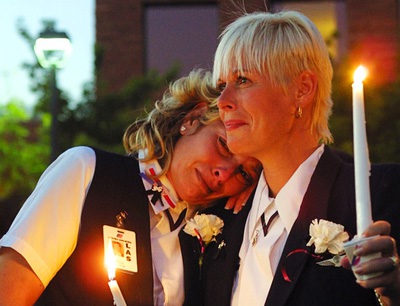
United Airlines flight attendants Deanna Rhodes, left, and MaryAnne Houser, vice president of the Association for Flight Attendants in Las Vegas, console each other as they join hundreds of police and fire personnel at the Clark County Government Center amphitheater during a memorial service Monday, Sept. 17, 2001, where Las Vegas' public safety community honored the firefighters and police officers lost in the terrorist attacks.
Since 2004, Nevada has received $131 million in federal homeland security money, and Las Vegas has received an additional $48 million since 2006.
Money has been spent on counterterrorism personnel, training sessions such as a regional multiagency anthrax exercise scheduled for March, robotics to diffuse explosives, and programs such as “See Something, Say Something,” which encourages the public to report suspicious activity by calling 828-8386 or accessing the website SNCTC.org.
Homeland security money is the reason Southern Nevada has an All Hazards Regional Multiagency Operations and Response unit, known as ARMOR. The team has experts in chemical, biological, nuclear and radiological monitoring and identification who will respond in protective gear to potentially hazardous incidents, such as envelopes with suspicious powders.
“We have the capability to put our task force on something quickly,” said Metro Capt. Brett Primas, who oversees the unit. It is equipped with sophisticated mobile devices to quickly identify suspicious substances at the scene. “Before 9/11, it would take hours or days before we could figure out what a substance was,” Primas said.
But terrorism funding is vulnerable to federal belt-tightening just like everything else. The state, which received $20 million in homeland security funds in 2006, received just $11 million this year.
Identifying potential targets
Through a post-9/11 initiative called the Nevada Silver Shield critical infrastructure protection program, authorities have identified more than 2,200 important sites and assets statewide that, if destroyed, could cripple the state’s economy or cause widespread injuries or deaths.
With the help of a consultant, the state has developed plans to protect 1,422 of them, including 952 potential targets in Clark County. The remaining assets should have protection plans in place within 18 months.
Nearly one-third of the assets are government facilities, 398 involve emergency services, 265 are commercial structures and 210 involve water.
The agency has gathered blueprints of the facilities, locations where dangerous chemicals are stored and lists of individuals who can be called in emergencies. Videos of the facilities are handy so that police officers and firefighters know rapidly what they’re dealing with.
“Our enemies are good at exposing our vulnerabilities,” said Primas, who also directs the Silver Shield program. “Our goal is to shore up our vulnerabilities.”
Hotel safety
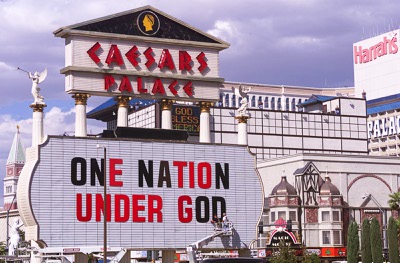
Jeremy Jackson and Roy Coronado put a message of solidarity on the Caesars Palace marquee Wednesday, Sept. 12, 2001, on the Las Vegas Strip in response to the terrorist attacks in New York and Washington, D.C.
Writing for The Atlantic magazine in January 2005, former National Security Council counterterrorism adviser Richard Clarke offered the hypothetical example of how easy it would be for a female terrorist to walk into a Strip casino and blow herself up, causing dozens of fatalities.
Major resort companies train employees to recognize and report suspicious activity, such as someone photographing part of a casino that normally doesn’t attract attention. These video lessons, made available through law enforcement, have also been used by taxicab and limousine companies, among others.
Shortly before Derk Boss left Las Vegas in 2009, where he ran security for the Stratosphere and Arizona Charlie’s, he co-wrote an article for the online magazine Security Management that detailed many of the security improvements made by casinos since 9/11. Among them have been increased use of smart security cards for access to rooms or buildings, photo ID check-in where guests’ names are run against those on a government’s terrorist watch list, and security posted at elevators to check guests’ room keys.
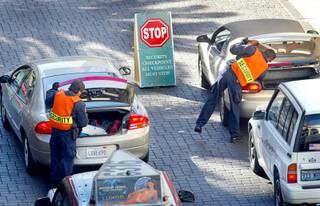
Boss wrote that some hotels have mandatory daily room checks if a guest posts a “do not disturb” sign for a significant amount of time and doesn’t respond to knocks or phone calls. Resorts have increased patrols, including use of bicycle-riding security in parking areas, and some properties use dogs trained to detect explosives. Although layers of security have been added in parking garages, randomly stopping incoming vehicles and checking trunks, which began shortly after 9/11, have been significantly reduced.
“There’s definitely been a falloff,” said Young, now corporate vice president of security for Station Casinos. “There was a time in the initial aftermath of 9/11 when resorts took extreme precautions until guests felt a certain comfort level. Stopping a vehicle is pretty rudimentary, but it’s distasteful to a lot of people who are on vacation. As time marched on and 10 years have passed since 9/11, resorts have found other things securitywise to take its place.”
Resorts use more surveillance cameras to focus on food lockers, chefs as they cook and food serving lines at buffets to guard against food tampering, Boss wrote. Some properties have added televisions and radios to their surveillance rooms so they can monitor breaking news that may affect those resorts, he wrote.
•••
Las Vegas is safer on other fronts, too.
Before 9/11, most local physicians didn’t have the ability to quickly identify whether patients were victims of an anthrax outbreak or certain contagions. State law requires Nevada doctors to take courses related to terrorism, including how to recognize common symptoms and deliver treatment associated with exposure to chemical, biological or radioactive agents.
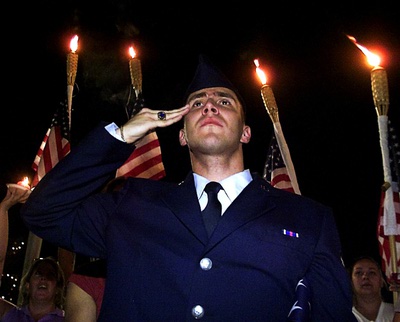
Airman 1st Class Sean Romero with the New Jersey Air National Guard, 177th Fighter Wing, salutes as the national anthem is sung during a candlelight vigil at the Thomas & Mack Center, Wednesday, Sept. 12, 2001, to honor those killed in the terrorist attacks.
The Southern Nevada Health District can field inquiries about potential health hazards thanks to a phone bank that, during the valley’s hepatitis C outbreak in 2008, fielded up to 4,000 calls a day. Dr. Lawrence Sands, the chief health officer, said the phone bank, operated by the Rocky Mountain Poison and Drug Center in Denver, would prove useful in the event of a terrorist attack.
Having said all this, Las Vegas — and any community, for that matter — is still vulnerable to a terrorist attack.
“We’re always worried about the lone wolves who aren’t connected to any terrorist cell or organization but just decide to do something and then do it,” Damarin said. “Any community is concerned about that.”
It is why Damarin and his colleagues in counterterrorism and emergency management stress the importance of the public watching out for and reporting suspicious activity to authorities. Examples of what to look for can be found at homelandsecurity.nv.gov.
It is still relatively easy for consumers to obtain combustible fertilizer containing ammonium nitrate, which Timothy McVeigh mixed with readily available race car fuel in 1995’s Oklahoma City bombing that killed 168 people.
An airborne bioterrorist attack could be virtually impossible to prevent, although its success would be limited by the difficulty of releasing harmful biological or chemical agents in large enough quantities to cause widespread damage. But bioterrorists could have a high level of success with an indoor attack because there aren’t wind or harsh weather conditions to contend with.
Although information technology specialists have worked hard to erect firewalls to protect computer systems, fear persists that cyberterrorists could disrupt the valley’s utilities, transportation systems, communications or hospitals.
The task of staying ahead of potential terrorist threats is never complete, says C. David Shepherd, former security director at the Venetian who is now CEO of the Las Vegas security firm Readiness Resource Group. He recalled serving in Vietnam, making sure that whatever he was defending was secure both inside and out.
“It’s a continuous process,” Shepherd said. “You might think you’re done, but you’re never done.”

Join the Discussion:
Check this out for a full explanation of our conversion to the LiveFyre commenting system and instructions on how to sign up for an account.
Full comments policy