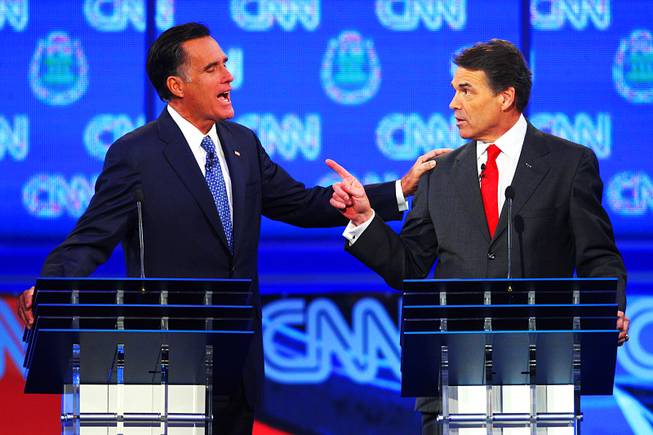
Rick Perry, right, shown with Mitt Romney at the Oct. 18, 2011, GOP presidential debate at the Venetian in Las Vegas, is the latest candidate in the Republican field to offer a flat-tax plan.
Tuesday, Oct. 25, 2011 | 3:34 p.m.
Sun coverage
Rick Perry’s doing it. So is Herman Cain. Even Mitt Romney has said he likes the idea.
The flat tax is having a Republican renaissance, as presidential candidate after presidential candidate rolls out an economic plan built around the simple message of a one-size-fits-all tax plan.
But local economists say the flat tax may be dumbing down economic recovery too much to provide real solutions for the Silver State.
When it comes to taxes, Nevadans like to keep it simple. No income tax. No corporate income tax. Sales and property taxes are a little steep, but straightforward.
Flat tax “sells better here than it does in most places,” UNLV economics professor Bill Robinson said. “Nevada is a more traditionally anti-government, and the flat tax always seems to resonate more with people who believe in smaller government.
“But all flat-tax plans are somewhat regressive,” Robinson continued. “It’s in the details. And politicians don’t usually like to talk details.”
Current national front-runner Herman Cain started the trend toward flat taxation with his “9-9-9” plan: 9 percent sales tax, 9 percent income tax and 9 percent corporate tax, with deductions for only charitable giving.
“It is fair, simple, transparent and efficient,” Cain says of the plan on his website. “It taxes everything once and nothing twice.”
Now, former Texas Gov. Rick Perry, who has fallen out of first place, is following up with a flat-tax plan of his own: a 20 percent flat option.
Perry says the plan would “cut taxes and spending, balance the budget, and grow jobs and the economy.” He’s also gotten the endorsement of the dean of Republican flat-tax aficionados, Steve Forbes, who ran for president on a 17 percent flat tax platform in 1996.
But local economists say there’s a catch in these plans — the middle class.
“I think most of us like the idea of the federal income tax being a little simpler,” UNR Economics Department Chairman Elliott Parker said. “But ... most of us would have to give up something ... having a flat tax means having the rich pay less and everybody else pay more.”
The federal tax structure is too complex to boil down to a few words, but the basic principle of the current system is a progressive tax code: Those at the lowest end of the income spectrum don’t pay as much of their income to the federal government, and those at the higher end of the spectrum pay disproportionately more: about 35 percent of their income, under the extended Bush tax cuts.
The extent of this system has upset many in the GOP presidential field, who have complained that too many citizens aren’t paying any taxes.
“Absolutely every American should pay something, even if it’s a dollar,” GOP candidate Michele Bachmann said in last week’s Las Vegas debate.
But presidential hopefuls pushing for flat taxes are looking for far more than a dollar from most in the middle class.
Cain’s 9-9-9 plan, for example, absolves the poor of any responsibility to pay income tax, but still hits them with a federal sales tax — the first of its kind — of 9 percent. It hits the middle class twice: with the sales tax and the income tax.
Perry’s 20-percent plan doesn’t impose a sales tax and exempts the first $12,500 in income from taxation for any individual (and his or her dependents) who earns less than half a million dollars a year. He also preserves the mortgage interest, charitable contribution, and state and local tax deductions.
“The criticism of a flat tax is that it tends to be regressive, but you can handle that with an upfront exemption. Then it turns into a progressive tax,” said Stephen Miller, chairman of the economics department at UNLV.
But compared with other tax proposals, Perry’s upfront exemption of $12,500 is low. Forbes’ plan would have included a $33,000 exemption to his 17 percent flat-tax plan. Miller also cited Connecticut, where the state flat tax of 4 percent exempts the first $25,000 in income. A lower exemption “means more people are going to pay the tax. It’s not as progressive as a higher deduction would be,” Miller said.
Preserving the mortgage interest deduction — a feature of Perry’s plan but not of Cain’s — is likely a point in Perry’s favor in Nevada, where the loss of a mortgage interest tax deduction would come as a heavy blow for those who have experienced financial losses on their homes.
But deductions can be a slippery slope.
“Once you open the door for one, then it’s hard to make the arguments against others,” Robinson added. “Should we have a child care deduction? Why not medical expenses? ... We’ve built a tax system which is grossly unfair, but while everyone who benefits from the unfairness of it may philosophically like the idea of a fairer system, they’re going to be personally opposed to when their unfair piece goes away.”
And if a flat tax is laden with too many deductions across the board, that brings about the problem of revenue neutrality: You can’t bring in less money than you were before.
“You can’t reduce the deficit and cut average taxes at the same time,” Parker said. “Do we really want the poor and the middle class to pay much higher rates of taxes than they currently do? I’m sure the wealthy would think that would be fair. But I don’t know if most voters, if they understood it, would.”
The potential for a shortfall in tax revenue has been a major criticism of Cain’s plan, as well as Perry’s, though both address the complaint by promising a combination of cuts in the federal budget, reductions in entitlement spending (privatization of Social Security is on the table), and new regulatory policies say believe will create jobs — and people who fill those jobs will become taxpayers.
But Miller, Robinson and Parker all agree that the GOP field seems to be avoiding the one big economic problem that could hinder Nevada from economic recovery: foreclosures, specifically, a way to push banks to write down mortgage principal so that homeowners can make good on their loans.
Specific initiatives to heal Nevada’s homegrown ills don’t appear in most of the GOP’s economic proposals, whether they’re based on a progressive or a flat-tax system.
But depending on the particulars of the proposal, a flat tax could widen Nevada’s above-average income disparities.
Median Nevada income is $51,001 per household, based on 2010 figures. But the state has a higher-than-average number of financially comfortable retirees who come here specifically to avoid steep tax rates in other states. For them, either of these flat-tax plans would likely yield lower net tax rates. Nevada also has a larger-than-average complement of service industry workers, who sit squarely in the middle class, where under these plans, many will see their net tax rates increase.
But as the Republican Party focuses ever more acutely on tax reform as its main jobs engine, economists predict more and finer-tuned flat-tax plans will be proposed.
“We’re probably going to hear more of these,” Miller said.



Getting rid of IRS and setting up a flat national sales tax would be a good idea. That takes into account all the underground cash that people use in this country.
The sales tax should not be on food, medical or your primary home. Since the "poor" say they spend all their money on Food, housing and medical they would not be paying the tax.
Rich would still be paying more since they buy big ticket items and spend more money then poor people. That should keep those happy that want the rich to pay the taxes.
I guess something like that would be to simple and saving billions of dollars by not funding IRS is just a bonus.
vegaslee, do you really think that the rich wouldn't find a way to avoid a national sales tax? Just look at what Kerry did with his yacht to avoid taxes in his home state.
No, a "flat tax" or "fair (sales) tax" is not the answer.
There is nothing more fair than a flat tax.
Those 47% who pay no federal taxes are NOT paying THEIR fair share.
The letter writer does not present any facts. Here is one example:
Herman Cains' flat tax is neutral, actually less for the middle class over all. For example a married couple with 99,000 in taxable income would pay $ 17,356 fed income taxes plus the payroll taxes of about $5595 for a total of 22,960. If paying the 9% fed income tax that would be $8910 and if they spent every penny they made it would be another $8910 for a total of $17,820, $5140 less than they are paying now. We know there will be some things that will not be subject to a flat tax, food, medicine, mortgage/car payments come to mind, so the middle class couple will not be paying a flat tax on their total spending. How is this rough on the middle class having to spend less for taxes?
So why didn't Perry create a Flat Tax for Texas Taxes? He has great ideas for the country that he can't even implement in his own State. Impossible to do it in Texas so he will bring it to the Nation instead.
What Perry needs is several shots of good Tequila (from 100% Blue or Tequilana Weber Agave) to get his head back in order.
boftx,
You are like many people these days. You can always find a reason why YOU believe something would not work but you don't have any idea's on what will work.
A flat sales tax with no exemptions outside of Medical, food and primary house makes it hard to cheat the system.
There are Billions of dollars a year spent in the underground cash system that would also be caught in this.
You have a workable plan Boftx?
Some form of Fair or Flat tax is needed. The country is ready for it, and its time. For the first time in my life, I will be a single issue voter.
A flat tax is a wonderful thing for the rich and wealthy, but grossly regressive on the middle class and poor,...its why Republicons like it.
vegaslee, please define "primary house".
It would be rough on any state's middle class.
This is every rich persons dream a flat tax. This will probably get voted since the majority of Americans are not so smart compared to the rest of the world.
ALL of the major GOP candidates for the presidency support raising taxes on the middle class and lowering them for the rich.
Talk about class warfare...
And those who are confusing Herman Cain's book tour with a run for the nomination are just endlessly entertaining. First he was shilling crappy pizza, now it's a half-baked tax scheme. You people never learn.
Same Greedy OLD Party RepubliCON games. These Bozos cannot come up with any NEW ideas. By the way, where are all of those Jobs promised for America in the 2010 election??? Same OLD LIES. Vote these lazy BAGS out in 2012!
boftx,
I know your fishing but it is really very simple.
I personally own more then one home. The home I live in and that I file my taxes from should be considered my primary home for this purpose.
No use confusing things. Keep it simple and easy to follow and it will be harder to cheat the system.
If I buy more homes, I should have to pay the national sales tax on them.
Instead of fishing for a way to cheat the system come up with a better idea. If's, and''s & but's don't make for a plan. Put your great knowledge to use for the good of mankind. ;-)
This flat tax plan well lets call it for what it is it's a Experiment intended on Socializing the Expenses for the federal government cost to the middle class and the poor.
A flat tax sucks.
A give away to the rich, nothing more.
Another republican con-job.
Speaking of jobs, where is the republican jobs
plan?
THE BIGGEST CRISIS IN OUR COUNTRY IS JOBS NOT
TAXES.
This tax talk is nothing more than republican
distraction because it is republicans who
destroyed American jobs.
TAX TALK IS A DISTRACTION FROM JOBS TALK.
STOP THE TAX TALK, AMERICANS NEED JOBS.
Yea more taxes, that will solve our problem of a corrupt government...
"Those 47% who pay no federal taxes are NOT paying THEIR fair share."
Does that include, for example, GM?
Here is my simple federal tax plan:
There will be no business income tax whatsoever
Personal income will be taxed at a flat rate of 25% (or whatever is needed to collect the same amount of revenue the government currently collects)
There will be zero deductions from personal income for any purpose
A company doing business in the U.S. must report what percentage of its sales are in the U.S. and also must report all wages and dividends paid to anyone in the world.
Taxes must be withheld by a company doing business in the U.S. if it paid wages or dividends to anyone in the world.
As an example, assume a company pays dividends of $100 million dollars to its shareholders and $100 million of wages to its employees and 50% of the company's sales are in the U.S. The company would be required to withhold $25 million in taxes and send this amount to the Treasury Department. The company's tax burden would be calculated as follows: $200 million (wages and dividends) multiplied by 50% (% of U.S. sales) multiplied by 25% (the flat tax rate).
Self-employed individuals would be treated as a company and would be required to keep records of cash taken from the company for personal use. The cash taken for personal use would be taxed at the flat tax rate.
The government could use IRS agents to audit the transactions of companies to make sure that the company does not purchase goods and services for employees and shareholders in an attempt to avoid paying the tax. Heavy fines and possibly criminal charges would be issued for any violations.
Does anyone like it?
Sorry about the previous post, none of the bullet points showed up in the final post. Here is a more easily readable version:
There will be no business income tax whatsoever.
Personal income will be taxed at a flat rate of 25% (or whatever is needed to collect the same amount of revenue the government currently collects).
There will be zero deductions from personal income for any purpose.
A company doing business in the U.S. must report what percentage of its sales are in the U.S. and also must report all wages and dividends paid to anyone in the world.
Taxes must be withheld by a company doing business in the U.S. if it paid wages or dividends to anyone in the world.
As an example, assume a company pays dividends of $100 million dollars to its shareholders and $100 million of wages to its employees and 50% of the company's sales are in the U.S. The company would be required to withhold $25 million in taxes and send this amount to the Treasury Department. The company's tax burden would be calculated as follows: $200 million (wages and dividends) multiplied by 50% (% of U.S. sales) multiplied by 25% (the flat tax rate).
Self-employed individuals would be treated as a company and would be required to keep records of cash taken from the company for personal use. The cash taken for personal use would be taxed at the flat tax rate.
The government could use IRS agents to audit the transactions of companies to make sure that the company does not purchase goods and services for employees and shareholders in an attempt to avoid paying the tax. Heavy fines and possibly criminal charges would be issued for any violations.
vegaslee, I actually wasn't fishing. I wanted your definition of the term.
I am working up an idea for what I would consider a reasonable tax plan. More than that, I am working up an idea to deal with the results of the housing bubble burst. I'm sure that my ideas will upset those on the right, but it comes back to the basic ideas of an action in equity.
I will say this much, I believe that a progressive tax system such as we have now is the correct approach as opposed to a "flat" or "fair" tax. It is the carve-outs that are the problem, especially in the corporate tax code.
The housing bubble burst is a much trickier problem, in that it is so hard to determine who has been harmed through no fault of their own. The basic premise I am using is that mortgage lenders have a basic duty to protect the value of the loans taken out by responsible people.
<<Those 47% who pay no federal taxes are NOT paying THEIR fair share>>
Noindex
It seems you always are throwing out this "47%" figure of those who do not pay taxes, but you never post any LEGITIMATE information on where this figure comes from. It would be nice if you backed up your claim with legitimate facts and by that I mean not off some website started by some disgrunted entity, but from a real, verifiable source.
Also, if a person is not paying federal tax that means the person is not making enough money for tax to be taken out; the person is not making a living wage or not working enough - which is very common these days. When I was working temp jobs last year, some of my checks were so low that no federal tax was taken out (but State tax was). And as you know - if a person is not working, ie stay at home moms and dads, they pay no taxes!! Or how about seniors who have to supplement their social security so they work a part time job for 10 hrs a week - they, too, pay no taxes because they don't make enough money to be taxed. So are these people included in your "47%" that pay no taxes?
Oh forgot - are American Indians included in this "47%"?
The compliance costs for the current tax code is estimated to be 1.7 trillion . Having this go away would be a good thing.
boftx,
If I am reading your idea on the housing bubble correctly you are like many that want to make someone other then the debtor responsible for their loan amount that they agreed to.
That seems to be a major problem in this country. To many want someone else to be the responsible party.
Back in the 80's we had a housing bubble problem. The people then did not complain about the lenders or the investors. They sucked it up and paid the mortgages that they agreed to when they bought their homes. Very few lost their homes and people were not walking away from them.
Yes, times have changed. More people believed in personal responsibility then.
I just think it's funny they all play "follow the leader" and jump on this flat tax shell game.
It's like they're all tripping over each other to desperately throw a plan out there, any ole plan that isn't even fact checked, in this Republican Party Presidential nominee process.
And it is certified that every one of them is unveiling something that isn't anything new. Just a run-of-the-mill flat tax plan that has been disavowed by the Republican Party a long time ago, something that is similar to a house of cards, surely to dissipate in the next strong wind, but all of a sudden it is produced by all these knuckleheads as the cure all elixir for the economy...when it's in fact only snake oil. Nothing but a thinly veiled plan to re-distribute the wealth to the filthy rich by attacking the lifeblood of this country: The middle class.
I swear that if you put a Republican in charge of our economic recovery, it would be the same as the Mayor of Tokyo rewarding Godzilla with the key to the city.
All of these ideas regarding a flat tax sound good until you do the numbers. Some of them just don't hold water.
The other issue is not whether these ideas are good, it's getting 2/3 of Congress to agree with it.
vegaslee,
No, I am not looking for a way for people to avoid a legitimate debt.
Think back and you should notice that I have often said that many of the borrowers were as much to blame as the lenders. But in some cases, people did make a purchase in good faith, with considerable down-payments, just to see it basically vanish due to actions of the lenders and others.
There should be some way for those people to seek redress in civil court for the harm suffered. That is why I am thinking about an action in equity, where both sides must come to the court with "clean hands" or the case is automatically thrown out.
The good thing about civil law is that even if a person or entity acts in what is otherwise a legal fashion, if the action is irresponsible they can still be held liable. I don't think anyone will disagree with me when I say that lenders acted in a irresponsible manner.
The trick is going to be how to identify buyers who acted completely in good faith.