File photo
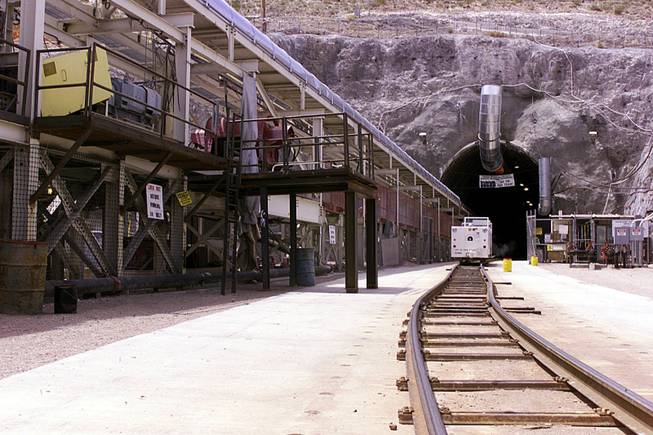
Yucca Mountain is located about 90 miles northwest of Las Vegas.
Wednesday, March 16, 2011 | 2 a.m.
John McCain

Shelley Berkley
John Ensign

Harry Reid
Sun archives
- Japan’s nuclear meltdown prompts talk of safety, Yucca Mountain’s role (3-13-2011)
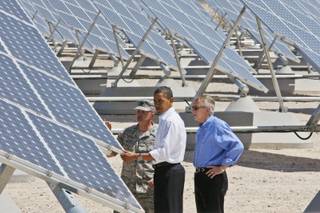
- Reid: Solar thermal project near Tonopah to create more than 500 new jobs in Nevada (12-20-2010)
- New solar test zone brightens the future of Las Vegas (7-9-2010)
- Solar research facility planned for Nevada Test Site (7-8-2010)
- State reveals plan to step up solar energy development (6-4-10)
- Obama to zero out Yucca Mountain funding, pull license (2-1-2010)
- Dying Yucca Mountain still has some life (1-30-2010)
- Obama administration: ‘We’re done with Yucca’ (1-29-2010)
- Friday announcement will unveil plans for panel on Yucca alternatives (1-28-2010)
- White House, Energy Department clash over Yucca Mountain cuts (1-14-2010)
- Report: Yucca Mountain costs double other alternatives (12-2-2009)
- Nuclear industry weighs in on nuke dump license (11-16-2009)
- In Nevada, nuclear raises touchy issues (11-14-2009)
- Feds to slash Yucca funds as project maintains life (11-9-2009
- 3 Las Vegans join state Commission on Nuclear Projects (11-5-2009)
As Japan reels from explosions and meltdowns at nuclear reactors damaged by last week’s tsunami, there’s talk in Washington about reining in the United States’ nuclear ambitions — discussions that will have an effect in Nevada.
Early cries for a moratorium on nuclear plant construction — some from Washington’s most vocal proponents of nuclear energy — suggest the disaster is going to affect the energy debate at home.
For Nevada, ending or significantly scaling back nuclear development could either bring about the demise of or facilitate renewable energy development. It could also do the same for the proposed Yucca Mountain nuclear waste repository.
Nuclear energy has been enjoying a renaissance in Washington, especially since Republicans scored major gains in the 2010 elections.
In a political climate where the energy debate has been dominated by competing cries of “cap-and-trade” or “drill, baby, drill,” nuclear energy was the one place where Republicans and the Obama administration agreed that investment and development was essential.
Because it provided common ground, nuclear energy has appeared to be the best means to balance competing interests on energy investment. Although too divided to hope for a comprehensive bill, lawmakers hoped that nuclear energy could facilitate compromises on federal loan guarantees — such as those for a planned solar plant in Tonopah — and establishing a national clean energy standard.
“If there was any hope for a clean energy standard, I don’t think you can get there without nuclear in the mix,” said Kenneth Green, an energy analyst with the American Enterprise Institute, a conservative think tank in Washington.
The trade-off between nuclear energy and renewable energy — both considered “clean” — is financial as well as political.
Nuclear power plants aren’t cheap: It costs about $10 billion to build one, meaning government-backed loans are essential to their construction. That’s a far steeper price than most renewable energy projects, but nuclear plants produce far more energy than your average solar or wind farm.
Scuttling funding for nuclear development doesn’t translate into a windfall for renewable energy projects, however — especially as lawmakers are looking to reduce federal spending. Also, nuclear’s backers aren’t going to pull the plug.
“I think it’s important to wait and see ... it’s not a reason for any snap decisions on anything,” said Sen. John McCain of Arizona, a nuclear energy proponent.
“I don’t think right after a major environmental catastrophe is a very good time to be making American domestic policy,” Senate Minority Leader Mitch McConnell said.
But the political process doesn’t always follow such logic. The United States all but abandoned nuclear energy more than 30 years ago after the meltdown of a reactor at Three Mile Island in Pennsylvania. The events in Japan have exceeded the severity of that catastrophe, and public safety officials are bracing for potentially more fires and explosions that could release more radioactivity into the air.
“You would have to be out of your mind to witness what we are seeing happening in Japan and still be urging this country to move toward nuclear energy with all deliberate haste,” Nevada Rep. Shelley Berkley said. “This should be a wake-up call to us: If we can’t do it better and learn from their mistakes, we’d better seriously look at alternative energy.”
Part of the concern for many lawmakers speaking out against nuclear energy comes from Japan’s reputation for technological advancement, and a nuclear industry with the best safeguards. The nuclear reactors in Japan had multiple backup systems, all of which failed under the tsunami’s sudden and powerful waves.
That’s raising the question for many about how safe U.S. reactors are, and in Nevada, about just how safe the Yucca Mountain site is — a concern that’s been somewhat eclipsed by worries about safe transportation in recent years.
“Some people who’ve long wanted to dump America’s nuclear waste in Nevada will use the Japanese disaster as a reason to tote it to Nevada,” and get it out of their own backyards, said Daniel Weiss, an energy expert at the Center for American Progress. He noted that opinion polls show even Americans who favor the expansion of nuclear power usually don’t want it near them.
In Japan, “the site is failing and could release a lot of radioactivity if it fails completely ... they’re just a tornado, a hurricane and flood away from having a huge environmental disaster,” he said.
According to the U.S. Geological Survey, Nevada ranks fourth in the nation for seismic activity — a factor in the design of the Yucca Mountain repository, as it is in the design and construction of nuclear facilities across the country.
But as the Japanese reactors illustrate, even the best designs can’t withstand every force majeure.
Yucca Mountain hasn’t been officially funded since President Barack Obama took control of federal budget requests, but the site is progressing through a certification process with the Nuclear Regulatory Commission. In the past few weeks, House Republicans have also taken steps toward reviving, or at least preserving, the site as a dump, including a prohibition on using federal dollars to scale down site activity in preparation for storage or reprocessing of spent fuel.
Most of Nevada’s lawmakers, in both parties, have opposed efforts to develop the site.
Senate Majority Leader Harry Reid has maintained that Yucca is dead since long before the Japanese nuclear crisis. But when asked whether fears of similar accidents in the United States would change the energy debate enough to remove it from the political dialogue entirely, Reid is tight-lipped. It’s a stance that likely has more to do with not wanting to prognosticate the future of renewable energy than any wavering on Yucca Mountain.
Without nuclear, potential energy deals of all kinds seem less probable. But there’s far less incentive to stop the energy discussion at a time when the country is struggling with rising oil and gas prices, the result of turmoil in the Middle East.
A group of Republican senators, including Nevada’s John Ensign, introduced what they called a budget-neutral compromise to develop both the country’s carbon-fuel resources — including opening up the Arctic National Wildlife Refuge to drilling — and use profits to support fledgling renewable energy projects.
“We would pay for renewable energy development with our own money and not with China, Saudi Arabia, and Russia’s, who own our outstanding debt,” Ensign said.
Although a proposal like that could win support on the argument it increases U.S. energy independence and national security, it does so at the expense of the clean-and-green ethos behind the renewable energy movement — making it a trade-off many Democrats probably wouldn’t support.
It’s potentially another setback for a fledgling renewables sector that Nevada’s depending on for an economic boom, but that’s in desperate need of government support.



Nevada Rep. Shelley Berkley said. "This should be a wake-up call to us: If we can't do it better and learn from their mistakes, we'd better seriously look at alternative energy."
Shelly has it right we need to learn the lessons from Japan and move on with nuclear power in our future.
As Shelly knows the U.S. has much better designs margins against the regional seismic events and tsunami on the West coast.
What would a tsunami do to a wind farm? The only problems with solar and wind besides being expensive and unreliable is low energy density and high energy sprawl. But that might require taking a thermodynamics course to understand. Lets keep importing oil!
Jackiebrown is exactly right. If the catastrophe in Japan accelerates the shutdown of the country's nuclear power plants, where exactly do you think the spent fuel from those plants will be stored? On-site at each individual location?
Don't count on that, especially after watching Fukushimi's spent fuel pools catch fire and burn, releasing more radiation into the atmosphere than is coming from the damaged reactors themselves. According to nuclear experts, when spent fuel rods in cooling pools catch fire, the high heat lofts the radiation up into clouds that spread the radioactivity. One expert said of that scenario, "It's worse than a meltdown."
If anything, Yucca Mountain will be fast-tracked in order to be ready to accept shipment of nuclear waste as the nation's nuclear power plants are decommissioned. Long-term storage on site will not be an acceptable option.
I would think this would bolster the movement to get rid of Yucca Mountain Project (YMP).
Nuclear waste doesn't belong in southern Nevada.
ONE mistake. ONE catastrophe. ONE error, whether it is man made or an act of nature. Or both at the same time.
You get only ONCE.
And it's over with.
I hate to say it, but northern Honshu is most likely going to end up a wasteland because of this horrific nuclear power plant accident caused by the tsunami/earthquake.
We can't afford that burden. Not now. And not for our children's children's children to unwittingly inherit this horrible legacy.
YMP is dead.
And it will stay dead.
And by the way, Pete's contention that the spent fuel pools catch fire and burn, and somehow if they had been transported somewhere else, that wouldn't have happened...don't cut it.
Spent fuel rods MUST be stored where they are made for quite awhile. Because they are still hot and CANNOT be transported to someplace like YMP. At least not right away. They need to cool down to acceptable levels in order to be transported safely later. It is a requirement they need to cool down. And this takes time.
So, that argument don't work. That spent fuel in those Japanese reactors needed to cool down before disposing of them. You can't just chuck this stuff in Hefty trash bags. There are important safety requirements.
I've noticed that all those people who want YMP to happen usually have an ulterior motive. And the large majority of them aren't from southern Nevada.
I've said it before and I'll say it again. People in southern Nevada control what happens here. NOT anyone else. Not from Washington State. Not from South Carolina. US. We decide. Not them.
YMP is dead.
Getting the spent rods and waste out of the many plants across the country should be a national priority.
I don't know enough about the science of Yucca Mountain to comment, but I do know that we need to formulate and execute a strategy to dispose of this stuff. The status quo is short-sighted and irresponsible.
Large solar plants like Solar Reserve or Ivanpah would not withstand siemic activity, but more importantly, will not power the country. The technology is not there.
The extreme lack of incentive to place solar panlels on rooftops and the fact that dim witted politicians don't understand remote solar energy will insure that Nevada will build lots of natural gas plants. People are more afraid of radiation than C02. Roof top solar gives you the most bang for the buck. Remote transmission loss is not an issue.
Harry is quiet because he supported a nuke dump in New Mexico. He likes the nuke industry but not yucca.
Barack Obama has been streamlining review for new nuclear plants in the US. He has cut down many EPA regs just to make approval go faster. He did this AFTER the BP oil spill!
To favor nuclear energy and oppose Yucca Mountain at the same time is contradictory and hypocritical. How about we curtail nuclear energy and go more for coal-fired power plants and more hydroelectric generating stations. How about more geo-thermal power plants, which would help Nevada? All these technologies are cheap, clean and efficient. (Yes, Mary Ann, coal burns clean with today's technology) Analysts say we have enough coal in our own country to supply our energy needs for 200 years. So, why the big push for "green energy"? Money, Mary Ann, money---for politicians and the big corporations like GE who feather their nests.
By the way, I just saw a segment where Ann Coulter was talking about Yucca Mountain Project (YMP) should happen and the people in Nevada complaining about it are "soccer moms."
Ann Coulter?
Who elected her an expert?
That anorexic, ex-lawyer who found a gig at Fox FLAVE (Fox Lies About Virtually Everything) News, who acts like she knows everything about everything, but only when it fits in her neo-conservative right wing nutball universe?
We should listen to her mouthing stupid stuff?
All she does is continually spout anti-liberal crap all the time and thinks she's funny and cutesy wutesy at the same time. She'll jump from one topic to another...just so long as it fits her narrow minded view.
Ann Coulter is crap. She don't speak for anyone in the nuclear industry and she sure don't even speak for southern Nevada.
Last time I checked, she scheduled some kind of speech in Las Vegas and then ended up cancelling it. Because no one wanted to listen to her superfluous bull puckey (to put it mildly).
As a matter of fact, on this YMP issue, she said so many disparaging remarks about Nevada that I'm pretty sure liberals, conservatives and independents don't want to have anything to do with her here in Nevada.
Bring it on, pro-nuke waste disposal lobby. Because if Ann Coulter is all you got, we got it easy fighting YMP and killing it off forever.
Has anyone heard about or felt an earth tremor around the vegas valley this morning around 7:30 am? My two cats were acting weird and the water in my toilet was dancing around. I've seen this before in cali during earthquakes.
There is no upsdie to Nuclear for Nevada. Few jobs and lots of risk. Would you buy a home near nuclear waste? Most people wont. Eventually something will happen and it would destroy southern Nevada.
Jackiebrown: Good point. Hi-level spent waste spread across the country is a disaster waiting to happen. Thanks Harry!
"Hi-level spent waste spread across the country is a disaster waiting to happen."
I guess putting all your eggs in one basket makes it safer...Let's put all of our nuclear arsenal in one location. Do you think any military strategist would agree this is safer?
How does moving spent fuel from a highly secured reactor site make the reactor safer? So your saying if the spent fuel in Japan had been moved the reactors would not be melting down.
Deep bore holes onsite is the safest current solution.
The dry casks in Japan have not been breached. Spent fuel still has to be cooled down in pools before placing in dry casks for storage or transportation.
This further shows onsite storage in dry casks is much safer than putting all your eggs in one basket and transportation risks.
"I guess putting all your eggs in one basket makes it safer...Let's put all of our nuclear arsenal in one location. Do you think any military strategist would agree this is safer?"
Yes, I do think it is safer. What does a nuclear arsenal in one place have to do with things anyway? A standard storage method at one facility makes more sense for waste than 100 different sites.
" So your saying if the spent fuel in Japan had been moved the reactors would not be melting down."
No, pay attention. The reactor cores are in meltdown. The wastes are not stored in the core.
The eco-whackos will have a field day with this anyway, and with natural gas so cheap and plentiful, building lots of new nuke plants is probably moot.
So with all the genius power here and in the world after several decades of research by the top physicists the world has ever produced, we have no plan that seems to work.
Yet as the data implies, we and many other nations are acting like it's okay to make piles and piles of stuff whose half-life continues for thousand s and thousands of years, right??
And continue generating time bombs that can bust through containment vessels like a hot knife through butter, right??
And decimate the biggest city in the world, right?
And spoil paradise for generations, right?
And still some are saying "Oh yeah, nukies are fine. Gimme the juice now and let thousands of generations DEAL with the crap from my greedy a$$!"
Doesn't this smack of hubris and selfishness beyond normal conscience?
Especially while the solar inputs here and all over Nevada could be harnessed for a fraction of the cost, at significantly less risk and handle the actual needs of a smarter and wiser group of people?
So who are we anyway, idiots, geniuses or slobs?
Or is it more a question of choice by a few with WAAY too much power deciding how things will be, how THEY can benefit from our needs, from their button-pushing desks, isolated and insulated from the realities most of the rest of us HAVE to deal with - the rent, food, gas, kids, school, jobs, the day-to-day-to-the-last-syllable-of-recorded-time??
Has manifest humanity handed off our wits and futures to these wealth wackos whose goal is world domination so deeply entrenched that even posterity will never find them out, hiding in their feathered nests chirping about chickens for health care, trips for free, and outlandish extravagance beyond what any of us po' fokes will ever see?
If nukies are so safe, why not build 'em in paradise? Too late; we already did and now what?? Can't unring that damn bell, can we??
But and it's a big BUT, we can go after those whose decisions have imperiled humanity at our expense and their massive profits with the bill passed on for eons, right??
If it comes to class warfare because of usurping of power for selfish gain at the expense of all our lives, then kamikazes will have places with views in Heaven and the big dogs will get trached and cherry bombs will alight in their lungs, fuses spitting fire until they 'splode inside.
Gosh, i'm sorry if my post may have offended anyone. I never meant to be so graphic or anti-incredibly wealthy people who control our planet for greedy reasons.
If I were a multi-billionaire too, I would probably not care much either about how any of you poor slobs struggle in your daily lives to find a meal and a place to sleep out of the cold or heat.
Maybe it's okay to screw everyone and just keep the flow a'rollin'. That's likely the way it is, er, was until...
It appears our brothers in Japan are unexpectedly acquiring tons of highly radioactive waste -- do they have a $10 B hole to burying it in?
Perhaps they'd be interested in lease one?
: {
It appears our brothers in Japan are unexpectedly acquiring tons of highly radioactive waste -- do they have a $10 B hole to bury it in?
Perhaps they'd be interested in lease one?
: {
It appears our brothers in Japan are unexpectedly acquiring tons of highly radioactive waste -- do they have a $10 B hole to bury it in?
Perhaps they'd be interested in leasing one?
Gee I wonder what a nuclear operator feels like when a wrong switch is flipped -- or when all the right ones are flipped and nothing happens?
Is it bear or bare... with me, I may never get it right?
: {
Ignorant republicans are the only fools that want
to use the Yucca dump.
Not a suprise.
Crazy republicans are wrong about everthing.
SOUND SCIENCE WILL STOP YUCCA FOR GOOD.
What is almost never reported are the "incidents" of accidentally released radioactive emissions from our nuclear power plants. In the 1970s, the Pilgrim One power plant in Plymouth, MA knowingly accepted a delivery of faulty control rods. The decision to use them was based on the idea that because the reactor was on the shoreline that any radio active discharge would be harmless because the winds would blow it out to sea. Apparently the people who were making the decisions had never heard of the nightly onshore breezes or were aware of lobster fishing on the Plymouth coast. Pretty much the same mentality as thinking it's an acceptable risk to build a nuclear reactor (or storage facility) on an earthquake fault.
Shortly thereafter, the cancer rate in the population spiked and the deaths began. Two of the deaths were young girls who were 4-H members that died of leukemia within weeks of each other. They had raised a goat together to provide goat's milk as their 4-H project. The grass that the goat ate was radioactive and became condensed in the goat's milk.
There is a lot more to this story, but I'm sure you get the point. Cheap, clean fuel? I don't think so, especially when you look at the true cost.
Yesterday I heard of the BILLIONS that went wasted as some half-assed reactors were planned and started and then scrapped. If you had handed me several $$B with a solar plan from ten years ago, we'd have soo much juice and such more savvy people that we wouldn't need a nukie to dookie this paradise up. We'd get by on the nukie in the sky, and not have to die to get its rays into juice for the A/C, fridge and big screen apple pie.
It's a money scheme for the big boys; it has nothing to do with smart or practical. Grab the $$ and run. Smash and dash energy policy ala Dick and W. Screw tomorrow!
Funny how the people who mention "sound science" never find the time to take a science course. Easily indoctrinated, maybe. Solar is okay, from 10am-2pm.
@Susan
Your story regarding "faulty control rods" is suspect as well as linking such to spiked cancer rates but your story shouldn't be dismissed.
Although radiation effects are age dependent with younger subjects being more susceptible due to higher cell replication rates a whole body scan/count would reveal the presents of any abnormal levels of radioactive isotopes ingested within the body -- hence, was a whole body scan performed upon the young girls mentioned -- if so, what did the results indicate?
Additionally, "faulty control rods" were more likely "faulty fuel rods" as it was not uncommon back in the '70s to have some "leaking fuel rods" within a core -- however, off-gases are treated with numerous vessels of charcoal prior to releasing gases to the atmosphere -- these gases are continuously monitored for radioactive prior to atmospheric discharge while a system isolation would automatically occur if detected radiation levels reached preset limits to avoid releases which would exceed limits/violate laws set by government.
Notes: Fuel manufacturing has drastically improved cladding materials along with fuel "burning" techniques to minimize the potential for fuel leakage over the past 40 years -- additionally, if fuel leaks are detected control rod patterns are modified within the core to restrict exposure/burning of leaking fuel rods -- moreover, if off-gas radioactive levels approach system isolation set-points despite modified control rod pattern efforts to minimize, reactors are shut-down and the leaking fuel bundles are replaced.
Indeed there's "a lot more to your story" but your point is noted as the with the following incident --
During annual whole body scans it was revealed that a group of nuclear plant technicians possessed radioactive levels of Cesium 137 an isotope commonly produced as a byproduct of the uranium and plutonium fission process -- questioning as to where/how this specific group of technicians ingested the isotope revealed that they were all together on a hunting trip to Canada in which they successfully hunted caribou -- it was surmised that the Canadian caribou they were eating resulted in their ingestion of the Cesium -- where the caribou ingested the Cesium was suspected to be from the fallout of the Chernobyl incident -- where Canadian authorities notified -- was the general public notified -- where other food products which could have been exposed to the fallout scanned for safe ingestion -- where any actions taken to prevent further ingestion of the radioactive isotope?
Other than the technicians and their families immediately stopping their ingestion of the tainted caribou meat -- nothing, to my knowledge, was done -- hell, Russian officials wouldn't admit they had a horrific nuclear accident until pressured by neighboring countries detecting nuclear fission products in their atmospheres.
: {