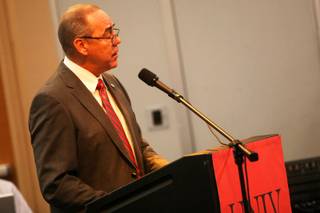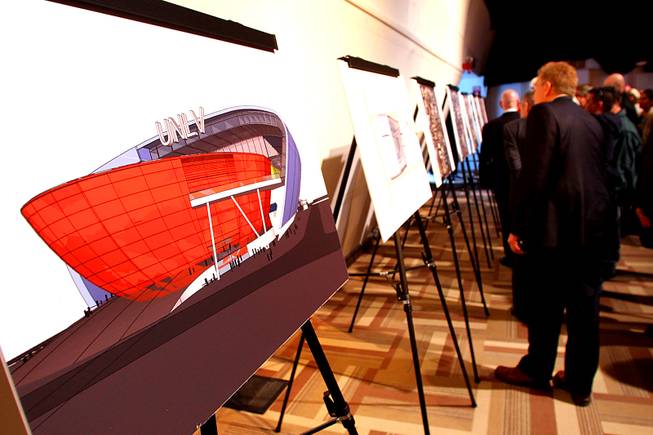
Invited guests look over conceptual renderings during a preview of a proposed on-campus, multi-use stadium for UNLV on Tuesday, February 1, 2011.
Thursday, July 28, 2011 | 2:05 a.m.
Proposed project location
Sun archives
- Developers continue push for UNLV stadium, retail district (2-1-2011)
- Developers put early plans for UNLV stadium, retail district on display (2-1-2011)
- Regents to hear UNLV arena plan for football, basketball (1-31-2011)
- Mayor: UNLV domed stadium wouldn’t conflict with a downtown Las Vegas arena (1-27-2011)
- Report: UNLV domed stadium plans will be unveiled Tuesday (1-27-2011)
- Goodman: Arena project a key issue for next Las Vegas mayor (1-20-2011)
- UNLV acknowledges effort to bring stadium, football to campus (1-19-2011)
Bobby Hauck wishes he was walking through a construction site at UNLV, wearing a hard hat and clutching blueprints that he struggles to decipher.
He’s more than ready to rearrange his hectic schedule to grab a shovel for a ground-breaking ceremony. He’s been thinking about it constantly since the winter, when an on-campus stadium for his football program was proposed.
More than just a football stadium, the project would span 150 acres and include 600,000 square feet of retail shopping, restaurants and student residences. The centerpiece would be the 40,000-seat domed stadium for football, which could be transformed to seat about 20,000 for UNLV basketball games and other events such as concerts, soccer, boxing and bullriding.
This would be a dream come true, the game-changer that would make UNLV football relevant, instantly taking the program from one of the worst in the nation to potentially a perennial top-25 team . Yes, I wrote it, a perennial top-25 team.
Playing eight miles east of campus at Sam Boyd Stadium has long been one of the major pitfalls in growing the program into a winner, with everything from the dirt parking lot to out-dated locker rooms used as excuses for the team’s shortcomings.
This would have changed everything. But ...
Some six months after the proposal was the talk of the town, the dim reality is setting in: It is a long-shot — let’s say 100-1 odds — worse odds, even, than the chances of the Rebels this fall winning the Mountain West Conference.
“It is something that a lot of us, me included, can get passionate about and fired up about,” Hauck said Tuesday during the league’s media day at Red Rock Resort. “I certainly hope for the betterment of UNLV itself we can move forward with that at some point.”
Finding creative ways to finance the multibillion-dollar project — the stadium alone is estimated at $600 million — is easier said than done amid the massive recession Las Vegas residents are painfully enduring. The economy is as bad as it’s been in 70 years, and it’s important to remember the project isn’t just about building a place for the football team to play.
It brings more housing and retail shops to a city that doesn’t need it — housing prices continue to drop and several retail stores have gone belly-up. It makes no sense to add more, even if the artist renderings look too good to be true.
The project took another blow in June when the Nevada Legislature didn’t approve a special taxing district that would have helped in being creative with the financing. This made it more difficult to find financing for the idea, which was proposed by Ed Roski, chairman and CEO of Majestic Realty and owner of the Silverton, and Silverton president Craig Cavileer.
If it were years ago, when the economy was booming, it would be a different story and UNLV would be playing games on campus.
Instead, a typical college football Saturday in Las Vegas is spent at a sports book rooting for your parlay to come in. The new stadium concept, funding aside, would have given the area a true feeling of college football.
Imagine how a game day would look and feel: the football players walking past a playing band and tailgating families into the stadium, a true home field advantage with more than 20 students in the crowd and plenty of good times after the game at the nearby restaurants.
“It is one of those things where having an on-campus venue, in terms of the collegiate experience and the atmosphere on campus, is a big deal,” Hauck said. “Football Saturdays are fun on campus. That is not to say we can’t have fun in our current venue. But to have a football Saturday on campus is really a cool part of the college experience. It would be a good deal for UNLV.”
Hauck, unlike former coach Mike Sanford, refuses to use Sam Boyd’s perceived weaknesses as an excuse. “Sam Boyd is a fun place to watch a game. There are good seats,” he said.
And that’s not Hauck toeing the company line. He is sincere. But he is also sincere about the benefits of a new stadium.
It’s something everyone would love to see, but don’t expect Hauck to learn how to read blueprints any time soon.



They need to just focus on building the stadium and nix the plans for the shopping and retail area. Just get the stadium built first and that will help create revenue later to help revatalize the areas around campus (Maryland Pkwy and Tropicana). An on campus football stadium would help boost UNLV football ten fold. No recruit wants to come play at a basketball school who has a horrible football facilities and no fan base. If you get the stadium built on campus that will make it easier for the students to get to the game and also fans throughout the valley to come out and cheer for the team. UNLV could be the next potential BSU, TCU, or Utah if that happened. Sam Boyd is outdated and located in the middle of nowhere. Build the stadium first and then focus on maybe revitalizing the area around campus with shops, bars and restaurants.
I second your comments, mj20. And, I would add that the creation of this facility would be key in the ongoing development (and survival) of UNLV as an academic institution.
Based upon the state of the economy in Nevada, UNLV will be best served by finding new and innovative ways to develop the funding necessary to accomplish its academic mission. This includes grant funding, fund raising, and commercial sources such as sponsorships.
In order to be in a position of strength to be able to do this, I believe that the University's athletic stature must be strong regionally. In particular, the football program must be prominent, as football 'drives the bus' in college athletics.
Las Vegas is a gambling town and this project is somewhat of gamble. But I think it is a gamble that is necessary for UNLV. Otherwise, like anything in the desert, it may wither and die.
I like Sam Boyd and would rather see them upgrade (and pave, etc. etc.) that facility. Frankly, I'm sick of driving that Airport by-pass traffic and Maryland parkway, shall we say, "inner city" zone and don't like going there when I don't have to. That's the problem with any urban campus. No one wants to "commute" there when they don't have to.
Leave the Stadium where it's at. If you want to draw recruits, build a state of the art weight room, players lounge, game film "theater" and practice facility. This is where they will be the majority of their playing career.
Schools like Notre Dame and others have old school stadiums with amazing practice facilities.
The Rebs have five home games this year. If you think five trips to Sam Boyd makes or breaks a recruit you are either intentionally obtuse or you have a personal financial interest in the dirt around the Campus.
UNLV has been missing the ship for some time in terms of what could have been. TCU, Utah, Boise St, in some respects BYU as well have all jumped ship because of either better opportunity or thinking their deal was rough with the MW. UNLV could easily have been a Utah or TCU had the facilities improved. However, that begins extremely early, and places such as Utah and TCU have a huge following of supporters and community members getting involved. Las Vegas not so much.
Think about this for instance. Wisconsin comes to town, and they get to the game and fill the stands. WAY more Wisconsin fans than UNLV fans. You don't see Wisconsin fans complaining that they have to fly 1700 miles to see their team play, or drive out to Sam Boyd to see the game. Hell, they even partied friendly at our tailgate. But that's the kind of support UNLV lacks.
Ever been to an SEC game by chance? I went to an Ole Miss/Auburn game a couple years back in oxford, and there were a sea of tents for people who couldn't get into the sold out game, and it becomes a day long event. Las Vegas has a whole lot more to offer than Oxford, yet locals don't seem to care what could happen if they got behind their school. I wonder what the money looked like when the sea of Wisconsin fans came into town not just at the game, but the casinos for sure make a pretty penny off all the tourists. It's a win-win for everyone if you can get teams to come to Vegas.
And what happens to that sea of Wisconsin, BYU, Hawaii fans or to bowl games (if ever get one again) when you build a tiny 40,000 seat stadium on campus?
@lvsreader Sam boyd is only about 36k seats...
40k is nothing to scoff at.
@sofakingbored - fair point but they've managed to pack over 44,000 people in there. What's the point of building a new stadium without room to grow into a more popular program or to host bowl games. If they say it can expand to 50,000+ seats, that would be a different story. The downtown stadium proposal started at 50,000 seats expandable to 70,000 seats. That's more like it.
See http://en.wikipedia.org/wiki/Sam_Boyd_St...
The author wrote "This would be a dream come true, the game-changer that would make UNLV football relevant, instantly taking the program from one of the worst in the nation to potentially a perennial top-25 team. Yes, I wrote it, a perennial top-25 team".
Really? I have followed (and liked) UNLV football for nearly twenty years, but are you kidding me? The latest Phil Steel guide has ranked UNLV this year at # 110 out of 120 programs, and dead last in the Mountain West. UNLV has been to exactly three bowl games in the entire history of its program, in 1984, 1994, and 2000. Since 1990 they have gone 76-167, and in the last ten years (starting with 2001) they have gone 4-7, 5-7, 6-6, 2-9, 2-9, 2-10, 2-10, 5-7, 5-7 and last year 2-11.
My family has had season tickets for a "perennial top-10 team" for forty-one years and here is some advice to UNLV -- start winning some games.
The nice thing about having loyal fans to a losing program is that many of the fans are extremely knowledgeable about the game and the program. The bad thing is, there just aren't many fans at all.
Winning changes all of that.
Building a new stadium will no sooner save UNLV football than Neonopolis saved Freemont Street.
Some good, clear-headed posts by Lvsreader, Getalife, and rjh1968.
While I understand the hopes of Coach Hauck, he's the only one pining for this boondoggle that I can excuse. The rest are just pump-n-dump developers who have their greedy, beady eyes on diverting a tax stream to their private coffers, in addition to stealing our publicly-owned real estate. Oh, and a UNLV president who must have legacy stars in his eyes, he touts this so.
Like the others said: Spruce up Boyd, give the players state-of-the-art training facilities, and be realistic about what we could ever really expect to come of all the rest of this noise.
Lvsreader is right to be concerned about building a stadium that doesn't offer a large increase (or the future possibility of such) in seating because that could make the success of the3 facility an liability.
By the same token, building a larger stadium downtown is just another way of spending money to actually recreate the same problems. Those who point out who popular football Saturdays are at places like Auburn, Ole Miss and Notre Dame should note that all those schools have ON CAMPUS STADIUMS. Even schools that don't perform well foster a following in their programs, an accessible facility that is actually part of campus is largely responsible for that.
This is a large part of fostering a sense of community at a university, and UNLV lacks that. Without that, students simply pass through the university and form no attachment to it. That type of college experience doesn't lend itself to alumni returning for "The Big Game." It doesn't lend itself to graduates becoming donors and leaving endowments to the University. It doesn't lend itself to prospective students viewing UNLV as able to provide the "typical college experience."
The Athletic department has already shown they have the tools to make their facilities not only pay for themselves, but they actually make money for the entire state.
The 2010 NCAA Report disproved the myth that Div. 1 football programs -- let alone school athletic programs -- pay for themselves. Only the top 10% of programs (I believe the number was) generate enough income to pay for themselves. And what is usually left out of the math, by those claiming football programs are profitable, is the huge subsidies required by a given school to sustain the football programs. The biggest subsidy is the free tuition, room, board and expenses given to sometimes over 100 players (red shirts and all) in a football program, each year.
Right on the money rjh... winning will cure of the drama, can't get the cart in front of the horse.
@DTJ....That 2010 NCAA Report also listed UNLV as the fastest growing program financially. Currently the UNLV Athletic Department receives about $7 million dollars in state funds. However, the state receives far more than that in the way of event taxes from events held at the UNLV facilities. In fact the NFR alone more than more than covered the state's expense.
When former UNLV Athletic Director, Dennis Finfrock, passed away in 2009 he was credited with bringing more than $1 Billion dollars into the Southern Nevada Economy. These were funds that would not have been raised had Finfrock taken his expertise and vision to another university.
Would George Maloof had invested in the casino industry had he not come to UNLV to play football?
BGHS,
I don't recall any mention of THAT in the NCAA report, let alone in the local media. You'd have to show it to me, in which case I'd be happy to review it.
That notwithstanding, and all the subsequent things you bring up have taken place WITHOUT a football stadium on campus. WITHOUT. And does the $7 million include the amount of money required to operate all these facilities? Does it include all the money paid out to each of the students receiving full-ride or partial-ride scholarships? I'm betting it does not.
DTJ...You would have lost that bet.
Here is a list of The Top 100 Revenue Schools in the NCAA for 2009-10(http://goo.gl/Fp1dh).
UNLV ranked 39th, sporting an amazing 84.6% growth in revenue. Check this out (http://goo.gl/9YaCx) for a pretty detailed look at the 2009-2010 Athletic Department budgets for every major University in the NCAA. You will see that both the operating costs of all the sports facilities as well as the costs of the athlete's scholoarships are all included in the department's 59,143,059.00 budget, with between $7 and $8 million coming from the state.
But as I posted earlier the revenues generated from the state entertainment tax on each ticket sold at the T&M, Cox Pavilion and Sam Boyd Stadium by far exceeded this amount. And while UNLV has been able to accomplish this "WITHOUT a football stadium on campus." Keep in mind that the NFR is dangerously close to outgrowing the Thomas and Mack. Since the taxes generated from this event alone cover UNLV's state funding we can't afford to lose that event.
An on campus stadium would be sweet but I'm not sure the Rebels deserve it. I would like to see some consistancy with the progam first. I'm sure it would help some when it comes to recruiting but I dont believe that it becomes the tipping point for UNLV. Yes, Sam Boyds dirt parking lots suck, the bleachers are uncomfortable, and it's next to a swamp but none of those things cause us to have one of the worst defenses in all of college football year in & year out. The 8 mile drive from campus doesn't cause our offensive players forget that they are supposed to be playing D1 football. I hope Coach Hauck can turn it around but I would rather see some W's before anything else.