Wednesday, July 6, 2011 | 2 a.m.
Sun Archives
- Blocking guns’ path to Mexico (10-28-2009)
- Man pleads guilty to buying guns in Vegas bound for Mexico (10-26-2009)
- U.S. guns are crossing border, but how many? (6-25-2009)
Related Document (.pdf)
BY THE NUMBERS
2 percent — Share of the guns from the United States that originated in Nevada. The majority of firearms come from the border states of Texas, California and Arizona.
Two years ago, the case of Zorra Penunuri put Las Vegas on the national map in the fight against cross-border contraband.
The gun-smuggling kingpin from Southern California had purchased $100,000 worth of rifles and pistols from Las Vegas gun dealers to shuttle to drug cartels in Mexico, where the weapons would be used in the proliferation of an illicit drug industry that reaches into most U.S. cities.
The case came from a federal program known as “Project Gunrunner,” in which agents with the federal Bureau of Alcohol, Tobacco, Firearms and Explosives attempt to trace and reduce the flow of firearms across the Southwest border. Penunuri was sent to federal prison after a U.S. District Court trial in Las Vegas in 2009.
Last fall, ATF announced that Las Vegas would be added to the list of border districts receiving special funding to fight and track cross-border crime, in a $37.5 million initiative to expand the program by seven cities.
But since then, not a dollar has landed. And as the fiscal year creeps to a close on Sept. 30, it’s more likely that the money Las Vegas was promised to fight drug-related gun violence won’t be coming.
Project Gunrunner has been making headlines the past few months under a growing scandal involving the Gunrunner operation known as “Fast and Furious.” In what appears to have been an effort to trace weapons to more high-profile targets in Mexico, ATF officials allowed sales of certain flagged weapons from U.S. gun retailers to proceed to “straw” buyers — and one of the guns purchased in such a transaction was used in the December killing of a U.S. Border Patrol agent in Arizona.
Since then, congressional scrutiny has focused on programs such as Fast and Furious and the ATF’s operations in general, and accusations are flying that the agency allowed guns to be “walked” across the border to pad its statistics.
The political fallout means Las Vegas is likely to get short shrift on aid to combat its drug violence problem.
The entire gunrunner initiative has been walking a political tightrope as the country figures out how to spend sparse dollars. The ATF’s budget didn’t expand as expected at the beginning of the 2011 fiscal year, because the government only funded itself under a continuing resolution through April. And the budget that’s now guiding the federal government reflects cuts more than cash influxes.
But the program isn’t just another casualty of bipartisan budget debates; even the Obama administration in January seemed ready to reduce if not kill its funding.
In a preliminary budget proposal first reported in the Washington Post, the president's advisers suggested slicing $160 million out of the ATF’s budget — a cut that would be 4 percent below current spending levels. But the ATF worried even that small of a cut would eviscerate the Gunrunner program because it’s so new: layoffs usually hit the newest hires, and the program has been around only since 2006 — 2005 if one counts the pilot stage. The president's final fiscal 2012 budget request actually raised ATF's allocation from fiscal 2010 levels by $26 million, or about 2 percent.
The administration suggested slicing $160 million out of ATF’s budget — a cut that would be 4 percent below current spending levels. But the ATF worried even that small of a cut would eviscerate the gunrunner program because it’s so new: layoffs usually hit the newest hires, and the program has been around only since 2006 — 2005 if one counts the pilot stage.
It’s not that the administration decided to get lax about gun control. Around the same time, President Barack Obama approved an ATF rule that would require gun shops in Arizona, California, New Mexico, and Texas to immediately report any bulk sales of semi-automatic weapons, the weapon of choice for cartels. The rule exists for bulk sales of handguns. The rule did not extend to Nevada.
But the step seemed to indicate that the administration had no plans to expand its project from the border anytime soon.
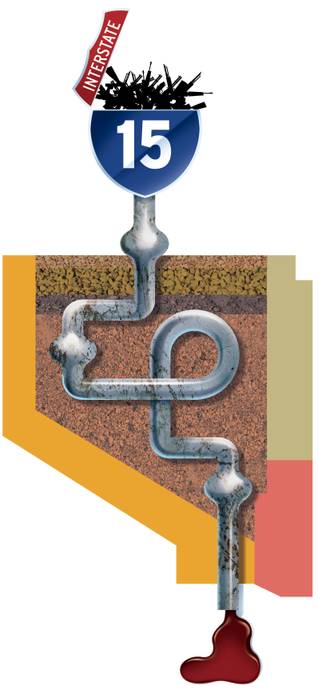
Las Vegas is certainly not a border town, but drug use is prevalent and its proximity to smuggling and transit routes — Interstate 15 links Las Vegas to the San Diego-Tijuana border — makes it a hub for contraband trade.
When ATF announced its intent to send federally funded Gunrunner teams to seven new cities last year, the list skewed toward places such as Las Vegas: off the border, but along the internal routes. The list included Atlanta, Dallas, Miami, and Oklahoma City.
Brownsville, Texas, and Sierra Vista, Ariz., were the only border towns flagged for the $37.5 million, and the only cities to have received any of the money so far.
“Due to the limited funding, ATF had to prioritize the order in which the Gunrunner groups were to be opened,” an ATF official said. “The offices in Sierra Vista, Ariz., and Brownsville, Texas, were opened first because they did not have existing enforcement groups.”
The ATF has an office in Las Vegas, run by resident Agent-in-Charge Thomas Chittum, who concurred that the department has been working on the issue, “even before the announcement of Gunrunner and additional assets, with whatever resources we have.”
But, Chittum added, the drug and guns trade is “still a very real concern for us here in Southern Nevada,” and said getting additional money and personnel “is still a very high priority.”
Part of the allure of a program such as Gunrunner is its dual focus: The ATF focuses on the guns, but the guns are directly connected to the drugs.
In Las Vegas, the drugs are the more visible cross-border problem, according to a spokesman for Metro Police.
Metro is one of 17 local, state and federal organizations with bases in Clark and Washoe counties that have pooled their attention under one other federal program, the national drug control policy’s high intensity drug trafficking areas initiative.
Nevada has, since 2001, been one of 32 target zones in the U.S. and its territories to be designated a high drug-trafficking area, a label that brings with it ideas for synergizing local efforts, and $3.2 million a year to do it.
“We’re the catalyst for forming task forces to get all of the agencies to work together toward a common goal,” said Kent Bitsko, who directs the effort in Nevada.
Drugs have been on the upswing lately in Nevada, he said. And so has the related take of guns.
But connecting the dots between the drug violence that exists in the city and an origin point across the border is trickier business in Las Vegas than it is elsewhere.
“You can’t link them directly, because usually it goes through Los Angeles or Phoenix or Tucson,” Bitsko said. “But our drug business is controlled by about 95 percent Mexican nationals. Not necessarily cartel members. But they do have a connection to Mexico.”
Compared with other cities, Las Vegas’ drug and related gun trade is small. But apprehensions suggest that problem is growing.
Heroin is the drug of choice in Las Vegas, said Bitsko, who used to work narcotics for Metro. Three years ago, police were only seizing about one or two kilos a year, he said; this year, they seized 14.
His office also keeps records on how many guns are seized in conjunction with drug operations. In 2010, there were 172; in the first quarter of 2011, law enforcement officials already grabbed 89.
But even as Las Vegas’ profile on the cross-border drug and guns trade gains more national attention, it’s not translating into increased federal help.
Funding for the high-intensity trafficking initiative in Nevada hasn’t changed in three years. Bitsko says the funding is adequate.
Hope is fading that extra ATF money and personnel will be allocated to Gunrunner.
Chittum said he doesn’t have any information about whether Las Vegas will see the money — although how much of the $37.5 million Las Vegas could have expected to see was never clearly laid out.
Such calculations may be moot at this point, given that the funding expires at the end of the fiscal year — in 12 weeks.

Join the Discussion:
Check this out for a full explanation of our conversion to the LiveFyre commenting system and instructions on how to sign up for an account.
Full comments policy