
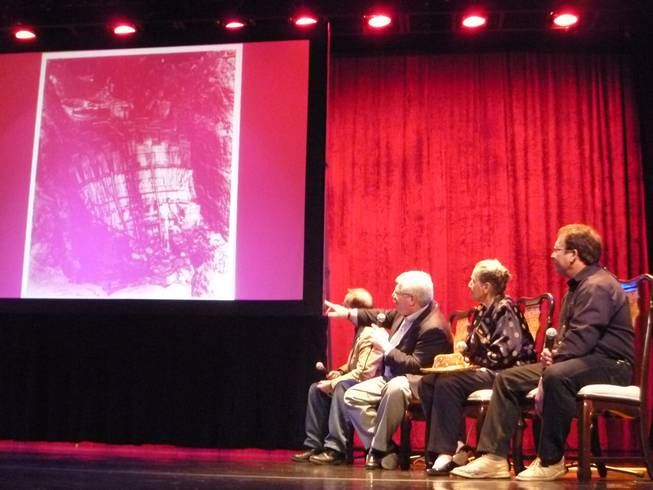
Michael Hiltzik, second from left, talks about Hoover Dam’s construction at Friday evening’s history panel at the Boulder City Chautauqua. Hiltzik, two Nevada historians and Laura Kelly Smith, a lifelong resident, discussed the city’s early years and its relationship to the dam.
Saturday, Sept. 18, 2010 | 2:05 a.m.
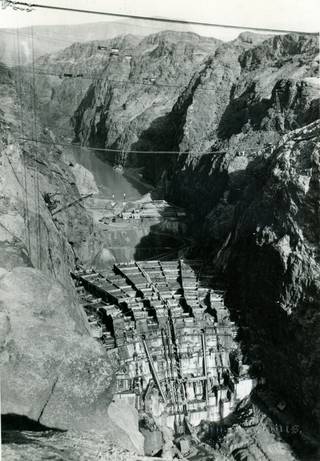
Out of the depths of the Great Depression, supported by the construction of Hoover Dam in the Black Canyon, Boulder City was born.
So on Friday at Boulder Theater, a panel of historians, joined by a lifelong resident of the city, reflected on the connection between town and modern marvel. The discussion marked the opening of Boulder City’s annual Chautauqua, themed “That Dam Depression” to commemorate Hoover Dam’s 75th anniversary.
An almost full-capacity crowd listened to Michael Hiltzik, a Pulitzer Prize winner and author of “Colossus: Hoover Dam and the Making of the American Century;” Nevada historians Guy Rocha and Dennis McBride; and Laura Kelly Smith, whose parents owned the first private house in Boulder City.
Michael Green, a professor at the College of Southern Nevada, moderated.
Guided by a slideshow of contemporary photographs, the panel toured Boulder City in its infancy.
Thousands of unemployed workers flooded the Las Vegas Valley from every corner of the country, families in tow, to find work when construction on the dam began in 1931. More than 100 of them eventually died working on the dam.
As Six Companies, the project’s contractor, tried to deal with the influx of workers and their families, Boulder City emerged. The panel dissected this relationship between the town’s development and the dam’s construction.
Families moved from tents and temporary settlements in “Ragtown” to permanent homes along the city’s oldest streets. The theatre was built in late 1931, and a school was erected.
Hiltzik described some of the engineering feats the builders achieved, such as the more than 250 concrete columns that form the dam’s skeleton.
They also told some more unusual tales of the city’s early days. McBride said that because the corporate-built houses all looked the same, men coming home from work would often park in the wrong driveway and walk into the wrong house.
Smith recalled the unfortunate death of Parson Thom, one of the founders of Grace Community Church, who was hit by a car while crossing the street to deliver chili to hungry crowds at the church.
And Hiltzik detailed how Six Companies used the schoolchildren as leverage against the federal government for tax exemptions.
Before the panel took the stage, Lynn Laughrey Mobley, another lifelong resident who graduated from Boulder City High School in 1946, recounted her memories to the audience in a taped interview.
She recalled running from the bottom floor of the elementary school, now City Hall, to see Franklin D. Roosevelt cruise by in an open car before he dedicated the dam on Sept. 30, 1935.
Mobley said she watched the dam, initially referred to as Boulder Dam, open for the first time and the waters of the Colorado River rushing through it. “It was a big thrill,” she said with a smile.
 Explore Las Vegas’ past and present
 Boomtown: The Story Behind Sin City
 Neon Boneyard: A 360° look
 Mob Ties: See the connections
 Implosions: Classic casinos crumble
Join the Discussion:
Check this out for a full explanation of our conversion to the LiveFyre commenting system and instructions on how to sign up for an account.
Full comments policy