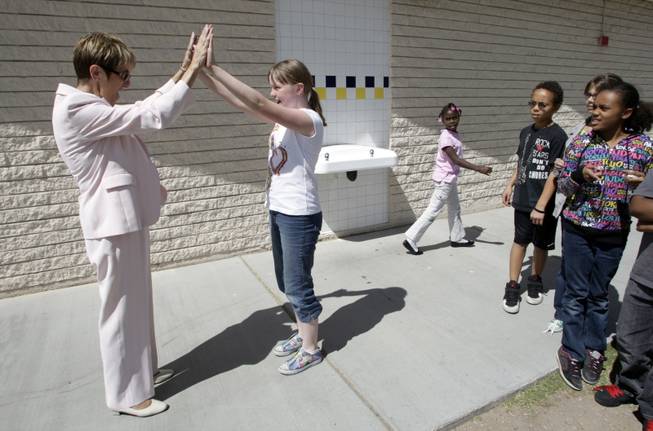
Fifth grader Vanessa Dickey, right, shows a dance she and a friend created for Principal Sherri Brewer, left, at Gilbert Elementary School Wednesday, May 12, 2010. Brewer will retire at the end of the school year. Gilbert, a magnet school for communication and creative arts, was recently named the top magnet school in the country.
Monday, May 17, 2010 | 2 a.m.

Sun Archives
- School District again taking heat for unequal achievement (8-16-2009)
- Airing of charter tensions set (2-20-2008)
- Charters aimed at minorities (8-7-2006)
Sun Coverage
Beyond the Sun
Gilbert Elementary Magnet School
By all measures, Gilbert Elementary Magnet School for Communication and Creative Arts is a success story.
The North Las Vegas campus boasts a diverse student population with high test scores in all core subject areas, an active PTA and almost no staff turnover. For the 2010-11 academic year, more than 1,200 students applied for 100 open seats.
And last week another honor was added, as Gilbert was named the nation’s top program by Magnet Schools of America.
For Principal Sherri Brewer, who will retire this summer after more than 20 years with the Clark County School District, the national award is a validation of the positive influence the arts can have on young children.
“We have very few discipline problems here, and I honestly believe it’s because everyone is engaged and busy all the time,” Brewer said. “This is a very happy school.”
It’s also a school many people — including district officials — say should be replicated in other parts of Clark County, so more students can access similarly specialized programs. Steps are being taken toward that goal, albeit at a slower pace given the district’s uncertain fiscal outlook.
The district is considering moving to an open enrollment policy in 2011, which would allow students to apply to a campus other than the one to which they are assigned. Ideally, open enrollment would promote competition among schools, and encourage campuses to develop specialized programs that would attract a wide range of students.
But there probably won’t be enough money to provide transportation with open enrollment, raising questions about fairness because not every family will be able to get their children to and from school without the district’s help. That leaves the magnet programs (which do provide transportation) as the most flexible option for students looking for something different from what their neighborhood campuses has to offer.
To be sure, Gilbert is just one example of the district’s successful magnet program. Applications exceed available spaces across all grade levels.
For the elementary magnets, there are no academic requirements for acceptance. Students are placed into a lottery, with a quarter of the seats set aside for children living in the immediate neighborhoods surrounding the campus. The middle and high school magnets — which include the career and technical academies — require students to meet certain academic requirements before they can qualify for the lottery, again with “neighborhood” seats set aside.
For the 2010-11 academic year, 2,337 elementary school students competed for 682 open seats at five campuses. At the middle school level, 4,502 students competed for 1,486 seats at six campuses. And at high school magnet programs, 9,634 students competed for 6,453 seats at 13 campuses, including the six regional career and technical academies.
The numbers suggest a stiff degree of competition. The percentage of the district’s more than 308,000 students who are in magnet schools remains fairly low.
That’s something the district wants to change.
Several new federal grant programs, offering tens of millions of dollars to Nevada schools, would require drastic reorganization and reform. The district is considering expanding its magnet school opportunities, particularly at the elementary level, as one route toward remaking its lowest-achieving campuses.
Clark County has a record of success with its magnet programs. Sandy Miller Elementary was the nation’s top magnet school in 2009, and Advanced Technologies Academy has been honored repeatedly by the U.S. Education Department as a “Blue Ribbon School,” the highest possible designation. Hyde Park Middle School’s students routinely win state math and science competitions.
Magnet schools are not for every student, though; they require an interest in a particular area such as mathematics, science, the fine arts or international studies. In many cases the expectation of parental involvement is greater. It’s not uncommon for students to brave lengthy commutes to school. Gilbert draws students from as far away as Boulder City.
Although magnet schools receive the same per-pupil funding as “regular” campuses, the programs are often supplemented by private donations and grants (the U.S. Education Department provides startup money that expires after three years).
However, it’s up to the individual schools to secure those dollars. At Gilbert, relationships with local businesses keep the dance studio well stocked with tap shoes. Volunteers help to make the costumes for numerous campus productions. A partnership with the new Smith Center for the Performing Arts is helping bring guest artists to campus to perform and work with students.
But it’s the staff, many of whom work evenings and weekends and take on extra duties without extra pay, who keep the ball rolling, Brewer said.
“Everyone wears lots of different hats here,” Brewer said. “If you’re a person who would rather not work beyond the regular contract day, this probably isn’t the place for you.”
For Daun Korkow, who has spent his entire 29-year career teaching at Gilbert, the extra effort is worth it. While the school focuses on the creative arts — students produce daily news broadcasts and learn the fundamentals of the performing arts, among other skills — it’s not about training students for careers in the limelight, Korkow said.

A view of the broadcast studio at Gilbert Elementary School Wednesday, May 12, 2010. The students at Gilbert use the studio for a live, news broadcast every school morning, said Daun Korkow, director of the morning news show and theater manager. Gilbert, a magnet school for communication and creative arts, was recently named the top magnet school in the country.
“This is about life skills,” said Korkow, the school’s magnet theme coordinator. “It’s about how to communicate and get your point across, and how to have confidence in who you are.”
Magnet schools are criticized for snagging talented students and their highly engaged parents from conventional campuses. Billie Rayford, the associate superintendent who supervises Gilbert, said that’s not the case.
“Magnets represent one type of alternative for students who might be interested in particular area or theme,” Rayford said. “It’s not what every student wants.”
But the district recognizes that demand is outstripping the supply of magnet seats. Plans are under way to survey families to gauge the most popular academic interests and to begin converting campuses to support those programs, Rayford said.
The potential benefits of magnet programs to students, particularly minority students from low-income households, are well documented, said Mike Petrilli, vice president for national programs and policy at the Thomas B. Fordham Institute, a Washington, D.C.-based think tank.
“If there’s a successful magnet program in Clark County, the question shouldn’t be whether to keep it, it should be how to replicate it,” Petrilli said. “It’s critical that there be places within the public education system where high-achieving kids can be challenged and fulfill their potential. It’s hard to do when the traditional setting is focused on mastering the basics.”

Join the Discussion:
Check this out for a full explanation of our conversion to the LiveFyre commenting system and instructions on how to sign up for an account.
Full comments policy