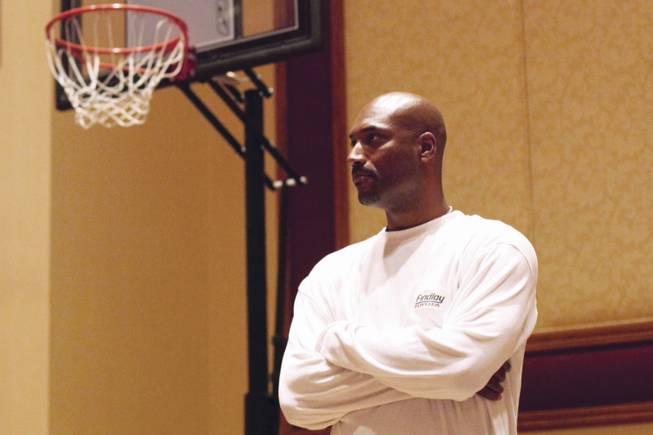
Henderson resident and former UCLA basketball star Ed O’Bannon particpated in a free throw shooting contest as part of a kickoff to the NCAA tournament at the South Point. O’Bannon is part of a class action lawsuit against the NCAA over a video game using his likeness.
Friday, March 19, 2010 | 2:01 a.m.
A multimillion-dollar federal class action lawsuit with the potential to radically change the NCAA is rife with poetic justice for fans of UNLV basketball.
The lead plaintiff is Ed O’Bannon, who has lived and worked in Henderson for the past seven years. But in his prior life as a basketball player, he led the UCLA Bruins to their 1995 NCAA championship.
That team is one of several featured in EA Sports’ video game “NCAA Basketball 09.” Last year a friend had O’Bannon sit down to watch his old team — and himself. The game includes a video character who looks like O’Bannon, shoots left-handed as O’Bannon did and wears O’Bannon’s No. 31 — a number UCLA retired in his honor.
“My friend said, ‘The funny thing about this is you didn’t get paid,’ ” O’Bannon recalls. “He laughed pretty good and I just sat there thinking, ‘Wow, that’s true.’ My reaction was a little bit of embarrassment, but I was also disappointed that no one told me that they were going to be using my likeness to make this video game. They never sent me any paperwork. I didn’t release my face or my likeness.”
The more O’Bannon thought about it, the more convinced he became that what the NCAA and the video game company had done was wrong. He filed a lawsuit last year seeking compensation for all the times that his image appears as a member of the 1995 Bruins in the ever-expanding world of mass media and merchandising. His suit has been joined by 15 former collegiate basketball and football players.
Although none of the plaintiffs attended UNLV, the school is mentioned in the lawsuit. The 1991 Rebels, which made it to the Final Four of the men’s basketball tournament, is one of the “classic teams” featured in “NCAA Basketball 09.”
But that’s not the only UNLV tie to this.
The coach of UNLV’s dominant teams of the early 1990s was Jerry Tarkanian, who also took on the powerhouse of amateur athletics, but for different reasons. Tarkanian’s long battle with the NCAA — one that went all the way to the U.S. Supreme Court — had to do with what he argued was selective enforcement of rules and lack of due process by the association when it punished him and his teams.
O’Bannon was part of that.
He was a hot Southern California prospect who was heavily recruited by Tarkanian and had verbally committed to play for UNLV. That was, until the NCAA placed the school on probation for recruiting violations, releasing O’Bannon from his verbal commitment and landing him at UCLA.
O’Bannon, a 6-foot 8-inch forward, went on to claim the prestigious John Wooden Award as the nation’s best collegiate basketball player in 1995.
“I always felt the NCAA was unfair, selfishly speaking, because I worked as hard as I could personally to become one of the top recruits in the country, O’Bannon said. “And I finally got my opportunity to play at a major university. And at the time, what kid didn’t want to go to UNLV? They had just won a national championship and were on pace to win another one.
“So I knew that I was going to be part of a great opportunity to do something special in college basketball. At that time, I felt the NCAA took that from me. I was upset.”
O’Bannon, 37 and a father of three, is active in local youth sports and works as a marketing and sales representative for Findlay Toyota. His office is decorated with a framed version of his college jersey, basketball photos and posters. A small 1995 championship banner hangs over his computer.
He — and UNLV — might have had a championship banner from 1991 if not for the NCAA, which Tarkanian as recently as January derided as “the crookedest organization in our society.”
O’Bannon doesn’t go that far. He just says, “Student-athletes nowadays need to stand up and say that what the NCAA is doing is wrong.”
“The athletes are the ones performing,” O’Bannon said. “They’re the reason people go to the games. When the players are being taken advantage of, that’s not a fair shake at all.”
The plaintiffs are not out to disband the association. They’re only interested in compensation for current and former college players whose likenesses appear in video games. And they want former players to share profits from sales of jerseys, photographs, DVD recordings, Web site content and broadcast of classic games on television.
O’Bannon never got paid for rebroadcasts of his UCLA games as he did after college when he collected residual checks for reruns of his occasional appearances in TV sitcoms.
“If I got checks for that, why wouldn’t I get them for basketball?” he says. “Someone is getting compensated, but not the ones performing. Why is that?”
If the plaintiffs win, possible ways they say proceeds could be divided among athletes include group-licensing similar to what is employed in professional sports, or funding for health insurance, additional educational or vocational training, or pensions.
“I would love for players to control their destiny in the sense that once they leave school, they can use their likeness in any which way they want and if it’s used, it’s used by their permission,” O’Bannon says. “I’m in favor of everyone making money. I would just like it divvied up in a fair amount.”
Sounding Tarkanian-like, the plaintiffs argue the NCAA, in conjunction with its commercial licensees, operates as an illegal “cartel” that engages in a conspiracy to prevent athletes from sharing in the profits. They say the NCAA’s strong-arm tactic is its requirement that student-athletes annually sign forms authorizing the NCAA or a third-party acting on its behalf to “use your name or picture to generally promote NCAA championships or other NCAA events, activities or programs.”
O’Bannon attorney Jon King of San Francisco says this language is vague, but has been used by the NCAA to deny compensation to athletes for use of their image, even in the decades following their collegiate careers. In doing so, the lawsuit alleges, the NCAA is violating its own constitutional principle of amateurism, one professing that “student athletes should be protected from exploitation by professional and commercial enterprises.”
But NCAA spokesman Bob Williams said O’Bannon and his colleagues don’t have a legitimate case.
“The NCAA doesn’t preclude Ed O’Bannon or anyone else from profiting off their likeness once they complete their eligibility,” Williams says. “They can sign autographs and are free to do whatever else they wish.”
The only thing Williams says he isn’t sure about is whether the athletes could profit from selling memorabilia featuring their team’s name or logo, since he said those marks are owned by the respective universities.
As for depictions of championship games, Williams says those are copyrighted by the NCAA and O’Bannon “has no right to that.”
One interesting aspect of the lawsuit is that it will require the NCAA to open up its books over the next six to nine months of discovery in the run-up to a possible trial as early as next year. The lawsuit states that the NCAA generated $614 million in revenue for the 2007-08 school year, but spent only $59 million to operate actual games.
Williams says he doesn’t think the books will show that the association enjoys a lavish windfall of money. But King thinks otherwise, saying the NCAA has benefited from “excessive commercialism.”
“Some of their personnel fly on private jets and they’re living the good life,” he says.
O’Bannon’s take: “The NCAA has always been wrapped up in the issue of money. Because the revenue is so high now and there are more games on television, everyone is getting paid more now. There are more ways to sell the product nowadays. It’s unfortunate that amateur players are being exploited and not being compensated. Everyone is making money, the NCAA, the television networks — everyone except the ‘product.’
“Maybe athletes shouldn’t get paid while they’re in school. I understand that. They’re on scholarship. But once we leave, why can’t we take our likeness? Why can’t we see some compensation for what we did while we were in school? Why is it that once you’re done, the NCAA can continue to take your likeness and sell it and continue to make money off it? That is beyond me.”
The plaintiffs argue that the video game producers, for example, promote realism to drive sales of their products, so much so that the athletes are mimicked down to their arm bands, hair styles and skin color.
Those are reasons why Electronic Arts of Redwood City, Calif., which produces the EA Sports lineup, is a defendant in the lawsuit. The company has argued in court documents that under the First Amendment it can produce “expressive work” that incorporates an individual’s likeness as long as the work is “transformative,” meaning the games involve more than mere likenesses.
Another defendant is the Collegiate Licensing Co. of Atlanta, which the lawsuit says manages the licensing rights for client universities and other institutions that generate more than $3 billion in annual sales and more than three-quarters of the college licensing market.
Williams’ response: “The NCAA doesn’t license likeness in any way or the intellectual property that belongs to the teams. Each individual school owns its own mark.”
O’Bannon, though, won’t back down from his position, which he sees as one of fundamental fairness. In that regard, he enjoys flashing a Tarkanian-like streak in his new hometown.
“I wouldn’t have it any other way,” O’Bannon says. “I’m very proud of the stance that I am personally taking in this case. This is where I am today and why I’m here.”

Join the Discussion:
Check this out for a full explanation of our conversion to the LiveFyre commenting system and instructions on how to sign up for an account.
Full comments policy