Thursday, March 11, 2010 | 2 a.m.
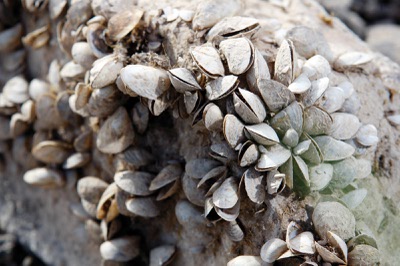
Dead quagga mussels are clustered on a rock at Lake Mead last year. The mollusks release toxins that can move up the food chain.
Sun archives
- Wary of invasive species, hatchery suspends operations (1-20-2009)
- Mussels’ last meal (6-20-2008)
- Get rid of pest? Not if it turns tap water pink (7-21-2007)
- Mussels now contained but need monitoring (1-18-2007)
- Lake Mead mussels identified as quagga, not zebra (1-13-2007)
THE WORST INVASIVE SPECIES IN NEVADA
Invasive annual grasses, such as red brome and Mediterranean grass
These grasses were introduced to North American from Eurasia in the 1800s. They have no natural enemies and thrive in Southern Nevada’s warm, dry environment. These grasses largely enabled fire to spread in the major 2005 wildfire season in Southern Nevada. As the grasses mature, a layer of highly flammable thatch accumulates around the plants. This helps wildfire spread from shrub to shrub across the desert, allowing the desert to burn in areas where it rarely burned in the past.
Salt cedar, also known as tamarisk
This shrub crowds out or replaces native wetland vegetation, resulting in the wash and river corridors being salt cedar monocultures rather than diverse communities of indigenous cottonwoods, mesquite, and other native species. Salt cedar invasions usually result in a rapid decline in the area population of other plants and animals. Research indicates that salt cedars consume far more water in drought years than native trees on an acre-by-acre basis. Estimates suggest that removing salt cedar from the Lake Mead National Recreation Area would restore enough water to satisfy the needs of 72,000 Las Vegas residents.
Quagga mussels
These little clams threaten access to Las Vegas’ main water supply and water quality. The mussels have no local predators and breed year-round in the relatively warm waters of Lake Mead, so the colony is growing extremely quickly. They must regularly be manually removed from drinking water intakes, boat hulls, hydro power infrastructure and piers. As the mussel colony matures, it could also hurt water quality. The clams excrete concentrated pellets of toxins they absorb from the lake’s water. These can be eaten by fish and crustaceans and work their way up the food chain. The quaggas also eat the kind of algae that keeps lake oxidation in check and cause another, toxic, kind of algae to thrive. This could eventually negatively affect everything from sport fishing to swimming in the lake.
Tall Whitetop/perennial pepperweed
This noxious weed has invaded waterways across Northern Nevada. Like the salt cedar, it chokes out native plants. This directly results in fewer waterfowl, deer, elk and other wildlife. It also reduces grazing on the land, forcing ranchers to pay to remove it and graze stock elsewhere until native vegetation can return.
Yellow starthistle
This weed infests wild lands in the northern half of the state, decreasing habitat for sport game and livestock grazing. It also makes land inaccessible for recreation.
Leafy spurge
Another major problem weed in Northern Nevada, where it dominates native landscapes, reducing habitat and forage for wildlife.
Everyone agrees that Southern Nevada needs to get rid of the quagga mussels that threaten to ruin Lake Mead, the foreign grasses that fuel wildfires and salt cedars that steal precious water and choke out native wetland vegetation.
The problem is that rooting out invasive species is extremely expensive.
Just mapping where all the land-based ones are in Clark County, for example, would cost around $1 million, says UNLV researcher Scott Abella, who studies Southern Nevada ecology.
Removing them costs around $100 an acre. To keep the invasives out, you’ve got to rapidly reintroduce native species. That can cost several hundred dollars more per acre.
The expense continues even after that, however. Like all living things, invasive species adapt to changes in their environment. They find new ways to survive. That means land managers need to continue to be vigilant even after they think they’ve eradicated invasive species, and researchers “need to keep up to date on the technologies we have for dealing with exotic species as threats,” Abella says.
For the quagga mussel infestation, the big costs right now are for research to figure out the best way to get rid of the clams, or at least control them. Officials haven’t even begun calculating the costs of whatever action is necessary.
Because of the massive price tags that come with battles against invasive species, Senate Majority Leader Harry Reid is taking another run at establishing a federal program to provide low-interest loans for the efforts.
He introduced the Invasive Species Emergency Response Fund Act on March 3.
The fund would provide low-interest loans to federal, state and local government entities, researchers, Native American tribes or private individuals for invasive species prevention and management. The bill calls for $400 million in loans over the next five years. The first loans would go out to Western states, which face millions of dollars in negative economic impacts from invasive weeds, insects and animals.
“For any other emergency, people can dial 911,” Reid says. “This legislation provides something comparable for first-line responders who work to prevent and fight against noxious pests.”
The bill is designed to promote better wildlife management, preserve water resources, reduce changes to wildfire habitat and protect ecological gems of the West, Reid’s office says.
Invasive species and habitat researchers would have preferred grants over loans, of course, but they still hail the legislation because it could provide the financial resources needed to fight exotic species at the early stages of invasion, before removal costs get out of control.
Some of the heaviest economic burden falls on ranchers, who must keep invasive weed populations down to maintain the quality of grazing land. Cooperative extension studies show that for every year weed elimination is put off, the cost to treat it grows.
An ongoing invasive species elimination trial in Douglas County that started in 2000 found that the cost of battling Tall Whitetop rose from about $12,647 to start removing the weed in year one, to as much as $36,121 to start removing the invasive weed in year four. The areas left for 10 years are expected to cost up to $174,350 to restore.
But as expensive as fighting the invaders is, the price to be paid if they win out will be higher, many warn.
The fire cycle in the Great Basin has shortened from 25-50 years to only 3-5 years as a direct result of the takeover of invasive weeds, Reid’s office says.
“Invasive species are real threats,” Abella says. “In Southern Nevada alone, fires fueled in large part by exotic species have threatened homes and other structures and changed the landscape for centuries over vast areas such as at Red Rock. Species like the quagga mussels have major potential for disrupting human activities like drinking water pumping or hydro power at Lake Mead.”
Nevada loses up to $17 million a year in recreation value due to invasive species and could lose as much as $34 million over five years if the invasive species invasion isn’t curtailed, according to information from the University of Nevada Cooperative Extension.
Nevada is not is the only state with major invasive species problems. More than 16 million acres of Western rangelands, for example, are heavily affected by alien plants, with 2,300 additional acres invaded each day, Reid’s office notes.
The dangers posed by the invaders is widespread and well-known enough now that Reid hopes he can muster enough support for his loan fund proposal. A similar one he introduced in August 2007 went nowhere.

Join the Discussion:
Check this out for a full explanation of our conversion to the LiveFyre commenting system and instructions on how to sign up for an account.
Full comments policy