Clean Water Coalition balks at localities’ request to return cash
Sewer service customers have been paying toward a wastewater pipeline the valley may no longer need
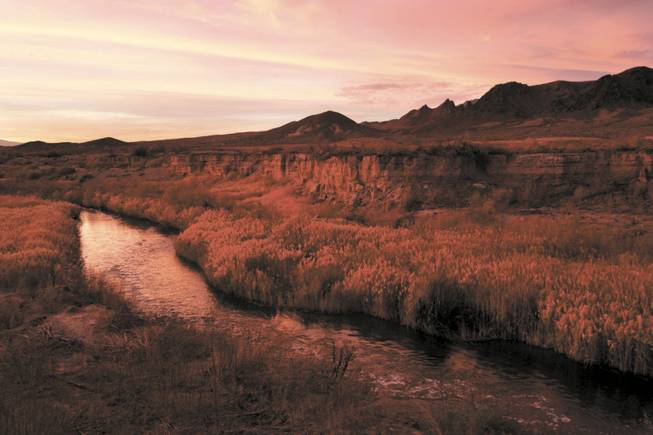
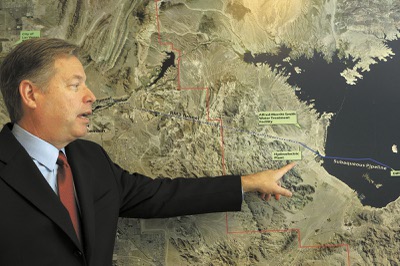
The path of the Clean Water Coalition’s proposed pipeline would cross this stretch of the Las Vegas Wash to expel treated wastewater into the deeper depths of greater Lake Mead. Currently, the wastewater flows through the Las Vegas Wash, and trickles into a part of Lake Mead called Las Vegas Bay, where it concentrates.
Sunday, Jan. 10, 2010 | 2 a.m.
This story, at a glance
- Where does our treated wastewater go now? Water flows down the Las Vegas Wash before trickling into and concentrating in Las Vegas Bay, which is a part of greater Lake Mead.
- Why a pipeline? The pipeline would cross the Las Vegas Wash and better dilute treated water by expelling it at the bottom of Lake Mead, increasing the lake’s overall water quality. As such, drinking water drawn from the lake will need less treatment by chemicals that affect taste and create health risks.
- Why don’t we need it? Technological advances have improved the quality of treated wastewater. In Lake Mead, toxins have been reduced by better chemicals and an invasion of quagga mussels.
- What about the money? Governments have asked for the fees to be returned, but the Clean Water Coalition intends to use the money for other purposes.
A combination of improved water-filtering technology, the quagga mussel and the lousy economy could save Clark County residents nearly $1 billion.
The managers of the valley’s local governments are urging elected officials to force the quasi-governmental Clean Water Coalition to kill its plan to build an $860 million pipeline to flow treated wastewater deep into Lake Mead. Currently, the treated water flows down the Las Vegas Wash and into Las Vegas Bay.
The project was once seen as way to improve the mixing of treated water with lake water. But better wastewater treatment technology and the way the massive colonies of quagga mussels are filtering lake water should allow the valley to get by without the project.
On top of massive future savings, killing the pipeline might save taxpayers money on sewer bills and sewer connection fees. Both increased in recent years to build reserves needed to start pipeline plans and construction, and plans were to keep increasing connection fees every six months until January 2012 to cover some pipeline costs.
Not only might bills decline, but some money could be returned to local governments. After the Clean Water Coalition pays off a $20 million short-term loan that was supposed to be used for the pipeline, it will have about $60 million in the bank. That money came from connection and sewer fees dedicated to the pipeline plan.
Now local governments say the money should be returned.
In a Dec. 8 letter that suggests terminating the pipeline project, the managers of Henderson, Las Vegas and Clark County also ask the coalition to find a way to “appropriately dispense the unspent funds.”
The coalition’s board didn’t do that at its Dec. 15 meeting, however. Instead, the board voted to mothball the pipeline plan until 2012, when it will have more water quality information.
Questions about the money — whether fees should be terminated and how money should be returned to governments or ratepayers — are to be discussed at the board’s Jan. 26 meeting.
Clark County Commissioner Larry Brown, the county’s representative on the coalition board, said the water panel needs to discuss “how we go about an equitable reimbursement program.”
Henderson Councilman Steven Kirk, his city’s voice on the board, said if the pipeline is killed, the Clean Water Coalition must return collected money, otherwise it would be tantamount to “collecting it under false pretenses.”
“Not giving it back wouldn’t make sense,” Kirk added. A dollar-for-dollar reimbursement won’t happen, however, because some of the money has been spent on design and other aspects of the project.
The largest, relatively new businesses such as M Resort, which opened in 2008, paid connection fees as high as $1 million, Kirk said.
Richard Mendes, general manager of the Clark County Water Reclamation District, is among those recommending funding for the project “should be terminated right now, and no more money should be collected.”
Not everyone agrees with Brown, Kirk and Mendes, however, most notably former County Commissioner Chip Maxfield. When he was a commissioner, Maxfield served as chairman of the Clean Water Coalition board.
Soon after he left elected office, the board hired him as general manager at the Clean Water Coalition, where he is paid $150,000 and gets $74,669 in benefits annually. All told, he and three staff members are reaping $621,557 in salary and benefits this fiscal year.
When the coalition board hired Maxfield in February, Brown recused himself because Maxfield had supported Brown’s campaign to win a seat on the Clark County Commission. Like Maxfield before him, Brown is now chairman of the coalition board.
When the Sun asked Maxfield how the pipeline money could be divvied up among Henderson, Las Vegas, North Las Vegas and Clark County, Maxfield asked a question back.
“Where are you coming from about giving the money back? What’s the basis for that?” he said.
He indicated the money and fees could be used to improve water quality in other ways.
“The underlying premise is maintaining water quality for this community,” Maxfield replied. “If (the pipeline) isn’t needed, then what other water quality improvements have been done and what other water quality improvements need to be done that are cost effective?”
Maxfield also said the roughly $8 a typical residence pays annually to the coalition should not be eliminated, and that sewer connection fees that have risen from $400 in 2006 to $871 this month should not be lowered.
“I would suggest that the (annual fee) does not go away because we need to maintain water quality,” he said. “The same with the hookup fees.”
Maxfield said the coalition is looking at how its money could be used to improve wastewater treatment. Among some of the ideas being considered, he added, are putting money toward better treatment at four wastewater plants in the valley and making improvements to the Las Vegas Wash, where all treated wastewater flows before going into Lake Mead.
Maxfield stressed that even if the pipeline is canceled, the Clean Water Coalition board has all but promised that the coalition would be preserved as a “regional voice for wastewater dischargers.”
“There is most definitely a need for the Clean Water Coalition with or without the (pipeline) project,” he said.
•••
Formed in 2002 through an interlocal agreement between Clark County, Henderson and Las Vegas (North Las Vegas joined later), the Clean Water Coalition was created with the express goal of building a pipeline that would jut deep into Lake Mead. Called the Systems Conveyance and Operations Program, or SCOP (pronounced “scope”) for short, the idea behind the pipeline was that releasing treated water deep into the lake would dilute it better than having it trickle from Las Vegas Wash into Las Vegas Bay.
As recently as last summer, the coalition said the pipeline was necessary. The agency wrote in its June 30 financial plan that “as Las Vegas grows, the mixing capacity of the Las Vegas Bay is reaching its limit.”
But in a recent interview, Mendes, the Water Reclamation District general manager, said the guiding principle behind the pipeline — that “dilution is the solution to pollution” — no longer holds because growth is stagnant and wastewater treatment has so greatly improved.
“We project that with the improvements (in treatment), we will not have a problem for at least 30 years, maybe longer,” Mendes said. “That’s even with no change in technology. So we don’t think the project is necessary.”
A big goal of wastewater treatment is the removal of phosphorous. Phosphorous is a concern because it’s something of a gourmet meal to algae. Phosphorous levels in Lake Mead became a big concern in the summer of 2001 after algae blooms broke out across the lake.
An organic material, algae forces water treatment plants to use more disinfectants, Water Reclamation District Deputy Manager Doug Drury said. Disinfectants such as chlorine react with organic matter to produce trihalomethane, which some studies have linked to cancer. Disinfectants can also affect how water tastes.
With graphs showing phosphorous levels in Lake Mead since the 1950s, Mendes demonstrated how new technology, especially the addition of another chemical process in 2005 to further remove phosphorous from the water, led to sharp declines in phosphorous after 2001 — even as the flow of treated wastewater into Lake Mead increased with the explosive growth of Clark County.
“The question is: If we can do it in our treatment plants, do you need the pipeline?” Drury said. “Ten years ago we didn’t have the technology to optimize treatment. That’s what’s really changed.”
Ten years ago, we didn’t have the quagga mussel, either.
Discovered in 2007 in Lake Mead, the aquatic foreigner is now believed to number in the trillions. Mendes and Drury said the mussel has had some effect on water quality because it feeds on algae, which feed on phosphorous.
But Maxfield countered that the mussel’s exact effect on water quality is unknown. (What, for example, will the excrement of trillions of mussels do to the lake water?)
That’s partly why the coalition board voted to only mothball the pipeline, Maxfield said. “By 2012, the mussel will have been in existence for about five years, and most experts say that before you know what kind of effect there will be, there needs to be about a five-year life cycle.”
Finally, the poor economy has led to a stabilization or decrease in Clark County’s population. The explosive growth that was occurring when the pipeline was dreamed up 10 years ago is not happening.
All that information was presented to the four member agencies of the Clean Water Coalition, Mendes said, resulting in the conclusion that “the SCOP project is not necessary.”
That conclusion was memorialized in the Dec. 8 letter to the coalition. The letter also asked the coalition to figure out what to do with unspent money, to stop collecting assessments from local governments, and to figure out what, if any, role the coalition has post-pipeline.
Finally, the letter calls for the coalition to deliver a report on this by June 30.
What happens to the Clean Water Coalition will be in the hands of its board, made up of elected representatives from Henderson, Las Vegas, North Las Vegas and Clark County. There’s a chance that even if the board decides it isn’t needed, it could be taken under the wing of the Southern Nevada Water Authority.
The county’s representative, Brown, acknowledged that the board will “look at the Clean Water Coalition’s role and see if that could be incorporated into the Southern Nevada Water Authority.”
J.C. Davis, water authority spokesman, said that if the Clean Water Coalition were dissolved, “we think its water quality function is important, and we’d be willing to take to the SNWA board of directors the idea of absorbing those responsibilities.”

Discussion: comments so far…
Comments are moderated by Las Vegas Sun editors. Our goal is not to limit the discussion, but rather to elevate it. Comments should be relevant and contain no abusive language. Comments that are off-topic, vulgar, profane or include personal attacks will be removed. Full comments policy. Additionally, we now display comments from trusted commenters by default. Those wishing to become a trusted commenter need to verify their identity or sign in with Facebook Connect to tie their Facebook account to their Las Vegas Sun account. For more on this change, read our story about how it works and why we did it.
Only trusted comments are displayed on this page. Untrusted comments have expired from this story.
No trusted comments have been posted.
Post a comment
Most Popular
- Viewed
- Discussed
- E-mailed
- UNLV can move forward without the burden of losing streak to San Diego State
- A wife’s wisdom shows birth control issue needn’t be divisive
- Surprise links, negotiated deals addressed by commissioners
- Motorcycle accident claims life of man in northeast valley
- Hope and change and … what’s missing?
- New York mayor has the right idea
- We don’t need a CEO in charge
- Paying our own way
- Country has ‘given’ citizens a lot
- Jerry Tarkanian: Mike Moser impresses yet again on a day to remember former Rebel greats
Blogs
The Kats Report
Color from scene at Thomas & Mack: We have a wire job! Rebels win, and Louie Armstrong sings!
South Point owner Michael Gaughan's take on 'Vegas Stripped': 'I'll give it an 8' (4 Comments)
Author relishes writing the life story of ‘larger-than-life’ Oscar Goodman (3 Comments)
Elsewhere
Landowner: All roads could lead to Uxbridge casino
Revel reveals smoke-free casino opening
Cirque du Soleil show in Sands China casino to close this month
Meet the woman behind Sheldon Adelson
The Sun
Locally owned and independent for more than 50 years.


All told, he and three staff members are reaping $621,557 in salary and benefits this fiscal year.
That about tells the whole story. I guess they don't want to do away with the CWC. Just continue to rob the rate payers
if we don't need give me my money back i can used it to paid bills or a rarity go to a movie
Maxfield's an okay guy but he is in this position because he was a Clark Co. Commissh, not because he's the most qualified guy they could find. His job is another form of the golden parachute. There are other gov't groups that can do the job of the CWC, it is unnecessary and always was. Say ouch and give the money back. Can this project and the Mulroy Memorial Pipeline. Both are evidence that Vegas is still run by the mafia, just not that mafia.
This is getting hilarious. The quagga mussel, which is fouling up our intakes and such, is now actually an asset? After years of hearing how they are such a disaster in the lake, now they actually help to clean our waste water? Hello?
I don't drink any public water produced here in the Valley, none of my friends do, either. Even bathing with the water seems an adventure now. Little quagga's on me when I take a shower? Can you say crabs?
Is the SNWRA a joke? Pat Mulroy, answer one question-you take home 300 Grand-do you drink the water? I didn't think so.
nice article
The question of the fate of waste from the Quagga is very easy to research,calculate, study and answer. I just spent an hour comming up with a decent and realistic answer. But that is from a scientific point of view. From Mr. Maxfields point of view it is best to tout this question as a fear based unknowable for the purpose of further filling his pockets with our money. One thing is very clear here: clean water for the public is not the goal of Mr. Maxfield. I would be more than happy to take over Mr. Maxfields position on this "coalition" for 1/4 of his benefits and salary. As a highly trained scientist it is my opinion that IF public funds are involved THEN politicos and businessmen types do not need to run any effort that should be run by science types who would never say and do the types of things being said and done here. Clean water is a science based issue and efforts towards it need to be directed by those who know a bit more about the world than accruing and funneling money to their friends and associates all at the publics expense.
Now we need it now we don't. Just another bunch of BULL S*** spewed by local politicians lining their pockets from payback jobs created just for them. Once they are voted out of office the gravy train continues. How many other boards are these board members paid to serve on $$$. How much more are the taxpayers paying them to serve on those boards. How many out of state conferences do they need to attend flying first class with their wives or girlfriends, with the taxpayers paying all the expenses. I wonder what kind of home they had before they were voted in office and now after being voted out. Oh by the way they must be doing a great job with Las Vegas having some of the worst water quality in all the nation, I won't drink and I bet they don't.
another nail why its not a smart move to relocate to vegas; more crooked politicians i never knew existed still claiming we need the money after being told its not necessary. kind of like, lets build another city hall. vegas is a nice place to visit but.....
Leave it to local Las Vegas officials to set up high priced gold plated coalitions proposing billion dollar solutions to problems that don't even exist.
What the heck is wrong with these people ?
Part 1 of 2:
The issue of what chemicals are in the Las Vegas Valley's tap water are more important, to a large extent, than where the valley's sewage treatment water is dumped.
Modern American water treatment procedures, before delivery of potable water to the public, involve the use of chloramines (as opposed to chlorine) as a disinfectant. The use of chloramines in public water systems is highly controversial, because of (1) there are no peer reviewed, EPA approved studies on the public health effect of chloramines; (2) chloramines cause the leaching of lead from pipes, and from the solder used in copper pipes into drinking water; (3) chloramines and lead are considered cancer causing agents.
Chloramines in tap water is deadly for dialysis patients. Chloramines exacerbate the effects of asthma. Chloramines cause severe skin and nerve problems for sensitive people, creating what is commonly called "toxic bath and shower water".
Common salt-based home water filtration systems do not remove chloramines from tap water. Chloramines must be removed from tap water with a GAC (granular activated carbon) filter followed by a reverse osmosis or Cation filter. In other words, the granular activated carbon filtration filters out only the chlorine from the chloramine molecule leaving the ammonia behind. The ammonia must be removed with the secondary treatment process.
Chloramine run-off from water hydrants or broken mains that enter storm drains, streams, lakes, rivers, and creeks, endangers the lives of fish, amphibians, water invertebrates, and other sensitive marine animals.
Thus, the use of chloramines to treat Las Vegas drinking water, with the chloramines staying in the water as it becomes sewage dicharge, raises serious issues:
Chloramine must be filtered out BEFORE it reaches bodies of water. This includes wastewater released into the environment from wastewater treatment plants.
Chloramine is toxic to fish, amphibians, and water-based reptiles and marine invertebrates. Chloramine enters directly into the bloodstream of fish, and amphibians through gills and skin, respectively.
The Canadian EPA ruled chloramine "toxic" as defined in Section 64 of the Canadian Environmental Protection Act, 1999, as a result of a study assessing the impact of high volume chloraminated water discharges entering the environment, particularly on fish.
Part 2 of 2:
To me, with respect to the duties of this "Clean Water Coalition" the critical issue is whether chloramines in waste water are being properly removed before being discharged into the Las Vegas Wash, ultimately ending up in Lake Mead.
The concern is that the Las Vegas area's use of chloramines for water treatment, with discharge of chloramine contaminated water into Lake Mead, and then further use of the chloramines to re-treat the already chloramine laden water creates a vicious circle exposing the public (let alone the environment) to more and more chloramine.
Ignoring the question of "which is more harmful to the aquatic environment" i.e. whether dumping of chloramine-laden sewage treatment water deep into Lake Mead through the Clean Water Coalition's pipeline, as opposed to chloramine laden water flowing in by way of Lake Mead, THE MORE IMPORTANT PUBLIC HEALTH QUESTION IS WHETHER THE MONEY FOR THE PIPELINE COULD BE BETTER SPENT REDUCING OR ELIMINATING THE USE OF CHLORAMINES AS A DISINFECTANT OF OUR DRINKING WATER.
Nevada is getting just like California. Too many overpaid coalitions, commissions, committees, etc. made up of former politicians getting paid big money for little work (and the "work" they get done is not always in the public interest). It is time for all of us to say ENOUGH! We cannot afford these inefficient bureacracies and their living high on the public dime. Time to derail the golden gravy train for all of these freeloaders. It's back to basics folks.
Good riddance to the badly mismanaged '00's.
Those thinking about long-term recovery, know the environment will be a big winner in the conversion to biofuels & biopower -- saw a cool site; Balkingpoints ; incredible satellite view of earth
...Cynical...although chloramines should be used as a distribution system residual disinfectant, they in deed are not used in Las Vegas Valley drinking water treatment...
We seem to be missing the issue. The first poster said it best, "All told, he and three staff members are reaping $621,557 in salary and benefits this fiscal year."
Seriously, Maxfield can't make $150,000 working another part-time job. He will try to keep his current position. I'd like the news to follow this clown and see how long he actually spends working at the CWC offices and how long he spends surfing YouTube.
Equitable redistribution of the funds? Are you kidding me? That money should be returned to the funds it was diverted from! The sewer bills that residents pay are supposed to pay for wastewater treatment.
In the City of NLV, 40 cents on the dollar of residents' bills get skimmed right off the top, into the General Fund. This has been going on for over 30 years. The actual cost to treat CNLV sewage was next to nothing, because the CLV was treating it--at a very low cost.
How much are the ratepayers of the CNLV really paying for sewage treatment? How much are they paying to support the CWC, and NLV programs?
Maxfield says that the average resident pays $8.00 a month to support the CWC fat cats. Not to mention the more than 100% increase for sewer hookup fees. Residents might prefer to enjoy going out for lunch, rather than supporting members of the CWC.
The CWC appears to be composed of a constantly rotating bunch of former elected officials, managers (who may have "managed" a position for themselves on the CWC, prior to resigning). When one runs for office, somone else holds their position for them.
The only pipelines that need to be built, are one-way chutes that return money FROM the CWC, to the Enterprise Funds of the CLV, and COH. As for CNLV, it would be better to issue refund checks to ratepayers, since their Enterprise Fund is simply a slush fund for the General Fund.
QUOTING DIRECTLY FROM THE ARTICLE (emphasis mine):
Maxfield said [THE COALITION IS LOOKING AT HOW ITS MONEY] could be used to improve wastewater treatment...Maxfield stressed that even if the pipeline is canceled, the Clean Water Coalition board has all but promised that the coalition would be preserved as a "regional voice for wastewater dischargers."
"There is most definitely a need for the Clean Water Coalition with or without the (pipeline) project," he said.
Maxfield obviously considers all this money as belonging to the CWC!!! I don't believe that the LV Valley needs the CWC to "be preserved as a regional voice for the dischargers," either. What IS needed is the elimination of the CWC.
A few bureaucrats saw an opportunity to build an empire. Naturally, they want to expand it. This requires money--LOTS of it, power--granted by managers and elected officials, and an uninformed source of revenue--THE PEOPLE. Oh yes, it also requires continued justification for its existence--at least at first. After awhile, people can't remember a time when the bureaurocracy didn't exist! I would like to know how much has been spent trying to convince taxpayers and ratepayers that it was necessary to form the CWC in the first place.
They can get away with it for awhile, until we all have to figure out ways to cut expenses. We begin to look at all expenditures. Something has to go. Logically, unnecessary expenses need to be eliminated first. Ever try to eliminate a bureaurocracy? Name one that has been. I can't think of any.