YUCCA MOUNTAIN:
What’s next for Yucca? Restoration
U.S. Department of Energy
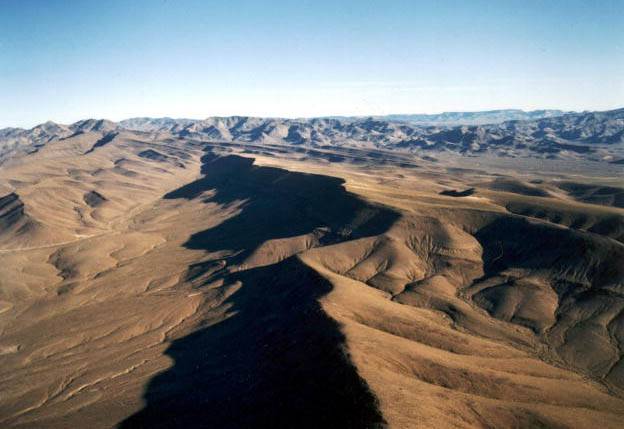
Yucca Mountain is located about 90 miles northwest of Las Vegas.
Sunday, Feb. 7, 2010 | 2 a.m.
Related story
- The phone call that would bury dump plan (2-6-2010)
FOR SALE: MOUNTAIN, PRE-DRILLED
The planned closure of the Yucca Mountain nuclear dump project allows an opportunity to ponder a different future for the place. Serious suggestions have included using the site as a long-term research facility or for weapons testing.
On the other hand, maybe Vice President Joe Biden can finally get his own “undisclosed location” or Zappos.com, the huge Internet retailer, could turn it into a really, big warehouse.
Other suggestions include:
- “Maybe it would be a good spot for a new brothel.” -- Mayor Oscar Goodman
- “There are a lot of extra grapes in Napa this year that need to be stored.” -- Bruce Breslow, executive director of the Nevada Agency for Nuclear Projects
- “I bet you could grow mushrooms in there.” -- Dan Burns, spokesman for Gov. Jim Gibbons and former public information officer for Yucca Mountain Waste Repository
- “They should do tours for kids and seniors. You could use the school buses that aren’t used during the day and take people out to Yucca Mountain to go down the tunnels. They already have rail tracks inside, so you just need a few rail cars and you’re set.” -- Anita Kramer, longtime Las Vegas Sun reader
- “Ask the Western Shoshone. It’s a sacred site to them and it’s their land under their treaty with the U.S.” -- Judy Treichel, executive director of the Nevada Nuclear Waste Task Force
- “From our perspective they’re all trespassing.” -- Ian Zabarte, Shoshone member
Sun coverage
Sun archives
- Feds file request for suspension of Yucca Mountain license (2-1-2010)
- Obama to zero out Yucca Mountain funding, pull license (1-31-2010)
- Dying Yucca Mountain still has some life (1-30-2010)
- Obama administration: ‘We’re done with Yucca’ (1-29-2010)
- Friday announcement will unveil plans for panel on Yucca alternatives (1-28-2010)
- White House, Energy Department clash over Yucca Mountain cuts (1-14-2010)
- Report: Yucca Mountain costs double other alternatives (12-2-2009)
- Nuclear industry weighs in on nuke dump license (11-16-2009)
- In Nevada, nuclear raises touchy issues (11-14-2009)
- Feds to slash Yucca funds as project maintains life (11-9-2009
- 3 Las Vegans join state Commission on Nuclear Projects (11-5-2009)
When it was on the drawing boards, the Yucca Mountain radioactive waste dump promised unprecedented challenges to nuclear engineers and physicists: How to safely store nuclear waste underground?
Now with the project being killed by President Barack Obama, the site will offer unprecedented challenges to desert ecologists: How to bring vegetation back to the mountain?
The task is both simple and overwhelming:
Under federal law, the Energy Department has to return the mountain landscape to a state similar to how the agency found it.
That’s easier said than done, because fully restoring a desert landscape can take centuries, or millennia.
Although desert landscape restoration has been attempted with varying degrees of success in recent years, there has never been a desert reclamation project of this size and type.
The Energy Department had not anticipated having to exercise the plan until the waste dump had been filled with spent but still highly radioactive fuel rods from nuclear power plants and shut tight more than 100 years from now.
But after more than 20 years of planning, engineering and design for nuclear waste storage, the department must abruptly change focus to how to restore the mountain.
The department will have to comply with regulations contained in the National Environmental Policy Act, the Federal Land Policy and Management Act, the Clean Air Act, the Endangered Species Act, the Atomic Energy Act and statutes regulating Bureau of Land Management right-of-way agreements.
And after years of geological and seismic tests and the drilling of a gigantic tunnel, there is a lot of damage to repair.
The restoration won’t be considered successful until at least 60 percent of the plant life that existed in 1987, when the agency claimed the site, has been restored.
The Energy Department doesn’t have a final plan for remediating the damage on the mountain, but it has revealed the type of work it had intended to do once the dump was filled.
The Reclamation Implementation Plan took more than 17 years and four revisions to develop. That document includes plans for massive cleanup and replanting efforts at Yucca Mountain.
It is expected to be the foundation for the final plan.
The plan doesn’t discuss what to do with a giant empty tunnel, but does outline how the outer layers of Yucca Mountain could be restored.
The reclamation starts with filling the more than 300 bore holes and numerous trenches and pits dug for hydrology and geology tests, along with tearing down all permanent and temporary buildings, wells and most of the roads. (BLM will have the option of keeping the roads on its land.)
But removing stuff is one thing; getting desert plants to grow in their place is another.
Desert soils and vegetation are fragile, and once severely disturbed, they can take anywhere from many decades to millennia to recover, according to UNLV restorative ecologist Scott Abella, who is wrapping up a study on how long it takes desert ecosystems to recover from disturbances.
His research shows that desert scars, if left to treat themselves, take much longer to heal than most people realize.
Without massive reclamation efforts, it can take at least 100 years for a plant community to begin to recover from the type of bulldozing, soil scraping and building that occurred at Yucca Mountain.
Planting or seeding native vegetation and manipulating the soil, as the Energy Department plans to do, have been shown to speed up recovery, but only if you get lucky and plant the right vegetation in the right year and get the right weather.
Desert reclamation is more trial and error than exact science.
But after studying numerous desert reclamation projects, the Energy Department thinks it has the right formula:
• Recontour the land to mimic original state and “blend into the natural topography of the area.”
• Restore drainage washes and stabilize the earth to reduce erosion.
• Create a seedbed (basically by puncturing compacted earth so seeds can be planted) and water catchment basins in which to plant.
• Test and replace the topsoil.
• Replant native vegetation (via seeds and transplants) in disturbed sites from October to December.
• Mulch the emerging plants with straw to hold in moisture.
• Fence in emerging plants and saplings with chicken wire.
These steps have proved to be effective in the past, at least individually or in pairings. But the Yucca plan is to do it all, and do it relatively quickly. The Energy Department did not answer questions about how long such restorations efforts would take, but the number that has been floating around hearings is two years for upfront work.
That may be overly optimistic.
The restoration would entail a complete rebuilding of a complex plant system over hundreds of acres. It will be unprecedented in both size and scope.
Most desert restoration work has been designed to “visually erase” the disturbance quickly, within 10 years, Abella said.
And even that doesn’t produce quick results.
Every study Abella found had at least one seeding or planting fail outright and have to be redone. Planting success rates averaged about 50 percent.
That’s because many factors that make desert plants grow slowly also can make them not grow at all.
The right weather for germinating seeds occurs only about once a decade. Planting or transplanting often works better, but only for certain plants. It’s also more expensive. And through it all enough rain is needed to keep seedlings and saplings alive through their first summer.
“Even if everything is done right and there is adequate rainfall, desert restoration still can probably only be classified as ‘risky,’ ” Abella said.
The Energy Department doesn’t appear to have much choice. It faces lawsuits and sanctions if the restoration is abandoned.
It’s a project many people, from state officials to local ecologists, will be watching.
It’s believed to be the first project to attempt to restore large tracts of highly disturbed land to anything resembling the original ecosystem.
Recontouring and planting areas will likely hasten the recovery time, but it will still be probably 30 years — possibly longer — before the land looks anything like it did before the Energy Department started drilling. And the department has to regularly assess and monitor the success of its endeavor.
Returning the entire ecosystem to its original state could take even longer.
“Our current technology makes the complete and rapid restoration of the desert unrealistic, but if done well and if done well with rainfall, restoration of soil and vegetation in an area like Yucca Mountain can potentially jump-start and accelerate natural recovery of the desert,” Abella said.

Discussion: comments so far…
Comments are moderated by Las Vegas Sun editors. Our goal is not to limit the discussion, but rather to elevate it. Comments should be relevant and contain no abusive language. Comments that are off-topic, vulgar, profane or include personal attacks will be removed. Full comments policy. Additionally, we now display comments from trusted commenters by default. Those wishing to become a trusted commenter need to verify their identity or sign in with Facebook Connect to tie their Facebook account to their Las Vegas Sun account. For more on this change, read our story about how it works and why we did it.
Only trusted comments are displayed on this page. Untrusted comments have expired from this story.
No trusted comments have been posted.
Post a comment
Most Popular
- Viewed
- Discussed
- E-mailed
- South Point owner Michael Gaughan’s take on ‘Vegas Stripped’: ‘I’ll give it an 8’
- Coolican: Henderson officials out of loop on police brutality case, raising red flags
- See mug shots of 16 arrested in stolen-property police sting
- Lumberjacks — ‘Where the Big Boys Eat’ — hiring for North Las Vegas location
- Berkley draws stark contrasts with Heller over immigration
- Conceptual design unveiled for Henderson Space and Science Center
- Send your loved one a virtual Vegas Valentine’s Day card right now
- Short memories may serve president
- Howard Miller, prominent lawyer and ‘true Las Vegas native,’ dies at 68
- Contraception controversy benefitting Santorum, Obama
Blogs
The Kats Report
Live color from the scene at Thomas & Mack Center: We have a wire job! Rebels win, and Louie Armstrong sings!
South Point owner Michael Gaughan's take on 'Vegas Stripped': 'I'll give it an 8' (3 Comments)
Author relishes writing the life story of ‘larger-than-life’ Oscar Goodman (3 Comments)
Elsewhere
Landowner: All roads could lead to Uxbridge casino
Revel reveals smoke-free casino opening
Cirque du Soleil show in Sands China casino to close this month
Meet the woman behind Sheldon Adelson
The Sun
Locally owned and independent for more than 50 years.


It is easy all you do is take all the Acorn cheaters and thieves. To fill all the holes plant new cactus and a big painting Obama and Reed Holding hands. With a big smiles that once again they the senate and congress and the big guy KING OBAMA get to screw us one more time. By the Billions in lawsuits. thanks
This story made my head hurt
Having been a frequent visitor at Yucca Mountain it has impressed me that efforts were always made to minimize impacts on the native vegetation and the natural lay of the land. There are roads, and areas that were scraped and leveled associated with working areas and drilling areas, and they can be re-seeded and watered a few years to jump-start restoration.
There were several restoration experiments in the past, and they showed promise. It is a fragile environment and it takes time, but so what? Is this land under consideration as a national park? It is largely part of the Nevada Test Site, which has its own environmental challenges (and some very nicely-done revegetation success stories and useful experience).
If you want to boo-hoo over desecration of our beautiful desert, then boo hoo over the colossal and ever-expanding sacrifice-zone known as the Las Vegas valley and its tributary communities and roads from all four compass directions. We, all of us (whether we are employed by Yucca or Wendy's is irrelevant) are the most destructive invasive species in this desert.
"The department will have to comply with regulations contained in the National Environmental Policy Act, the Federal Land Policy and Management Act, the Clean Air Act, the Endangered Species Act, the Atomic Energy Act and statutes regulating Bureau of Land Management right-of-way agreements."
And the above is the sole reason liberals wanted to stop the funding. They will now spend billions funding even more liberal lunatics and retired political leaders to act as consultants or to form some political action committee to further line their pockets with our money.
Before this goes any further, Americans need to stand up and be heard, no past or present elected officials, family members, political action committee, or certain race can be employed or contract to perform any work or receive any type of compensation for providing work either directly or indirectly on this site. All work regardless must be hard bid, no affirmative action or 8A set aside allowed, must use E-verify and employ only Americans.
I know the above is a pipe dream; Harry and company will retire from office and will end up making a few billion providing some type of service for this project when it's all said and done. Al Gore will become the next multibillionaire and the Environmental nutcases will make billions lying to us again.
Are we also going to restore all of the huge craters left by near-surface nuclear explosions on the test site? How about the portal and lay-down areas from the many underground tunnels in Ranier Mesa where weapons were shot?
I agree - inane articles like this make my head hurt. It bothers me that reporters like this are given marching orders to write such drivel.
Why isn't King Harry and the Sun sychophants jumping up and down requiring we immediately reclaim these area? The reason - they don't care because it doesn't serve their political purpose.
Mr. vanLuik is exactly correct - the biggest environmental disaster to the southern Nevada desert ecosystem is the Las Vegas valley and its never-ending need for electric power and water. Where is the Sun writing investigatory articles on the LV Water Authority and its stealing of water from other parts of the state?
Blows my mind
Just a quick clarification. The Yucca restoration (as well as most Yucca Mountain Waste Repository activities) is to be funded by money collected from ratepayers who get their electricity from nuclear power. Thus, this restoration is not paid for by "us" because we don't have nuclear power plants.
Once again, I join Mr. van Luik in his opinion about the latent hypocrisy of this article. I have said many times before on these blogs that we Nevadans have a disgraceful environmental record on vivid display in Vegas in particular. The same people who celebrate massive water-wasting projects and drive around in vehicular monstrosities like Hummers; who dump mattresses and worn out tires in any vacant desert lot; who build mini-mansions right to the edge of Red Rock and then complain when they can't go further; who condone and actively participate in every environmental abuse known to man -- these same Nevadans suddenly become environmentalists when it comes to the subject of Yucca Mountain.
Ms. Tavares and her ilk mouth the soothing syllables of the conscientious environmentalist, the whole while ignoring the obvious fact that the Yucca Mountain site is part of an environmental apocalypse known as the Nevada Test Site, where upwards of 1,000 nuclear bomb tests were conducted, above and below ground.
Hence, Gov. Gibbons' idiot spokesman suggests growing mushrooms there, apparently ignorant that we were growing mushroom clouds there for over 50 years.
This crowd of know-nothings needs to be confined to this state, which has become a kind of repository for stupid people. They would build a drinking fountain at Love Canal. They are so clueless that they will feverishly promote a massive site remediation project, and demand that "we get our desert plants back," in the most highly irradiated place on earth, while they continue to plow under the vegetation beneath their very feet for the next City Center project or shiny new City Hall.
They are like Eliot's Hollow Men, only it's impossible to feel sorry for them.
Just a quick clarification to the clarification:
Have you confirmed that fact, Ms. Tavares? The Nuclear Waste Fund was established under the Nuclear Waste Policy Act. It is a contractual arrangement between the DOE and the nuclear utilities under which those utilities would charge their customers a fee in exchange for construction of a repository.
The courts have already made clear, in lawsuit after lawsuit, that the Nuclear Waste Fund cannot be used except for the purposes laid out in the NWPA. Given that building a repository was stipulated in NWPA, and that is not going to happen, and given that the courts have refused to let the Nuclear Waste Fund be misused, I would suggest that the money will indeed be coming from taxpayers, not ratepayers.
The NWPA calls for site reclamation after a repository is built, operated, and closed. And it does allow for reclamation in the event that the site characterization process disqualifies the site. However, that process found that the site was qualified, and that a repository could be built there, a determination seconded by Congress and the President, per the law.
So are you really going to suggest that the people who funded the Nuclear Waste Fund, and the utilities who collected the money and turned it over to the government for construction of a repository, are going to sit by and let the government spend that money on site reclamation?
I don't think so. There will be a legal firestorm surrounding this issue, and in the end the taxpayer will be on the hook. Nevadans will join that sad fraternity of taxpayers who have already paid over a billion to settle lawsuits brought against the government by nuclear utilities seeking to recover damages for DOE's failure to follow the NWPA. This will become another aspect of that legal reality, which we taxpayers (including you) will feel the effects of, to the tune of $50 to $100 billion.
Mark my words.
I would recommend that Ms. Tavares and any other "wishful thinkers" review Section 302 of the Nuclear Waste Policy Act of 1982. In particular, paragraphs (c) and (d).
I would also recommend that any journalist reporting on this story give the reader the straight scoop. Put away whatever glee, whatever personal enthusiasm you may feel, given the apparent outcome of the sad Yucca Mountain saga, and look at the regulations and the case law.
Whatever one's personal stance on the issue, what is clear is this: The Yucca Mountain Project is going to cost ALL OF US a lot of money. Nevadans especially don't appreciate the fact that the NWPA is a CONTRACT with the nuclear utilities. We forced them to pay a fee for construction of a repository, and they paid it. Canceling the repository is a clear breach of that contract, as was DOE's failure to take possession of the utilities' nuclear waste in 1998.
Since then, the utilities have prevailed in lawsuit after lawsuit. It's cut and dry. But so far, because DOE was continuing to make progress toward actually building a repository, the cases have involved "partial breach of contract." Now, with the cancellation of the Yucca Mountain Project, the government is in full breach of contract, and the lawsuits will be more cut and dry, and more expensive to the taxpayer.
Face it, Nevada. We have cost ourselves and our fellow taxpayers what will ultimately amount to $50 to $100 billion dollars. That money will not come out of the Nuclear Waste Fund. Rather, it will come from the Department of Justice's Justice Fund, which is funded by taxpayers.
Given that the repository was going to cost $98 billion to construct, operate, and close, Nevada just handed the nuclear industry a massive subsidy. Instead of having to pay for its own storage, the nuclear industry will now have its storage costs paid for by the taxpayer. In addition, the nuclear utilities will probably recover the $23 billion currently in the Nuclear Waste Fund, so at least the ratepayers who contributed to this fund over the years will eventually be "made whole."
The rest of us will have to pick up the tab.
Here's what Ms. Tavares and other anti-Yucca Mountain reporters never tell us Nevadans. It's from the Department of Justice's 2011 budget request and planning document:
"Spent Nuclear Fuel Litigation: $11.4 million and 13 positions (10 attorneys) to defend as many as 25 trials that are expected in FY 2011. To date, a total of 72 cases have been filed by nuclear power utilities seeking in excess of $50.0 billion in damages for the federal government's delay in accepting the utilities' spent nuclear fuel by January 1998, as mandated by the Nuclear Waste Policy Act of 1982. Defending these cases will involve intensive resources due to their complexity and high financial stakes. Without the requested additional funding, the government's posture will be severely weakened potentially leading to massive Treasury losses. FY 2011 current services for this initiative are 28 positions (22 attorneys) and $10.5 million (including $6.0 million for litigation support)."
That's the consequence of canceling the Yucca Mountain Project -- $50 billion in damages awarded to nuclear utilities and paid for by the taxpayer. Nevada, which comprises less than 1 percent of the population, has just cost 300 million American Taxpayers $50 billion dollars!
One senator has won his victory for less than 1 percent of America, which all of us will have to pay for. Meanwhile, the other 99 percent, 160 million of whom currently live within 60 miles of nuclear waste, will have to finance the stubborn and ignorant pseudo-environmentalism of a small minority of Humvee-driving, desert-tortoise-killing hedonists who think with their groins and their addictions.
And by the way, contrary to Ms. Tavares implication, Nevadans do use nuclear power: an estimated 16 percent of it comes from nuclear plants like Palo Verde, which is 50 miles outside of Phoenix, AZ.
Nuclear waste needs to be recycled at each
power plant location, not shipped to Nevada.
Yucca is dead.
Everyone seems to forget that chunk of desert is already "HOT" from testing of years past..The problem won't just go away.killing Yucca will be a short term victory till there is a regime change in Washington..Then Yucca will be back
bigdan:
The future of nuclear waste is to be recycled
at each power plant site.
The dump site is old school.
Teamster...You are almost right but...The technology is years off and the funding is not there yet add in agendas of Washington,Corporate America and the tree huggars,No matter what the problem is now and we need a dump now while waiting for the solution of the future,but you are right it does need to be recycled along with other waste streams that are buried and not recycled..I should know I was in the Haz Waste biz for alot of years and I know of alot of waste that went to Mercury and Beatty.It was for the best. Alot of communities are no longer cancer clusters.
Ms. Tavares have you ever been to the test site. I think they still offer tours to the public. You need to see for your self the effects of 50 years of nuclear weapons testing. There's one crater out there that's 330 ft. deep and 1300 ft. wide. Maybe you could help plot the plans to put it all back in its pristine state. I get a warm fuzzy feeling just thinking about it. I would be willing to donate a shovel so you could start tomorrow. By the way the government is reneging on its agreement to build a repository with the fees payed by the nuclear industry. This will result in more legal ramifications which in the end will cost the tax payers. When has the government every been fiscally responsible, they screw up everything they're involved with. This will cost billions more before it over with, if its over with.
This is a very old thread, but the original post just showed up in my Google alert on Feb. 15. Something said in the comments must be challenged: TEAMSTER: THE FUTURE OF NUCLEAR WASTE IS TO BE RECYCLED AT EACH POWER PLANT SITE.
I am about to retire from the nuclear power industry. If teamster is saying that used fuel now stored at the 104 reactors should be sent to a fuel reclaim facility for recycling, he's absolutely correct. A VAST amount of potential energy is locked up in used fuel, and should be reprocessed.
But if teamster is suggesting that every nuclear station should get into reprocessing high level nuclear materials on-site, he is talking total balderdash.
It costs billions to build a reprocessing facility. Reprocessing hyper-radioactive used fuel is an extremely dangerous undertaking that must be done ONLY by a staff of experts in a super safe facility built specifically to handle used fuel.