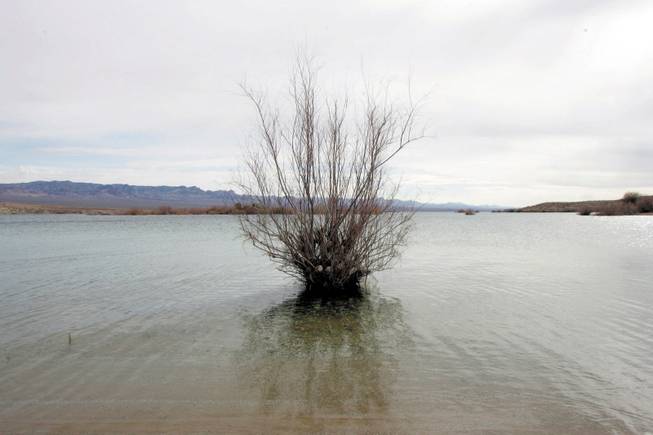
A tamarisk bush grows out of the water along the shore of Lake Mojave near Cottonwood Cove.
Monday, Feb. 1, 2010 | 2 a.m.
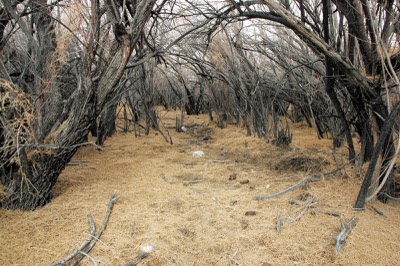
The ground around a stand of tamarisk along the shore of Lake Mojave near Cottonwood Cove is covered with duff from the branches last week. The duff's high salt content inhibits the growth of other plants.
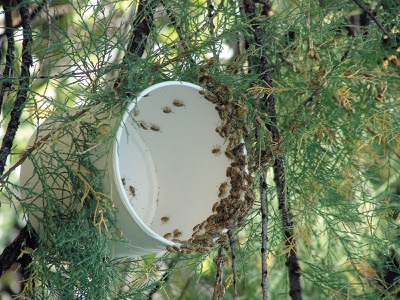
Tamarisk beetles, voracious eaters of saltcedar, are released in 2008.
Sun Archives
- The small oversight that threatens the valley’s big pipeline proposal (1-31-2010)
- Nevada Supreme Court tosses Las Vegas claims to rural water (1-28-2010)
- Nevada Supreme Court to expedite water rights case (1-22-2010)
- Governor delays signing Utah-Nevada water-sharing pact (1-9-2010)
- Supreme Court OKs $4 million water rights settlement (12-14-2009)
- Utah, Nevada draft water agreement (8-13-09)
Sometimes in nature, the simplest solutions lead to the most convoluted results.
Take the saltcedar tree, one of the greatest scourges of the West; it chokes out native plants, sucks up water like a sponge and ruins recreation spots.
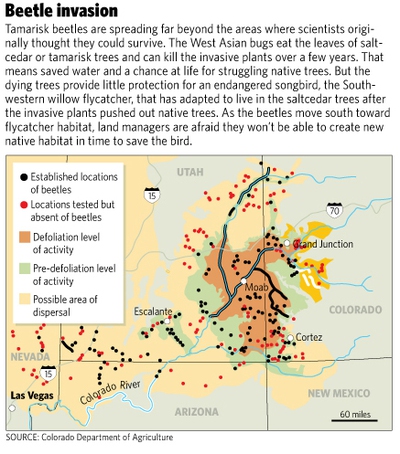
And it might have been good news that there’s a small, voracious insect — the tamarisk beetle, moving into the area from the north that, left on its own, seems destined to devour and kill the saltcedars that are clogging washes and sucking them dry.
But the saltcedar is now protecting itself with a hostage: the endangered Southwestern Willow flycatcher, a songbird that has adopted the plant as its habitat.
In the face of this ecological challenge, land managers are scraping together a desperate plan to save the bird and reinstate native ecology.
Federal agencies and conservation groups are on the hunt for money to introduce their strategy at Lake Mohave and along the Virgin River.
The U.S. Fish and Wildlife Service hopes to land a federal stimulus grant in the next few months to pay for a crew of chainsaw-wielding contractors to clear a couple of hundred acres of saltcedar in the best bird habitat spots alongside Lake Mohave and replace them with native vegetation to serve the flycatchers while the beetles destroy the other stands of saltcedar.
There is urgency in their work, because the beetles are on their way.
In this ecological melodrama, here’s the playbill:
The tamarisk
Tamarix trees, known locally as saltcedar or tamarisks, were introduced in the United States from Western Asia in the late 19th century as a fast-growing windbreak. But the hardy trees’ massive annual seed output allowed them to spread quickly, settling in creeks and washes where they pushed out native cottonwood and willow trees.
They’re easy to kill — a bulldozer or fire will do it — but they’re so quick to sprout new saplings that cleared riverbanks need constant maintenance in order for natives to re-establish.
The invasive saltcedar is no friend to the desert. It provides little shade, supports few birds and bugs, and significantly increases the salt content in soil. The tree drives out hawks and eagles and most of the smaller plants that would have been able to thrive under the canopy of a billowy willow or tall cottonwood.
“If you’ve spent any time in the back country in Southern Nevada and sat down under one of these wonderful cottonwood or willow trees, there are all these little plants and all the animals around you,” said U.S. Forest Service Vegetation Chief Alice C. Newton. “Contrast that with a thicket of tamarisk — nobody wants to walk through that, even animals. There’s almost no shade unless you’re huddled underneath and the ground isn’t covered with babbling brooks and leaves. It’s all tamarisk duff. It’s about as ugly a monoculture as you can get.”
Most damaging about the tree is its tremendous water consumption. Saltcedars are estimated to use a million acre-feet of Colorado River water every year — about four times the amount consumed by Southern Nevada annually.
Removing the saltcedars “benefits all Colorado River users by conserving billions of gallons of water,” Southern Nevada Water Authority spokesman J.C. Davis said. “We have been monitoring the beetle strategy, and early results give cause for optimism.”
The beetle
The quarter-inch-long tamarisk beetle originates in China and two areas of Kazakhstan in western Asia, where they are so voracious they often must be attacked with insecticides to protect the native tamarix stands.
It is a singularly focused insect, eating little else. It has other benefits in the war against the saltcedar: the beetle doesn’t produce the air pollution that would result from burning saltcedar trees, doesn’t taint soil as would herbicides, and is cheaper than running bulldozers.
The flycatcher
The endangered Southwestern Willow flycatcher, a small songbird that lives along tree-covered riverbanks in the desert Southwest, was forced out of native cottonwood and willow stands for the encroaching saltcedar.
The slow destruction of the saltcedar could be a good thing for the flycatcher except that the beetles kill the trees after the birds have nested, leaving them vulnerable to sun and predators, and native vegetation can’t grow back fast enough to create new nesting sites.
The scene
The beetle is wending its way down the Virgin River from St. George, Utah, where it was wrongly released by researchers in 2006, and from other parts of Utah.
Wildlife experts expect it to be established at Lake Mead by 2013.
In the wake of the St. George release, the Center for Biological Diversity and the Maricopa Audubon Society in 2009 successfully sued to stop further releases of the insect, claiming the government should have known the beetle could survive further south, killing saltcedar and putting the flycatcher at risk.
“This is very serious because if they get below Lake Mead, we’ll lose the flycatcher in Arizona and New Mexico,” Center for Biological Diversity co-founder Robin Silver said. “Because of the blunders and corruption of (government) officials, we’re looking at an extinction.”
But there are no efforts to halt the spread of the tamarisk beetle. Beetle studies across the West are wrapping up, including those in Northern Nevada, which loses its funding this month. Researchers here have mostly moved on to other projects or moved out of state.
“At this point we decided we’ll not promote any further movement of the tamarisk beetle in Nevada, but we’re not putting forth any proposals to (kill) the beetles that are eating the saltcedar,” Nevada state entomologist Jeff Knight said.

Join the Discussion:
Check this out for a full explanation of our conversion to the LiveFyre commenting system and instructions on how to sign up for an account.
Full comments policy