John Coulter / Special to the Sun
Friday, April 23, 2010 | 2:01 a.m.

Andrew Clinger
Related story
Sun Coverage
Sun archives
- Gibbons signs budget bill; state draws M Resort lawsuit (3-12-2010)
- Budget gets OK as session ends; sales tax extended for roads (3-1-2010)
- Bipartisanship emerges in anger at Gibbons over session deadline (2-25-10)
- Democrats: Trim education cuts to 5 percent (2-24-10)
- Gibbons adds to agenda, says session will end by Sunday night (2-24-10)
- Relationship between Gibbons, Raggio shows strain on Day 2 (2-24-10)
- Plan to use cameras to catch uninsured motorists appears dead (2-24-10)
- Gibbons’ budget plan risky in an election year (2-24-2010)
- Proposal to close state prison meets opposition (2-23-2010)
- Budget crunchtime: Lawmakers set to tackle historic deficit (2-23-2010)
- State budget comes up $800 million short (8-22-2010)
- Forecast: Economy will begin to rebound in mid-2011 (1-22-2010)
- Gibbons’ no-talk order further divides branches (1-22-2010)
- Special session may require help of state Supreme Court (1-10-2010)
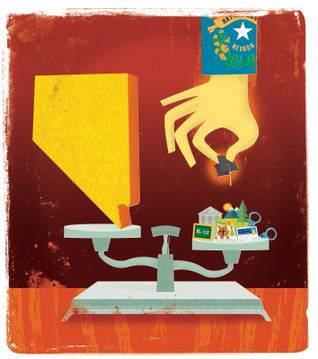
After struggling through a series of historic budget deficits the past two years, state officials are now trying to answer perhaps the most pressing question facing them: What exactly should Nevada government be doing?
It’s as much a philosophical question as a practical one. But those charged with overseeing state spending know it’s a question better asked now than later as the clock ticks on the next fiscal crisis — Nevada will be short $2.5 billion to $3 billion when the governor, whoever it is, and 2011 Legislature begin work on the budget early next year.
To answer the question, officials are for the first time embarking on a complete inventory of thousands of state services, programs and activities. Each will be ranked as high, medium or low priority, based on its cost and how necessary and effective it is.
The judging will be done by a committee, the Nevada Priorities of Government Working Group, which met for the first time Thursday.
The group is made up of Budget Director Andrew Clinger, four state department heads and Gov. Jim Gibbons’ deputy chiefs of staff, Stacy Woodbury and Lynn Hettrick.
“Instead of looking at the state budget in silos, we’ll be looking at state services as a whole,” said Clinger, who conceived the idea. “What, in our opinion, are the highest priorities?”
State government operates under what can appear to be a byzantine system of budget accounts and work programs. Its general fund has 400 budget accounts, which include thousands of programs ranging from building highways, operating prisons, funding K-12 schools, higher education and Medicare, to running museums and distributing rent rebates for seniors.
“We’re trying to think about government in a new way,” Woodbury said. “With the shortfall we have, government is not going to be doing everything it does today.”
She said the committee will begin with figuring out which programs are required by federal and state mandates or the Nevada Constitution.
The inventory, according to Clinger, will help decide what, exactly, is a priority for the state’s dwindling revenue.
Given the rancor of recent legislative sessions, it’s hard to imagine that the debate over the group’s decisions won’t break down along political lines.
Some on the political right think government should perform a minimal number of jobs dictated by the state constitution. Some on the political left argue that government has a larger role to play, protecting the poor and elderly, providing education opportunities to level the economic playing field and maintaining a certain quality of life.
Conservatives have long argued for a complete evaluation of each state program every two years, as the budget is developed.
Geoffrey Lawrence, a fiscal policy analyst with the libertarian Nevada Policy Research Institute think tank, said it’s impossible to know whether Nevada needs to raise taxes without a comprehensive review of its government programs. “It’s hard to estimate how much money is lost until we go through some type of performance-based budgeting process,” Lawrence said.
Until now, however, most veterans of state government thought such an inventory wasn’t feasible given the time constraints on Nevada’s part-time citizen Legislature, which meets every other year for 120 days to vote on policy and pass a two-year budget.
Carole Vilardo, president of the Nevada Taxpayers Association, called the state’s historical process “automatic pilot budgeting.”
“It assumes that everything from the prior year is correct” and adds increases for things like building maintenance, utility costs and higher employee costs, she said.
The current economic crisis “has us truly looking at what services government is providing and what we should be providing,” she said. “I think that when all is said and done, we’re absolutely up to doing priority budgeting. The only question becomes if there is the political will.”
Legislators are developing their own process to vet spending, which will add another voice to the debate leading up to the 2011 session.
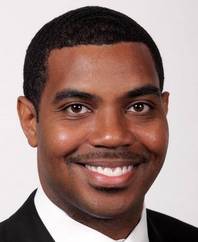
Senate Majority Leader Steven Horsford, D-Las Vegas, said the Legislature’s Interim Finance Committee will next week consider creating a Subcommittee on Spending Efficiency and Accountability.
Horsford said the subcommittee of six legislators will “stop allowing agencies to carry over expenditures, year after year, without justification.” He said it will also create performance indicators for state programs and agencies, something legislation during the 2009 session would have required, except it was vetoed by Gibbons.
Steven Horsford
“The bottom line is we need to rethink what is necessary and what is not necessary in state government,” Horsford said.
The Legislature’s subcommittee will make a recommendation to the Interim Finance Committee by Sept. 1.
Clinger said his working group would complete its review by November.
Clinger acknowledged that lawmakers and the public will likely disagree with some of his group’s rankings. “Not everyone is going to think we get it right, but it will be a tool for everyone to look at,” he said.
In a typical year, the state’s budget office would have by now directed agencies to prepare a balanced budget with cuts or roll-up costs, which account for inflation, caseload growth and employee pay raises, ahead of the legislative session.
Because of the size of the anticipated deficit, that approach won’t work, Clinger said. Out of a $6.4 billion two-year budget, Clinger estimates the shortfall at between $2.5 billion and $3 billion.
Clinger said asking agencies to prepare a budget with, for example, a 50 percent cut would be an arduous and unrealistic exercise “only to have us say, ‘wow, we can’t implement that.’” Instead, he is directing agency heads, including K-12 and higher education, to prepare 10 percent budget cuts, and initiating the parallel process of examining the entirety of state government.
To get a sense of the impact a deficit of between $2.5 billion and $3 billion could have, consider that when the state faced an $800 million budget deficit this year — prompting Gibbons to call a special session of the Legislature — among the cuts being weighed were eliminating a health care program for 20,000 poor children, cutting dentures and hearing aids for the elderly, closing a state prison and shuttering housing for the mentally disabled.
(Under an agreement between the Legislature and governor, those cuts were eliminated, and a 10 percent cut for K-12 and higher education was reduced to 6.9 percent.)
The Great Recession’s impact on tax revenue has forced a half-dozen rounds of such cuts since 2008. Added to the current economic uncertainty is not knowing who will occupy the Governor’s Mansion — Gibbons faces a tough re-election bid — and the Legislature, which will see heavy turnover. For example, because of term limits, no more than six of the 14 members of the key Assembly Ways and Means Committee will return.
The governor, whether it’s Gibbons or someone else, is required by the state constitution to submit a balanced budget to the Legislature in the first weeks of January.
“I see this as establishing a framework for putting together a budget in the future,” Clinger said of the group’s work.
Gibbons, a Republican, faces former federal Judge Brian Sandoval and former North Las Vegas Mayor Mike Montandon in June’s GOP primary. Clark County Commission Chairman Rory Reid, a Democrat, will likely face the Republican nominee in November’s general election.
Gibbons, Montandon and Sandoval have all maintained they will not raise taxes or extend the approximately $1 billion in taxes passed by the 2009 Legislature. The new taxes are scheduled to expire July 1, 2011.
Reid, meanwhile, has dodged questions about taxes, saying instead that he will await the Legislature’s Vision Stakeholder Group, a committee formed in 2009 to make recommendations on the state budget and quality-of-life measurements.
Those with experience examining the state budget say it would be impossible to cut $2.5 billion to $3 billion from state spending and not face federal and state lawsuits over failure to provide minimum services in education, health and welfare, prisons and services for the mentally disabled.
The state could cut $2.5 billion to $3 billion from the state budget, Clinger said. “The question is if you can live with the impact of having those services eliminated.”

Join the Discussion:
Check this out for a full explanation of our conversion to the LiveFyre commenting system and instructions on how to sign up for an account.
Full comments policy