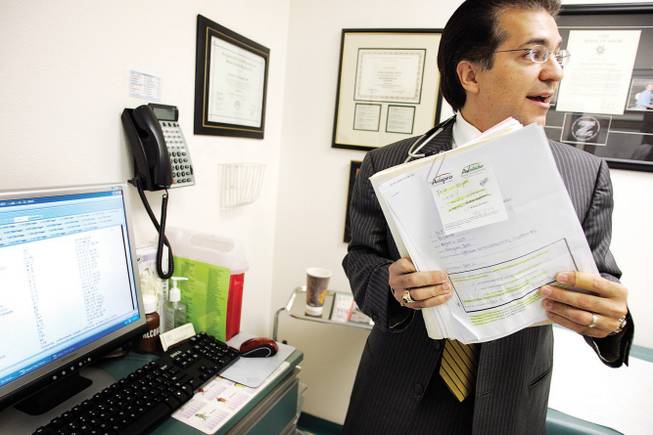
Dr. Tony Alamo holds paper medical records, the kind he used to deal with exclusively before converting his three-doctor practice to an electronic medical records system, visible on the computer screen at left.
Tuesday, Sept. 8, 2009 | 2 a.m.
Sun Archives
Sun Coverage
Dr. Tony Alamo grips a patient’s file — three inches of notes, lab results and pages of vital signs crammed into a manila folder — and compares it to the computer monitor in one of his exam rooms.
The folder is the traditional way doctors have kept their medical records. It’s worn and tattered, not easy to leaf through to find buried information and requires expert skills in handwriting interpretation.
The computer is his pride now. In the past year he’s converted to an electronic medical records system at his internal-medicine practice.
Alamo describes the paper file, the type of records kept in about 80 percent of small medical practices nationwide, as “cumbersome” and “difficult.” Still, he calls it “my comfort zone.”
“When you do it this way for 20 years it doesn’t bother you,” he says, holding up the fat manila file folder.
The government wants to spur doctors to make the transition to electronic medical records because of the benefits for patients, hospitals, insurance payers and the doctors themselves: fewer errors, less waste, reduced costs and greater patient confidence.
The Nevada Academy of Family Physicians is promoting the switch to its members, said Executive Director Brooke Wong. But she says there are two hurdles: cost (it’s on the doctors’ backs) and tradition.
“Old dog. New trick,” the 45-year-old Alamo says of himself and electronic medical records.
Alamo switched his three-doctor practice to electronic records to test a system that’s being developed by a friend, cardiologist Dr. Raj Chanderraj. That saved him the expense of the software, but he invested about $30,000 in hardware.
Patients now can see their records on flat screen monitors in each exam room. When Alamo pulls up their lab reports he can talk about their current cholesterol and blood pressure levels, and if patients are curious, flip to their lab reports from years back for comparison. With the click of a button he can print any portion of a record for a patient.
When Alamo writes a prescription, the program automatically points out quantity and dosage levels and generic equivalents, and alerts him if the patient is on a similar drug or if the medication might cause a reaction. Then the prescription is printed. No messy handwriting that could lead to errors.
The federal government is promoting the conversion with both carrot and stick. The American Recovery & Reinvestment Act of 2009 includes incentive payments for doctors and hospitals to convert to electronic medical records. And if doctors and hospitals don’t make the transition by 2015, they will be penalized with reduced Medicare and Medicaid reimbursements.
It could cost a single physician about $30,000 in hardware and software to make the transition to electronic health records, said Russell Suzuki, president of Certified Healthcare Systems, which sells the popular electronic records system Allscripts.
But there’s a significant financial return for converting to electronic medical records. A study in the American Journal of Medicine estimated that a doctor would realize an $86,400 net benefit over a five-year period.
Nevada’s pioneer in electronic medical records has realized a substantial cost savings. Southwest Medical Associates, the 250-physician practice affiliated with Sierra Health Services, the state’s largest insurance company (which is now owned by UnitedHealth Group), started installing electronic health records in 2004 and went totally paperless in 2008. Dr. Craig Morrow, medical director of Southwest, said it cost about $5 million to make the conversion, but the one-year savings on drugs alone was $5.4 million. Transcription costs were reduced by an additional $1 million annually and the records staff has been reduced by about 40 percent, an $800,000 annual savings.
“This is the most important step forward in medicine in my career,” said Morrow, who has practiced for 19 years.

Join the Discussion:
Check this out for a full explanation of our conversion to the LiveFyre commenting system and instructions on how to sign up for an account.
Full comments policy