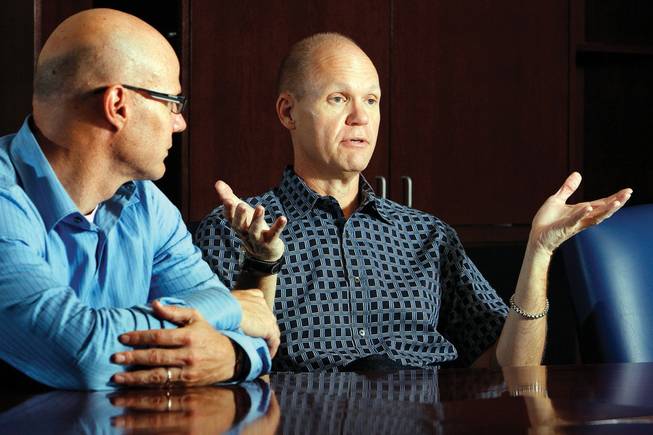
Regional Transportation Commission Director Jacob Snow, left, and transportation consultant Tom Skancke discuss a new multistate rail alliance last week.
Monday, Sept. 7, 2009 | 2 a.m.
Reader poll
Sun Coverage
Sun Archives
- DesertXpress train aiming for March construction start (9-1-09)
- Freeway to Phoenix gains traction with bridge work (7-11-09)
- Maglev or DesertXpress? One could be your new ride (6-14-2009)
- Trade-offs between technologies include speed, cost (6-14-2009)
- Maglev train to press on without Reid (6-10-2009)
Imagine boarding a train in downtown Las Vegas and getting off at a Colorado ski resort just a couple of hours later.
Or making a quick jaunt by train to Phoenix to catch a Suns game or some spring-training baseball. Or a quick round trip by train to Carson City via Reno to testify before a legislative committee. Or taking just a little more than an hour by train to get to the Mormon Temple in downtown Salt Lake City.
And just think of the millions of people across the West who might take a last-minute trip to Las Vegas to unwind if a train were available.
Even as two organizations are pitching high-speed transportation lines connecting Las Vegas and Southern California, some public transportation planners in Nevada, Utah, Colorado and Arizona are focusing on an altogether different vision: developing rail service in their states and others in the West.
Theirs is not just idle, wishful chatter around the water cooler. The officials formally ratified their alliance last week.
The group, which has been in an embryonic state for three years, calls itself the Western High-Speed Rail Alliance. Working with counterparts in other Western states, Jacob Snow, general manager of the Regional Transportation Commission of Southern Nevada, found several common interests within the Intermountain West and the Southwest, particularly among some of the fastest-growing states in the country.
“Since we do transportation planning and so much of what we do has to deal with the federal government and the bureaucracy and federal funding, we said, ‘What should our position be on transportation policy in the country?’ ” Snow said last week.
To find out, Snow met with representatives of transportation planning agencies in Salt Lake City, Phoenix, Denver and Reno and the Brookings Institution, a Washington-based nonprofit public policy organization that has researched transportation issues.
When Barack Obama was elected president and it became clear that high-speed rail would be an important part of his transportation policy, Snow moved to formalize the relationship with the other planning organizations.
Referring to Obama, Snow said, “When you look at what he has pushed for and what Congress has included in revenue for high-speed rail, there is money available. And we don’t want to be left out of where the country is going and where we think the country needs to be.”
The planning organizations on board with the alliance are the local RTC, the Regional Transportation Commission of Washoe County, the Maricopa Council of Governments in Phoenix, the Utah Transit Authority and the Denver Council of Governments. The organizations have made overtures to the Mid-Region Council of Governments in Albuquerque, but that group has not signed on. Planning organizations in Tucson and Boise have also been contacted as potential members.
Consultant Tom Skancke, who coordinates transportation initiatives for the Las Vegas Convention and Visitors Authority, embraced the concept and helped form the alliance, saying he likes the idea of planning regional transportation at the local level rather than letting federal transportation officials dictate policy.
“If you look at what has happened in the past with the interstate highway system, the federal government came in and said, ‘There’s a highway coming though here.’ And that was great, but there wasn’t any planning around it,” Skancke said.
Allowing local agencies to develop routes and technologies will better enable resolution of potential problems, he said.
“We can’t move Las Vegas Boulevard,” he said. “They can’t move the temple in Salt Lake City. You can’t move the football stadium in downtown Denver. So you’ve got to start from this local planning perspective.”
Some in the alliance fear that the federal government would ignore the Southwest, Midwest and Intermountain West states to focus on the East Coast’s and California’s intrastate train systems. Snow said John Inglish, general manager of the Utah Transit Authority, was indignant that federal officials would concentrate so much on high-speed rail on the coasts when his state is the home of the golden spike that linked the nation’s first transcontinental railroad.
So what would the Western High-Speed Rail Alliance’s system look like?
Snow said it’s way too early to know for sure, but members say a start would be linking the major cities — Denver, Salt Lake City, Phoenix, Las Vegas and Reno. Because of Las Vegas’ location, he envisions it to be a major hub.
Because the system could become part of a nationwide network, Las Vegas could become the gateway for travel to Southern California.
Developers of a high-speed rail proposal to link Las Vegas with Southern California — the DesertXpress — want to break ground on the traditional rail line by the end of March. Meanwhile, backers of a maglev system are drafting an environmental impact statement for their project.
They also have started a three-week television advertising campaign to show Southern Nevadans what a similar system operating in Shanghai looks like and to inform them of how many jobs would be created.
The alliance hasn’t decided on what type of technology would be used in its network. Snow said the newest versions of steel-wheels-on-rail trains in France are reaching speeds close to what the 300 mph maglev can achieve, but maglev, although more expensive, has some advantages.
The alliance’s next order of business is to get funding. Snow hopes to take the organization to nonprofit status with its own executive leadership. The alliance would qualify for grants from the Federal Railroad Administration, Federal Transit Administration and U.S. Transportation Department. Individual agencies are familiar with the application process. Snow thinks there is greater strength in multiagency requests.
He is setting up the alliance’s next meeting, in October; the group probably would meet once a month by teleconference and quarterly face to face.
Realistically, Snow and Skancke know that a regional rail system won’t be in place for at least 20 years — that’s about how long it takes to develop a freeway interchange or 10 miles of highway because of the necessary environmental approvals. But they agreed that developing a high-speed rail network has to start somewhere, and starting it with local planners is best.
The end goal, Snow said, is to expand capacity in Las Vegas, offering a new, easier mode of transit for people tired of lines in airports or who are afraid to fly.
“This is an investment,” Skancke said. “This is not a chance. This is not a roll of the dice. This is an investment in sustainability for our communities for the next 50 to 100 years.”



The statement that steel-wheel railways in France are reaching close to maglev's 300 mph speed is just complete garbage. 180-200mph top speed is nowhere near 300 mph, let alone maglev's far superior accelerating and braking capabilities which all significantly reduce trip times.
And France's TGV (which is actually inferior to both the German ICE and the Japanese Shinkansen) only achieved its marketed top speed in a trial run under special circumstances that are absolutely not achievable within regular operating conditions.
Steel-wheel rail systems require very extensive and expensive daily maintenance at these speeds and it is just not economically feasible to further introduce their top speed. There are also significant safety concerns at these speeds - any vehicle kept on tracks by small wheel rims only is not your ideal method of life insurance.
On the other hand, maglev does 300mph easily with low maintenance costs - simply because maglev technology is better suited for high-speed travel. Its inherent safety, convenience and economical feasibility is unmatched: a system that cannot derail and doesn't degrade its own infrastructure due to its contactless technology is the way of the future.
Maglev's low maintenance costs easily pay off even in the short run; even if it's slightly more expensive to build at flat terrain (while cheaper on mountainous areas), within a few years you're already winning on your budget with maglev.
Just imagine....Imagine boarding a plane in Las Vegas and getting off at a Denver just a couple of hours later.
Or making a quick jaunt by a plane to Phoenix to catch a Suns game or some spring-training baseball. Or a quick round trip by a plane to Carson City via Reno to testify before a legislative committee. Or taking just a little more than an hour by a plane to get to the Mormon Temple in downtown Salt Lake City.
We should all just hope that one day that occurs.
Hey....wait a minute....that has been happending for decades.
Given the time involved to get federal grant money and begin the official planning process for the multi-state corridors being talked about here, there;s plenty of time to work out the possible technical approaches.
Not meaning to sound like a pessimist, but 'the group has been in an embryonic state for three years...', so if this happens it will not be in our lifetimes. Europe runs on rails, and why, with all of our available land in the Western states, do we not take advantage of the rails to move goods and people. It was the basis of our Country's growth many years ago.
We can't afford maglev and it would never work in the west. Way too many mountain passes. They could never build one of those to Salt Lake City. Magnetic trains can't climb hills very well.
Another bad idea. Seems like a daily thing to read bad ideas in this paper every day.
AIr travel is too expensive for consumers, too time consuming for users, and really is an unpleasant experience. We've spent billions building airports in every American city... we can find the money to build high-speed rail between cities.
I am very concerned about ventures such as the DesertXpress. Why? Look who is backing this proposal...Marnell and Tharoldson. Why would these folks get involved with a train? For love of country? For love of Vegas? No. The train station will be a casino/hotel. They only view the DesertXpress as a method of shuttling people to their proposed casino. These kinds of people are what caused the monorail to fail. I will only support serious-minded people who want to build a legitimate transportation system. Not a choo-choo to their casino.
The state of Nevada has no money for the roads that we need now plus all the new money that we don't have for all these new trains that are on the RTC wish list' Plus that nice new highway that they want to build between Phoenix and Las Vegas and then on to Reno. And lets not forget Terminal 3 at McCarran airport. So are we like paying cash for all of this or is this just going to be another credit card purchases.
"air travel is too expensive with escalating fuel costs and surcharges for baggage and landing fees"
I doubt that the Maglev ticket prices will be cheaper than the airline's and that is with the billions in taxpayer money to support it.
Spend, spend, spend....deficits, deficits, deficits....tax, tax, tax...Spend, spend, spend....deficits, deficits, deficits....tax, tax, tax...Spend, spend, spend....deficits, deficits, deficits....tax, tax, tax...Spend, spend, spend....deficits, deficits, deficits....tax, tax, tax...Spend, spend, spend....deficits, deficits, deficits....tax, tax, tax...Spend, spend, spend....deficits, deficits, deficits....tax, tax, tax...Spend, spend, spend....deficits, deficits, deficits....tax, tax, tax...Spend, spend, spend....deficits, deficits, deficits....tax, tax, tax...Spend, spend, spend....deficits, deficits, deficits....tax, tax, tax...Spend, spend, spend....deficits, deficits, deficits....tax, tax, tax...Spend, spend, spend....deficits, deficits, deficits....tax, tax, tax...Spend, spend, spend....deficits, deficits, deficits....tax, tax, tax...Spend, spend, spend....deficits, deficits, deficits....tax, tax, tax...Spend, spend, spend....deficits, deficits, deficits....tax, tax, tax...
Nice idea but we'll all be dead before we see somet hing like this.
Boy! Look at all the 'can do' spirit here from the conservative k(no)w nothings.
"We can't afford maglev and it would never work in the west. Way too many mountain passes. They could never build one of those to Salt Lake City. Magnetic trains can't climb hills very well."
Another falsehood raining on us from the sky. For some reason, it happens all the time.
Maglev is well known for having significantly better grade climbing abilities than other ground transport systems. It can climb up to 10% grades which results in far less viaducts and tunnels while allowing much more challenging routes to take than any conventional high-speed train today (which are maxed at about or below 4%).
Why? Because maglev won't slip on the rails, regardless of weather conditions. It has no surface to slip on and the magnetic fields won't release the trainset.
Please gather some real information before spreading misinformation.
and what would be the cost for that train ride...2, 3, 400 bucks per person? everyone talks how wonderful it is but does not discuss fares!
is this another government run am trak?
SgtRock, like most other right-wingers, likes being underdeveloped, under-invested and economically irrelevant, not to mention repeating talking points ad nauseum.
Thinks like trains are called investments and when the 'government doesn't work' people don't get their crooked hands on the cash through cozy insider contracts and outsourcing, it tends to pay back far more than is invested.
The problem isn't spending money, it's giving it to glad-handling crooks who hate government, but like tax money.
If ya'll want to live in a backwards, underdeveloped, undereducated dump that people are screaming to leave, then please move back where you came from.
POWERPLAY,
When businesses make a big investment, do they pay all cash for it? Very rarely.
Please learn how a large projects are actually funded.
POWERPLAY,
When businesses make a big investment, do they pay all cash for it? Very rarely.
Please learn how large projects are actually funded.
"particularly among some of the fastest-growing states in the country."
What States are those? Nebraska? Texas?
They are pitching an idea to State(s) that are not currently "growing".
Sunlizard, what the hell do you know?! The Desert Xpress is not the option. Who the hell wants to take a train to Victorville and have to drive the rest of the way or catch an Amtrak the rest of the way? Nobody!!
Either build the damn train all the way to L.A. and Anaheim or go back to the drawing board. Victorville sucks and nobody wants to go there.
Priceless! Jacob Snow, prior to "working" at the RTC, was one of Randy Walker's boys (or "brothers") and between the two of them, or three if you include Sig (four, if you include another lobbyist name skank-ie) could not get a mass transit system from the airport to the strip!
Vegas should have the worlds best, easiest, cleanest, safest, nicest monorail or light train from the airport to any hotel on the strip.
Portland & San Fran both have excellent systems! Vegas...we got RTC, what a joke!!!
But then again, Sig with Walkers "sons" ran the mono rail bankrupt and into the ground.
Sounds like the dreams of 150 years ago.
Kresnik, like most other koolaid drinkers, likes being spending tons of money on economically disadvantage systems just to have the ability to "feel good" about themselves while our nation is generation trillion or mult-trillion annual deficits.
If you want a Melvel train then go out SPEND YOUR MONEY and buy that train companies' stock and bonds.
Do not bury my children and the following generations with tons of debit to build systems that are already serviced by cheap airline systems.
To maintain credibility the RTC should consider finding a new "consultant." One that doesn't make such stupid statements like, "If you look at what has happened in the past with the interstate highway system, the federal government came in and said, 'There's a highway coming though here.' And that was great, but there wasn't any planning around it," Skancke said." Even elementary kids know how to use the internet:
http://www.fhwa.dot.gov/interstate/homep...
Even if we all approved of the Desert Xpress, would you honestly be satisfied being transported to Victorville and no further?
Doc Holliday: of course no. Noone wants to go to Victorville, either from LA or LV.
That's why the DesertXpress is no option. There is a reason to the DesertXpress ending at Victorville: it can't climb the mountains towards LA.
But the maglev can. Maglev can be routed through the Cajon Pass because it can handle the challenging terrain.
The maglev can go directly to Anaheim, be the first intercity maglev in the world and thus bring pride to the US, keep a significantly higher top speed, accelerate faster, brake faster, be more convenient - and cheaper to maintain.
What else is there to consider?
"Realistically, Snow and Skancke know that a regional rail system won't be in place for at least 20 years -- that's about how long it takes to develop a freeway interchange or 10 miles of highway because of the necessary environmental approvals."
The environmental impact process shouldn't take 20 freakin years. We need to be more nimble. I'm all for protecting the environment but that is ridiculous.
This actually is the first good idea i've heard in a LONG time. As long as:
a) it's economically viable
b) doesn't take 40 years to do (yes, that is ridiculous and strangling the US). I'm a conservative (I guess) and an environmentalist (I guess) as long as both don't get in the way of doing ANYTHING.
c) you don't have "TSA" type security that turns a 30 min train ride into a ridiculous 4hr trip (issue with the "plane" approach), assuming terrorists play ball of course and don't make it a target
d) costs (tickets) are reasonable
High speed rail connecting all even better. We spend "trillions" other sh-t, why not spend a few billions on something that can ACTUALLY work (like this "could")
I'm with Doc Holliday, kill the Desert X-Press. Use the "X" as the mark to drive the stake through its heart. Then lock the corpse up in a box and bury it miles deep inside the belly of Yucca Mountain. Do it right and build the line all the way to Los Angeles, or don't do it at all. (Victorville?? Get outta town!)
Sgt.Stone,
You get outta town, too. Flying is one of the worst and most inconvenient experiences anyone can think of. And while it is NOT even "cheap" now, as you claim, costs are going to go through the stratosphere just as soon as the global recession ends. China and India are booming, and are going to suck up every last drop of petroleum they can get their thirsty tongues on. The mark of a true conservative is one who understands that their IS a limited role for government in the affairs of the people. The scope of putting together a modern rail system in the U.S. is only something we can undertake together as a nation.
If we don't do this, our national economy will be at a significant disadvantage with Europe, Japan and China, all of which are moving ahead with their own versions of government-sponsored, 21 century high-speed rail transportation.
"...already serviced by cheap airline systems..."
My arse... Get back to us when you have a constructive idea, Sgt. Stone.
yes, and that "Victorville" train nonsense...ROFLOL (holding nose, can you REALLY be serious about that kind of nonsense)?? unbelievable. Reminds me of McEnroe (given i'm watching tennis): "you CANNOT be serious" (about victorville) ROFLOL
Since when can't a steel wheel on steel rail vehicle climb a 10% grade? They do it all the time in Pittsburgh and Portugal, rain or shine. If a locomotive can haul scores of loaded freight cars up Cajon Pass, then it can haul itself up a grade several times as steep. All it takes is to have every axle powered. Electric and diesel multiple unit trains(EMU/DMU)are nothing new. The 1960s San Diegan Budd RDC and every subway train are examples. The problem with steep grades is the enormous power they require, especially at high speed, but the same is true of maglev.
90% of the current fiscal debt is due to regan and bush tax cuts for the rich and spending for military campaigns.
This is 9 trillion dollars wasted on weapons and death.
Building railroads is a much better thing than bombs, bombers, missiles, land mines, etc, etc.
"The limited role of the govt" is to protect and defend the constitution and protect it's citizens, not build another sink hole for money. Amtrak is a good example of govt waste and inability to operate in the free market. A coast to coast ticket on Amtrak costs the taxpayer about $500. Airline travel is faster, less expensive, and safer than rail travel, and will always be the prefered method of travel in the USA. Keep the govt out.
Jacob Snow wants to spend millions if not a billion on these train schemes, but at the same time refuses to allocate any portion of his agency's funds to provide simple bus service to the portion of metropolitan Las Vegas south of the 215 and west of the 15....even though there are at least 50,000 residents living in the area.
Nice guy. Maybe some transit agency in a larger metropolitan area will hire him away, and rid us of him.
To SgtRock: Go to work, get your pay, support your family...go to work, get your pay,support your family...go to work, get your pay, support your family...that's what government does. It works, collects taxes, and supports the country. To be confused about this basic relationship indicates that something is happening in this nation. We are seeing the emergence of a true PEASANT CLASS. They work for low wages, they are fiercely loyal to "The King" and they resort to violence at the drop of a label. Blind authority. Blind following. Dark Ages to follow.
"If we don't do this, our national economy will be at a significant disadvantage with Europe, Japan and China, all of which are moving ahead with their own versions of government-sponsored, 21 century high-speed rail transportation."
Only a very, very, very, very tiny portion of travelers in Europe, Japan and China is done via high speed rail.
If they want to spend billions of taxpayer money to build and hundreds of millions each year on high speed rail so that relatively few number of travelers can go by high speed rail then they should go right ahead.
Let them be proud and beat their chest.
If you think it is a great idea then go and buy stock or bonds in the company that will build and run the trains. Do not force me, my children and their childrens' children (from this generation to next) to pay for money on such wasteful operations just to make you feel good.
If high-speed trains are so great then why do they need billions of taxpayer money to build and then hunreds of millions annually to run.
All other forms of transportation (other than government ran Amtrack) is self-funded. Roads are built and maintained from gas taxes paid by users. Airports are built and maintained from fees charged to the Airlines.
BTW, the US government spends around $1,200 to fund a Amtrack passenger to travel from NYC to LA. That fact should be enough information to doubt high speed rail.
DTJ:
You are kidding with your criticism of air travel, right. Although I agree that is is a pain in the as.....er....butt, you can't say it is not econimical. You can fly from here to Orlando on Southwest for about $200. Just the gas would cost you that to drive. Try to keep it real.
It s great to hear that highspeed rail in the US is now becoming concrete. When I was in the US last year I was really surprised how such a great country can live with such a poor transport infrastructure. Just look at Europe, at Japan, at China: Paris-Marseille (470 miles) in 3 hours, Madrid-Barcelona (390 Miles) in 2:40, Peijing-Shanghai (810 miles) in 4 hours! Not airport to airport, but city center to city center. What are the Americans waiting for?
But forget about maglev! Its a fantastic technology for a test run - but definitely not for daily service. We have been discussing it in Germany for 40 years now, examined tree projects - and abandonned them all. Same thing in China, they built a demonstration line in Shanghai, and finally switched to conventional rail for their nationwide network. There are plenty of reasons for this:
- Maglev is extremely expensive - even more than you can imagine. The Munich Airport Link would have cost per mile five times (!) the price of a TGV Highspeed line, and nearly the double of the very expensive British "Highspeed One".
- Maglev makes you dependent on one provider, because trains from competitors don t work on it s highly specialized track. For the second batch of trainsets you will pay monopoly prizes! With Rail you can combine nearly everything (Spain is running trains from 4 different providers!). Would you really built an special airport where only Airbusses can operate, no Boeings?
- Maglev is not suitable for networks: It can t be integrated in existing rail infrastructure, making it difficult to run into city centers. Just look at Shanghai, the Transrapid ends in the suburbs, where passengers have to change to the metro, loosing all the gained time. Guess why they built afterwards a direct metro to the airport... The maglev switches are very complex, expensive and slow, suitable only for point-to-point lines and lengthening the headway of trains (5 min for Transrapid, but only 3 min for TGV and Shinkansen).
- Most of the advantages claimed by the maglev industry have never been proven. Maintenance costs, energy consumption? I ve been asking for decades for solid facts - nothing available. I can guess why they don t want to publish it...
Let s hope that the US will make the right decisions - and not waste time and money in discussions where the result is long since known.
"Boy! Look at all the 'can do' spirit here from the conservative k(no)w nothings."
Just one word for you, mschaffer -- AmTrak.
For the rest -- just imagine instead of catching or train or plane to SLC to go to a Mormon temple, drive east on Bonanza until you run into the local Mormon temple sitting up there for all to see at the foot of Frenchman Peak. SLC's only significance is its historical and sentimental value.
PBIM72,
The conversation is about travel within the region: Vegas to Pheonix, Vegas to L.A., etc. If I want to go to L.A., I hop in my car and get there -with my car still at my convenience, for LESS money than it would take to fly. And if my family of four is making the trip? Back atcha: "try and keep it real."
Additionally, as I point out, once the global recession is off, jet fuel prices will e.x.p.l.o.d.e. -I guarantee it. Your trip to Orlando will cost you your $200 (one-way) in extra charges, alone. Forget about what airfare will be!
What is a "Mormon Temple"?
While the above poster was busy extracting his head from his posterior, the rest of the country learned first hand how it was the right-wing "crackpots" who ran this nation into the ground. If not for the emergency CPR performed on the national economy by the federal government, said poster wouldn't even have his job allowing him to drive his 10 miles-per-gallon heap.
And nobody is saying you can't continue driving your heap. We'll all wave to you from inside the high-speed train when we whiz by, as you push your pile towards the gas station charging $9 per gallon of gas.
A better network of trains is the future, it's coming, get used to it. Japan and China are NO Russia. You're on the wrong side of history, not to mention you're side lost the election. Obama is no left-wing ideologue, anyhow. He's a pragmatist who's interested in what works. That said however, last time I checked, in this country you are still free to remain a buffoon. So think and do as you please.
Please tell me they'll go further than Victorville.
Mormons,
Jeez, lighten up. Obama is not out to do all that stuff. If he did, I'd lock-n-load and stand beside you. But he's not. Our nation is in a mess right now, and he happens to have a plan to right our ship.
I'm pretty sure the pendulum will eventually swing too far (it always does), and then we'll need the second coming of Ronald Reagan to correct that mess, too. But that's not where we are right now; we're in the toilet because of too much greed, too much narrow, right-wing ideology, and not enough oversight. Obama happens to be just what the doctor ordered. Let's give him a chance. He's not the wild-eyed commie radical you fear.
The claims stating "maglev is extremely expensive" are lies. Maglev is not more expensive than a conventional high-speed train - construction costs are approximately the same while maglev's operating costs are significantly lower so within a few years of operation it's already a winning scheme.
Anyone claiming falsehoods about maglev's "immense" construction costs are challenged to prove their claims - they won't be able to do so and I can prove the contrary.
Surmoka,
Don't wait -state your case. I'm a neutral party in the Maglev/high-speed rail debate. May the better technology win. But today is hardly the first time we've heard that Maglev is expensive. That it requires an entirely new route infrastructure, whereas existing lines can be used, or upgraded, for convention rail stock, would seem to be the biggest hurdle. Just purchasing and piecing together public and private property to line new routes throughout the nation seems daunting, at best. Please tell me how I'm wrong.
I'd love for the U.S. to leapfrog the Europeans and Asians in Maglev technology and have all the world's Maglev rolling (floating?) stock produced in the gool ol' US of A.
DTJ: you're right about Maglev requiring new infrastructure. But conventional High-speed rail requires entirely new infrastructure also. There's no way you can use the existing tracks in the U.S. for high-speed rail travel. Everywhere in the world, HSRs run on dedicated lines - take a look at Japan where the Shinkansen has its thoroughly fenced rails even inside cities.
So you're not better off with conventional HSR either. You don't build rail infrastructure for a few months or years - you build it for many decades and if the U.S. sticks to the technology of the 19th century, which serves its purpose well but has reached its limits, the U.S. forever misses its chance to leapfrog an entire generation and go with the maglev.
Let's examine the most recurrent points against Maglev briefly:
1. "too expensive": false. It depends on what you are willing to pay for what you get. You get, for approx. the same construction price as HSR, a system with lower maintenance costs. Due to maglev's superior routing parameters, on a challenging terrain you need far less viaducts/bridges and tunnels (for reasons see below) which makes it cheaper to build maglev on mountainous areas. And a HSR can't even pass through the Cajon Pass because of its limitations (and thus can't go to Anaheim or LA, that's why it would end at Victorville); for the Maglev it's a no-brainer.
For a comprehensive analysis including a business case in the UK, refer to this document at the UK Ultraspeed site:
http://www.500kmh.com/UKU_Factbook2.pdf
2. "bad climbing/traveling etc.": false. Maglev, compared to any other ground transport system, has significantly higher top speed, better acceleration and braking, better grade climbing capabilities, smaller turning curve radii, higher ride comfort, lower noise, lower maintenance costs, less vibrations, higher passenger capacity, and all while using up less energy for operation. Maglev's drawback: there's a lower maximum of payload mass capacity but still easily enough for passenger transport. Other drawbacks: none.
3. "bad safety/reliability etc.": false. Over 90% of railway accidents happen due to/as a consequence of derailment. But the maglev can't derail because it wraps around its guideway. You'd practically have to completely dissect the train to get it off its tracks. The maglev won't be brought to a halt because of ice tearing down the overhead wires because there's no overhead wiring. The cables lie on the underside of the guideway, protected from precipitation and wind. The Shanghai maglev has a reliability of 99.98% up to this day and has a cumulative delay under one second over entire operating days.
For visual demonstrations, try here:
http://www.transrapid.de/cgi-tdb/en/basi...
@Nozomi07:
You can visit the Transrapid test facility in Germany to verify data yourself.
Different vendors for trains -yes. Purchase any train to run on HSR - no. HST are mostly custom built to match voltage and signalling systems. In Spain only the Siemens Velaro is a 'off the shelf' product. Note that Transrapid is also multi vendor.
As you live in Germany, let's take a look at what happened to all the routes where the Transrapid was proposed; to this day no HSR or comparable solution was built instead:
1. Hamburg - Berlin
Maglev plans abonded in 1999/2000; the railroads decided to go 'cheap'. No new HSR line was built. Instead the existing line was upgraded twice for tilting ICE trains. Route now covered in 90 minutes; 37 minutes slower than the Maglev would have been. Higher speeds strains the track more - concrete sleeper failures had the line out of service recently. Over $ 1 billion was spend on its infrastructure already. Also the ICE train service seriously limits the freight train services on the line. Penny wise, pound foolish example?
2. Metrorapid
Maglev plans for a 80 km intercity connection "Dortmund -- Essen -- Dusseldorf", abonded in 2003. Government funding was available, the region was willing to press on, but according to the book of professor Schach the Green Party (strong Ttransrapid opponents) sacked it by threathening to step out of the government if the Maglev plans were pursued.
No viable solution is in place, the nearest plan is for a metroexpress that might be ready by 2023. Existing 4 track infrastructure(!) is too intensively used. Hence new infrastructure is required anyway - exactly the reason why the Green Party canned the Maglev. Initial CAPEX already estimated over $ 2 billion.
3. Munich airport line
Plans for a 40 km Munich airport link. Abandoned in 2008, when cost estimates nearly doubled from $ 2.6 to $ 4.9 billion. However this was due to longer tunnels, underground stations and the like, not to Maglev. No solution can be found for the amount of money available. The favored S-Bahn express alternative, an extension of the commuter rail connection, already exceeds the available funding with an estimate of $ 3.4 billion.
So none of the proposed steel-wheel alternatives have proven to be much cheaper either.
Research data on Transrapid is available if you look at the right places. Stochastic costs of rail and maglev are given in a book by Professor Schach which I recommend you for reading (in German) : [http://books.google.nl/books?id=STA6BWv_hGoC&pg=PT1&lpg=PT1&dq=hochleistungsbahn+prof.+schach&source=bl&ots=9u9rBcsn6H&sig=TKGYLghe4C58zSbTZK5FMH9BKCI&hl=nl&ei=L-97SvXjFYPW-QbXxMEw&sa=X&oi=book_result&ct=result&resnum=1]
RailObserver: you're wasting your time on "Nozomi07" as he is a well-known anti-maglev propagator (possibly paid by the rail industry), over there on the Maglev Board he has already been banned for repeatedly spreading lies and intentionally deceiving people.
Rail travel will only work in the USA if gas prices are $5.00 a gal and air travel is scaled back. Rail sounds sexy, but the truth of the matter is most people want to get from point A to point B quickly and cheaply. Let private money fund this and lets see just how profitable it is. I wonder what % of Govt funding these other countries rail programs receive to operate.
Keep the US Govt out.
If you want an AIRPORT or a ROAD then go out SPEND YOUR MONEY and buy that AIRPORT or ROAD companies' stock and bonds.
There Sarge, I fixed that for ya.
Oh and do you mean money wasting, budget busting big-government boondoggles like the Highways and Roads you drive your car on?
The construction costs of maglev are definitely higher. Just compare "Highspeed 1" in Great Britain with the maglev project in Munich: Both have long tunnels to reach the city center and run through similarly populated areas. Here are the prize tags:
- Highspeed 1 (rail): 5.2bn for 67 miles -> $115m per mile
- Munich Airport Link (maglev): EUR 3,8bn for 23 miles -> $230m per mile.
For maglev you have to pay double the prize, in a similar situation! The greatest advantage of Rail is not included in this example: In many cases existing infrastructure can be used (as the TGV in Paris does), lowering the costs per milte to $50m.
On the other hand, the claim that maintenance costs of maglev were lower is simply unproven. A maglev vehicle costs 3 times(!) the prize of a highspeed rail vehicle, so also spares are much more expensive. Even if they last longer, it does not mean lower costs.
Just look at the German Transrapid projects: in all three cases significantly higher fares were planned! To finance the losings of Metrorapid fares for all public transport in the region would have gone up - you can imagine the protests, wich finally helped to skip the maglev project. And in none of the cases any private investor was willing to put his money in maglev - they know why.
You don t believe me? Then you should believe the transport experts in the world. Why did China decide against maglev, in favor of rail? Same with Corea, Taiwan, Spain, Russia, Italy, Argentina, ...(the list is endless), they all build high speed rail, no maglev. The list of Transrapid projects in contrast is short: 20 miles somewhere in the suburbs of Shanghai, that s all. Great success after 25 years of intensive commercialization, isn t it. No wonder, if you see the maglev prize tag.
Just to back up the original point about construction costs, standing strictly on the ground of reality:
* The Shanghai Maglev line cost about $70 million per mile including vehicles, maintenance facility, service track segment and the stations; moreover, the almost the whole track has been built on swamp, significantly boosting construction costs.
* Baltimore to Washington Maglev is planned as a $3 Billion project budget
And it doesn't matter what technology you use, you won't be able to achieve a lower cost-per-mile ratio.
Talking about construction costs, I'd like to dispel misbeliefs (or better said, the lies that were spread intentionally): maglev is significantly cheaper to operate than high-speed rail and this is proven in Shanghai and the test track in Germany. High-speed rail requires DAILY maintenance, as opposed to Maglev. Maintenance costs don't primarily originate from vehicle costs but the costs of the track/guideway and this is where maglev wins hands down.
Operating costs count a lot more even in the short run than construction costs. One of the main reasons why Maglev hasn't been deployed yet in intercity scale is the rail lobby: industry is interested in the expensive maintenance of existing high-speed systems. They'd just lose a large part of their job in operating a very low-cost system.
Maglev or SteelWheeltoRail?
Both has advantages and disadvantages.
Everything was discussed by bloggers that supports each side. But let's discuss other facts. Las vegas to So.Cal corridors is just on extension of California west corridors from SF/Sac down to SDiego. Based on the California Rail Authority website their train is steelwheel to rail and they are currently working their EIS. In fact Californians has approved $9.5B Prop.10 last year, plus the fund coming from the Federal Stimulus Fund. Having said that, a COMPATIVILITY, CONTINOUITY, of rails is very important in the operation incertain corridor. I think California will not permit a Rail on the side and maglev at the end. or having maglev in between routs. The same I think with the concepts of the Federal on all corridors, they want all corridors have a continous, compatible rail around the whole United States. Maglev if Maglev, Rail if Rail.
In addition before Maglev can be applied, a Safety Standard has to be set first before the Federal Railroad Administration and Transportation Safety Administration because we do not have it yet,which I think it will take time.
It seems it's necessary to repeat and stress that YOU CAN'T USE EXISTING CONVENTIONAL RAIL TRACKS for high-speed rail travel. You must start from scratch with either technology. There's no point in sticking to the current technology and forever miss the unique chance of making this technology leap.
i hope they have a cargo car to hold all the furniture of people leaving vegas.
A lot of posters far more knowledgeable than I am, have showed up and shared their views. (Methinks a few of them are not posting from this community -nor from this country, for that matter -that an ongoing debate from some European forum has found its way over to our humble, little site. But THIS IS A GOOD THING. More information is good; I am hardly complaining.)
I do believe that this is a rare opportunity, ie., the political consensus, the availability of funding (the stimulus money is going to be spent whether you like it or not; why not put it into something that will pay long-lasting dividends), and the fact that no other nation has taken any clear-cut lead on this, all point to this being a moment in time we should not squander. Just as U.S. aerospace remains one of the last few bastions of good, competitive U.S. jobs, may the outcome of this debate lead to a whole new industry providing the U.S. with jobs and technology.
Who are they going to bring in to build these railroads? No american will work in 125 degree deserts from Vegas to Wherever for less than 25 an hour?
Since this project would be at least partly publicly funded, jobs would pay prevailing wage which comes in at least $25 an hour. If truly privately funded, it would still probably pay at least that much. Any large construction project needs the unions on board to man up. Especially in this employment climate, I don't see getting workers to build it as a problem. Heck, people stood out under the desert sun and built houses and roads in this So. Nevada for years, for far less money. However crews that maintain rail lines or highways operate now, is how this would be done.
Let me give you one more example of cost comparison between maglev and rail:
There is a study commissioned by the dutch government for a high speed line between Amsterdam and Groningen*. The results (investment / travel time)
Maglev: EUR 6,7 bn, 60 min
High speed rail: EUR 4,1bn, 75 min
Conventional train on improved tracks: EUR 2,6bn, 105 min
As you can see, maglev has the advantage of higher speed, but for a much higher prize! The question is wether these 15 ninutes really matter. We must not forget that we re talking about taxpayers money, so efficiency is very importand. The dutch finally decided to built the cheapest variant.
Sumoka, your figures from Baltimore maglev are just a cost estimate - and these are often created to convince polititians to start the projects, the real costs will show up afterwards. We have seen that in Munich: Estimated at EUR 1.85bn, the maglev would finally have cost 3,8bn! The shanghai maglev is difficult to compare with american or european projects since manufacturing costs in China are much lower.
By the way, it would be helpful if you could give me reliable souces for your claim of cheaper running costs for maglev. I ve never found any figures proving that. And if you don t believe that high speed trains can use existing lines, there s a simple solution: just board one and find it out. E.g. Paris-Marseille: The train uses existing lines in both urban areas, but in between it whizzes with 200 mph through the countryside. That reduces both travel times and construction costs. All highspeed systems in the world - except Taiwan - use existing infrastructure!
*http://www.tu-dresden.de/vkiva/hlb/fachtagung_tr/trt5/07_trt5_vortrag7.pdf
sorry, only in german, but the data can be found on pages 8 and 11.
... About TIME S. Nevada!?! We're doing this in the Bflo./Niagara region with-a-high speed route between us-&-Albany, the state capitol!
Redwood, A Mormon Temple is a place everybody on the back of a milk carton ends up.
Oh, Victorville??? Do you get a free air freshener with ticket purchase??
I would take a regular Amtrak to California or Salt Lake City, only if the was a stop in Vegas. Many people from Southern California Take Amtrak California Buses to the Greyhound Bus Depot downtown. Just think if they rebuilt all the train stations throughout the West would all be getting out at the Las Vegas Station, currently the Plaza Hotel downtown. They could make if a like a booze cruise from LA to Vegas in a few hours time. Vegas families could make daytrips to Disneyland and be home for work the next morning.
Getting on a train is alot easier than going on a plane. Taking a plane to Phoenix (a hour flight): you have to show up 90 minutes early, wait another 30 minutes to board the flight, fly, wait 15 minutes to taxi for the entrance, spend 30 minutes to get out. Basically, it takes 4 to 5 hours to even use a flight, about the same time if would take to use your car to get there.
At least on a train, they could be much nicer than the help in the air.
Nozomi07: and your cost figures are just cost estimates from Holland, same as with the Baltimore-Washington line.
I see you elaborately "forgot" to take the Shanghai facts into account. The costs are there in black on white, not esitmates. You have no chance to "prove" your repeated lies about Maglev being eeeextremely more expensive. Truth and reality easily wins over you.
All you Proponents of the train sinkhole can just go back to your train sets in your garages and play engineer with your HO scale high speed maglev toys. We don't need more TAXES, nor do we need more Govt. Let private money build the rail system. Not the Govt. Very few people will use the train, that's why private money isn't being invested.......It is a loser.
Sumoka,
we should only compare things that are comparable. Not chinese wages with american ones (as you do in the Shanghai example), and not estimations with real costs (as you do in the Baltimore example.
In my dutch example I compare estimation with estimation, carried out in a country that has neither rail nor maglev industry. This is the fairest comparison you will ever find. And the result is similair to many other studies, e.g. California Highspeed Rail.
This discussion is typical for the hundreds of maglev discussions I have experiencenced. Maglev proponents promise heaven on earth, but when you ask for facts and figures, you get no answer. Just look at the very first posting here:
"Maglev's low maintenance costs easily pay off even in the short run..."
Sounds great! But can you prove that? Apparently not. And it was definitely wrong for all three german maglev projects: None of them would have payed back its astronomic construction costs. Munich would at least have earned its runnig costs, Metrorapid would have needed subsidies for all lifetime. That s why thousands of citizens went on street to protest against this waste of money, and the government finally had to stop them - we all remember that.
Surmoka, you are perfectly right if you say "Truth and reality easily wins". So was it in Germany and China, and so will it be in America. I think we should stop with this debate now. All arguments have been mentioned, so the readers can form their own opinion.
As I know you quite well, I'm not wasting my time on getting with you into discussions which, in a very short time, inevitably end up in a pointless debate about a truckload of falsified data.
Other interested readers are advised to refer to the www.transrapid.de page for technical and economical info, as well as this document:
http://www.500kmh.com/UKU_Factbook2.pdf
where detailed and comprehensive analyses can be found about maglev, among them the construction and operating costs.
Surmoka, is this really the only source you can give us? A single maglev fan somewhere in UK, running a private fanpage called "UK Ultraspeed"? Yes, it s exactly that paper I have in mind when I say: They promise heaven on earth, but can t give reliable facts and figures. In the UKU-Dreambook I do not find any sources for the fantastic things they claim. But I see that their cost estimations greatly differ from what the german government calculated. Now comes the big question: Who is wrong, the german government, or a single maglev fan in UK? And why does the UK government plan a normal highspeed rail (HS2)- and no maglev?
Just a short notice to readers: the guy above is lying (again).
* still no answer to the undoubtable Shanghai case
* UK Ultraspeed is not a single maglev fan but a joint enterprise of more than 6 companies, developing the maglev case for the UK; the project is alive and kicking
* the UK government hasn't made any decision on HSR or maglev.
Surmoka, on the UKU Homepage I can t find any of those "6 companies". Could you name them please? And you really find it "kicking" if the last update of the "factbook" is 3 years old, the last news 5 months? I wonder what those "6 companies" are doing all the time...
I find it quite dubious to call other participants in a debate "liar". But if you do so, you should at least prove it.
Spocanon,
"Let private money build the rail system. Not the Govt. Very few people will use the train, that's why private money isn't being invested.......It is a loser."
To begin with, a high-speed train DONE RIGHT will have plenty of ridership. Just look at the Amtrak commuter runs on the eastern seaboard. You don't know what you're talking about. And, it's precisely because this is too big for private money, that public money must do this. Even if they could, unlike you, I would never want the idiots who built the Las Vegas Monorail touching this project. These same private sector geniuses now want to build the train to Victorville.
The problem with you formulaic right-wing philistines is, you have failed to notice the monumental failure of the captains of private capital, who have just finished destroying untold trillions of dollars and damn near brought down the planet's economic edifice. In fact they would have, if not for *government* intervention around the world. Wake up! Smell the roses, the coffee, and the right-wing manure. Then buy the ticket, take the ride. High-speed train service is a-coming 'round the bend. ALL ABOARD!
DesertXpress is the nation's first privately funded, exclusive (passenger-only) high speed interstate passenger railroad. The high speed rail system is being developed to provide a convenient and efficient travel alternative to Interstate 15, without tax payer dollars. Traffic on the I-15 is expected to grow 60% during the next several years. There are no public funds programmed, nor plans developed, to widen this highway over the majority of its length, which in most places has only two through lanes in each direction. A new transportation alternative is needed to mitigate traffic congestion on I-15. Victorville is the key to making the project financially viable by avoiding the inestimable high cost and environmental and community impacts of extending the line over Cajon Pass into the LA Basin; while bringing the service close enough to the majority of Southern Californians who drive to and from Nevada to make the project successful. The Victorville hub station diverts over 25% of the auto passengers off the road, thus providing much needed relief and bringing more people to Las Vegas by delivering high quality, frequent and reliable service in less time than it takes for most people to drive all the way across the Mojave Desert, or park, wait in line, board and fly to Las Vegas. The DesertXpress line is planned and designed to be extended as rapidly as possible approximately 50 miles to interface with the inter-modal facility planned in Palmdale on the voter-approved California High Speed Rail Project. Since the system will use non-proprietary, high quality, standard gauge steel rail technology, the lowest possible cost can be realized for expansions. The system also is designed to facilitate extensions to Ontario and other destinations in the Los Angeles/Orange County Basin, as and when funding becomes available. In Nevada, the system can be readily extended to other destinations as well, such as Phoenix and Salt Lake City, and can easily serve the proposed Ivanpah Valley Airport, which would locate its terminal complex immediately adjacent to the DesertXpress tracks.
The California Nevada Super Speed Train Commissions' Maglev project is hoping to get $2 billion in Federal high speed rail grant money for a system that only spans 40 miles from Las Vegas to Primm. Recent independent cost estimates for Maglev construction in this country, referenced in the Government Accountability Office (GAO) study, were performed by the Southern California Association of Governments, Maryland MTA (for the proposed Baltimore to Washington DC maglev), and the designated public transportation planning agency for the San Diego Association of Governments, found that the cost of maglev construction would likely range of $99 million to $199 million per mile. Given the above information, the cost for the proposed 260 mile line from Las Vegas to Anaheim would be between $26 billion and $52 billion. There in only one application of the Maglev train technology in the world. It is a short 19-mile demonstration segment at Shanghai's Pudong Airport in China. Rather than extend this demonstration project, China chose to terminate utilization of Maglev and implement its own state of the art high speed rail network similar to what is being used in Europe and other parts of Asia. Maglev is built on an elevated structure even when running "at-grade". No matter the height of the structure, it requires extraordinarily tight tolerances and structural stiffness, which translate into very short structural spans, very stiff structural decking and columns, and therefore, incredibly high costs. Operations and maintenance costs of Maglev are virtually unknown due to lack of manufacturing, servicing, etc. There are no existing US safety standards for Maglev technology. Therefore, the certification process for use in the US would take many years.