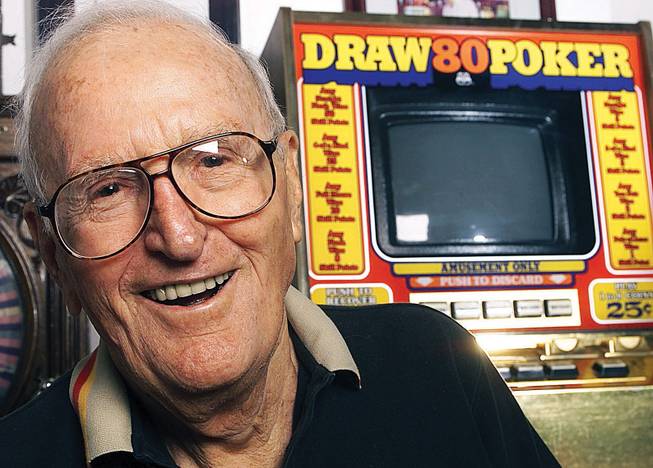
LAS VEGAS SUN FILE
Si Redd, the late creator of the modern video poker machine, said he never imagined how popular the game would become. Many experts say the relatively simple machines may be more addictive, or appealing to addicts, than video slots with a lot of entertainment features.
Tuesday, Nov. 24, 2009 | 2 a.m.
Interactive Slot Machine

Try your hand at the slots while learning the inner workings of the machine and the chances of a win.
Have a Question About Addiction?
Problem Gambling Center executive director Krista Creelman will answer questions about gambling addiction from Las Vegas Sun readers from noon to 1 p.m. Tuesday, Nov. 24. Submit a question now and we'll post the answers on Tuesday.
Local Gamblers Anonymous Meetings
See a map to find out about Gamblers Anonymous meetings in the Las Vegas Valley.
20 Questions of Addiction
Gamblers Anonymous offers these questions to anyone who may have a gambling problem.
Share Your Recovery Story
Want to let other Las Vegas Sun readers know your story of recovering from a gambling addiction? Send us your story.
Bottoming Out
Tony McDew not only recognized that he had a gambling problem, but set out to document it with his own video camera, hoping that sharing his experience could help others. When the jackpot hits, "It feels like you're getting high." And when it doesn't? "You want to crucify yourself."
About this series
In the three decades since the psychiatric community recognized compulsive gambling as a mental disorder, it has evolved from a small area of study to a global research effort involving dozens of medical doctors and other specialists who have generated hundreds of studies and hosted as many conferences.
Yet it remains a largely secret affliction, in part because it carries a stigma even here in the birthplace of modern gambling. As a result, sufferers don’t want to discuss the problem or seek help.
Fewer than 10 gambling treatment programs run by state-certified counselors exist in Nevada. The number of nonprofit treatment clinics that waive costs for those who can’t pay — a common predicament for gambling addicts — can be counted on one hand. Fewer than 400 people underwent treatment for gambling problems in state-funded counseling programs in the two-year period ending Sept. 30. Though many more seek out self-help groups such as Gamblers Anonymous, it’s believed to be a fraction of the more than 90,000 Nevadans with gambling problems.
Starting with this story, the Las Vegas Sun explores problem gambling three ways — through the experiences of an addict, by examining what happens inside the brain of an addict, and by considering the role of slot machine designs in feeding gambling addictions.
The stories
- Part 1: Tony McDew not only recognized that he had a gambling problem, but set out to document it with his video camera, hoping that sharing his experience could help others. When the jackpot hits, “It feels like you’re getting high.” And when it doesn’t? “You want to crucify yourself.”
- Part 2: The mere sight of a slot machine can trigger a chemical response in the gambling addict’s brain in the same way the thought of cocaine stimulates a drug addict. Some researchers are exploring the use of drugs to treat addicts. Robert Hunter offers old-fashioned group and one-on-one therapy.
- Part 3: When designer Si Redd realized the overwhelming attraction of his video poker machine, he advised addicts to get help — and leave Nevada if necessary. Today the role of the machine in feeding addiction is debated. At some casinos in Canada, gamblers can tell slot machines to limit their play.
Related Stories
Sun Archives
- LV companies in denial about problem gambling (11-20-2009)
- New courts will stress treatment of gamblers (6-1-2009)
- Criminals could get help for gambling, not prison time (4-18-2009)
- LV attorney who stole $398,345 for gambling habit suspended (2-19-2009)
- Gambling addict’s misery detailed (10-2-2002)
Hoping to solve the decades-old mystery of why some people develop gambling problems, a growing number of researchers are studying the other side of the equation: the games that gamblers fixate on.
Casinos and slot makers have long been accused of fueling gambling addiction. When video poker became known as the crack cocaine of gambling, Si Redd, the founder of slot giant International Game Technology who created the modern video poker machine and who died in 2003, didn’t get defensive. Instead, he advised addicts to get help and move from Nevada, if necessary.
“Of course it hurts me when such things are said, I guess because it is kind of the truth,” Redd, then retired, told the Sun in 2001. “I never intended it to become that way, and I never could have dreamed of how successful the video poker machine would become.”
In fact, if the industry has learned one thing in its constant hunt for more popular slot machines, it’s that there’s no magic formula for what makes a machine successful. Some players prefer big jackpot games that pay back less frequently, and others like games that hit frequently, though in smaller increments, for example.
And researchers don’t know why many problem gamblers in Las Vegas tell addiction counselors that they succumb to video poker — a device that has changed little over the years relative to slot machines with catchy themes and high-tech features — while other gambling addicts, especially in other parts of the world, are drawn to other kinds of games.
Indeed, the role that various elements in a casino play in the addiction process — defined by experts as the relationship between a person and the object of his obsession — is up for debate.
Slot and video poker machines get the most attention from problem-gambling researchers in part because most people who seek treatment appear to be hooked on machines. That makes sense to some observers, who believe that slots, for addicts, behave like fast-acting drugs in that they allow gamblers to play rapidly and thus trigger rewards that more quickly reinforce such behavior.
Others say the implication that machines cause the problem is false.
“This focus on ‘things’ is taking us totally off base,” said Christine Reilly, executive director of the industry-sponsored Institute for Research on Gambling Disorders. “People drink excessively and don’t become alcoholics. Things aren’t addictive. But people want a quick fix and think if we ‘fix’ all the machines, we’ll fix the problem associated with it. It’s not that simple.”
The machines' tease
In general, the same elements that make games attractive to casual gamblers may also make them addictive to others, says Mark Griffiths, a psychology professor and director of the International Gaming Research Unit at Nottingham Trent University in England.
He is among dozens of researchers who have developed and tested multiple theories about how different elements and designs of machines influence behavior, including:
• Gamblers long ago gave up their buckets of quarters in favor of machines that operate with “virtual” money — racking up and deducting credits instead of hard cash and dispensing paper tickets that need to be redeemed for cash. It is cleaner, easier, saves the casino money — and is psychologically pleasing because turning money into credits has the effect of gently separating the gambler from his cash.
• Bonus rounds — when a player is rewarded with a free spin on a separate game within the primary one — indulge the player’s sense of involvement with a slot machine. Similarly, features allowing players to decide when to stop a spinning reel or the ability to “nudge” a symbol onto the pay line can give the illusion of control.
• Many slots come alive with the sound of a payoff even for “hits” that in fact only pay back a fraction of the amount wagered. Gamblers tend to report these as “wins” rather than a minimized net loss because they focus on winnings while ignoring losses, or the amount of money spent to get those wins.
• Sound effects, video snippets, celebrity voices, musical sequences and even certain colors add to the entertainment value of the machines.
It’s all about entertainment, the gaming industry says.
The industry view
Indeed, casinos and slot makers don’t want addicts because they create legal and financial problems for them, said Glenn Christenson, chairman of the industry-sponsored National Center for Responsible Gaming and former chief financial officer for Station Casinos, one of many gaming giants that donate money to treatment and research efforts.
“Most of the enlightened gaming companies, the vast majority of them, understand there’s no upside to pursuing problem gamblers,” Christenson said. “At some point there’s going to be issues with them that the industry doesn’t need. Companies feel they are better off being supportive rather than ignoring the problem. I’m not sure 30 years ago I would have been able to say that.”
Game designers like to consider themselves more a part of the movie-production business than the gambling business because their job is to create products that hold people’s attention.
Creating machines that entice gamblers to play longer might sound like a conscious effort to cultivate addicted gamblers. Slot companies don’t see it that way.
“This is a competitive industry. Our game designers are trying to keep the games fun and exciting and better than Brand X,” said Connie Jones, director of responsible gaming for International Game Technology.
IGT hired Jones, the first executive of her kind in the gaming industry, eight years ago to help demystify gambling machines to a skeptical public and disseminate problem-gambling research to governments legalizing gambling, among other groups.
By spending millions of research dollars on bells and whistles such as animated cartoons and sound clips, and creating hundreds of different games a year, slot companies aim to seek out the broadest possible audience rather than home in on any one niche, said Marcus Fortunato, owner of Dingo Systems, a Las Vegas company that develops slot machines for manufacturers worldwide. Compulsive gamblers, by contrast, appear to be drawn to simpler machines featuring such gambling basics as a hand of video poker or easily deciphered reels of cherries and 7s, as they probably don’t need more elaborate features to get their fix, he said.
Added Mike Shackleford, a Las Vegas-based mathematician and former actuary who analyzes and designs slot machines: “Slot companies don’t sit around their boardrooms and talk about how to make their machines addictive.”
Natasha Dow Schüll, a cultural anthropologist at MIT who has spent years interviewing gamblers, casino officials and slot manufacturers in Las Vegas in an attempt to uncover the pull of slot machines, agrees.
And yet Schüll, whose book documenting machine gambling and compulsive behavior, “Addiction By Design,” will be published next year, says machines play more of a role in the addiction process than the industry would care to admit.
“This isn’t like buying shoes,” she said. “These are potent and powerful devices that are effective in shifting your inner mood and state.”
People with gambling problems told Schüll of “zoning out” in front of a machine and gambling for gambling’s sake rather than for reasons that make sense to casual gamblers and are cited by manufacturers, such as the pleasure of winning something, however small, or the anticipation of a big jackpot.
Government's role
Although slot machines are regulated for randomness and a minimum payback for players, they aren’t subjected to consumer protection laws or warnings like alcohol, tobacco and other consumer products that affect behavior or personal health, said Schüll, who doesn’t advocate any particular regulatory approach toward gambling.
Some countries are tackling the problem more proactively by tinkering with the machines themselves — an approach the industry says is motivated more by politics and public relations than science.
Hit by a rash of class-action lawsuits by gamblers, the Canadian government, which owns some of that country’s casinos and slot machines, has in some areas imposed “smart cards” that allow players club members to opt into various “safety” features on the machines, including a record of what players have won or lost and the ability to set budgets and time limits.
Some Canadian casinos are using information tracked by the cards — data used for marketing purposes by American casinos — to identify problematic behavior and intervene on gamblers’ behalf. Some of these casinos use biometric software to match problem gamblers with photos on file, including people who have filled out paperwork to voluntarily ban themselves from the casino floor.
In Australia, where publicity about gambling addiction has fueled a politically popular “war against gambling,” governments have slowed down the speed at which machines play, limited the number of machines that can be offered and, in certain areas, prevented the further spread of machines.
Nova Scotia commissioned one of the few major studies on responsible gambling features such as pop-up reminder clocks, mandatory cash-outs and meters showing how much is spent in dollars and cents. It found that some features had little to no effect on the play of problem gamblers, though players reported losing track of time and money a smaller percentage of the time.
Some safety features — such as forced time limits — might have the opposite effect by prompting compulsive gamblers to gamble more or faster knowing they will shortly be cut off from the object of their obsession, said Bo Bernhard, director of problem-gambling research at UNLV’s International Gaming Institute.
It’s unrealistic to believe that people in the throes of an addiction can be swayed by warnings or other educational features on a slot machine — though the technology holds the potential to prevent people from developing gambling problems down the road, Bernhard said.
“This is a psychological disorder that needs to be treated by professionals, not a machine,” he said.
Added Jones of IGT: “If there was any solid, peer-reviewed research that identified specific game characteristics as harmful, all manufacturers would be required to avoid incorporating them into games. If IGT designed our games around speculation about what may be harmful, we would likely be out of business in short order.”
Still, education about how slot machines work — which includes debunking gambling myths such as “lucky” games — has an important place in the treatment of compulsive gamblers, according to some experts.
Clinical psychologist Robert Breen, who directs the Rhode Island Gambling Treatment Program at Rhode Island Hospital, is among several psychologists who have successfully treated gambling addicts by incorporating information about slot machine math into an abstinence-only program.
“But once that person is sitting in front of the machine,” Breen said, “they’re dead meat for the rest of the night at that point.”

Join the Discussion:
Check this out for a full explanation of our conversion to the LiveFyre commenting system and instructions on how to sign up for an account.
Full comments policy