Monday, Nov. 23, 2009 | 12:08 p.m.
Sun Archives
- The skinny on the health care reform bills in each chamber of Congress (11-22-2009)
- Senate bill would cover Medicaid expansion for all states (11-19-2009)
- Long-sought, Harry Reid’s goal of health care reform a step closer (11-19-2009)
- 2,074-page health bill includes surgery, payroll tax hike (11-18-2009)
- Harry Reid to present $849 billion health care bill (11-18-2009)
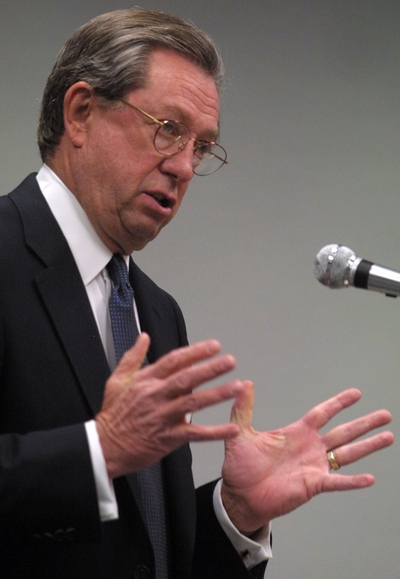
WASHINGTON -- Former Republican Gov. Robert List said today that the nearly 500,000 uninsured Nevadans do not lack health care because they can receive public hospital and emergency room treatment in the state.
"I think it’s incorrect to say these people don’t have health care," List said during a conference call arranged by the Republican National Committee. "The public hospital treats anybody who walks in the door, in the emergency room, or claims an emergency or they need health care. So it’s a misnomer to say these people are without health care. They may be without insurance, many of them are."
List said the Senate health care bill engineered by Majority Leader Harry Reid and advanced by the Senate over the weekend is one that will cost the Nevada senator his re-election in 2010.
"It's the wrong direction for the country and the wrong direction for Nevada, and Harry Reid is going to pay the price next year," said the former governor, who is now an official with the Nevada Republican Party. "This is a clear abuse of power that Nevadans are not going to tolerate."
List predicted that as Republicans begin offering amendments once the Senate resumes debate after the Thanksgiving break, Democratic support for the bill will wane, leaving Reid without the 60-vote majority needed for approval.
The former governor called the 2,074-page bill "so excessive, so liberal, so radical." He said that Nevadans would support a more incremental approach to health care reform that includes some elements of the Democratic plan, such as the prohibition on insurance companies denying coverage for pre-existing conditions, but drops others, such as the proposed public option and penalties on those who do not carry insurance or businesses that fail to offer it.
Health experts have said that treating patients in emergency rooms is more costly than routine medical care, and studies have shown that caring for the uninsured increases the costs of private health care premiums and taxes.



Who woke Bob List up? Oh yeah, this time its the RNC who is prepared to pay him to talk. Months ago the pro-nuke, pro-screw Nevada forces paid him to say that the Nuke Dump was the greatest thing since sliced bread. He shut up after a few days-the money must have run out.
The only time Bob List has something to say is when someone from the political right is paying him to say it.
"This is a clear abuse of power that Nevadans are not going to tolerate."
Riiiight, Bob. Is that fat wad of cash the RNC gave you abusing the seams of your wallet to the point where it can no longer tollerate it? Who will rent your mouth next, Wal-Mart?
Former Republican Gov. Robert List said today that the nearly 500,000 uninsured Nevadans do not lack health care because they can receive public hospital and emergency room treatment in the state.
Maybe I 'm reading this wrong but....does this guy know ANYTHING about health care???? ANY kind of health care other than just showing up in the ER???? What about after care? Prescription drugs? If you can't afford to go to a doctor outside of an emergency room, that is NOT having health care!
Would Obamacare kill medical innovation? http://reason.tv/video/show/medical-inno...
CJ: Is it accurate for me to assume that you don't like former Governor List?
"Health experts have said that treating patients in emergency rooms is more costly than routine medical care, and studies have shown that caring for the uninsured increases the costs of private health care premiums and taxes."
These studies don't calculate other costs -- like compliance costs and opportunity costs - associated with government run health care and therefore end up overestimating the cost of uninsured individuals. For example, Democrats are not counting the individual mandate as part of the $900 billion Obamacare cost.
Interestingly, people who study Nevada history used to agree unanimously that List was the worst governor in the state's history. Now, there is unanimous agreement that he is the second worst governor in the state's history.
I'm always glad to hear someone use the word "liberal" as an epithet, rather than expend the intellectual energy required to provide specific criticisms. That's always a clear signal that the speaker has no idea what they're talking about, and I needn't bother to take their blatherings seriously. Definitely a time saver in this modern 24-hour news cycle!
Rejco,
Did you know that Americans are more likely to survive cancer than Europeans? Did you know we are twice as likely as the British to get dialysis treatment? Did you know premature babies have a better chance of survival in America than in England or Canada?
Our system isn't perfect and it is expensive (The bulk, 40%, of the expense is already paid for by our government). We need radical reform, but more government control is not the answer.
Will health care reform kill medical innovation?
"This is a threat that we've heard from the pharmaceutical industry for a long time. Virtually every progressive recommendation about health policy for the last 20 or 30 years that the drug industry felt might harm its bottom line has been met by the threat that if they don't make as much money before, innovation will cease and there will be no cures for new diseases. It came up around Medicare drug pricing and generic drugs. It's not a surprise to see it come up around health-care reform."
"There are a couple reasons that this is a specious argument. One is that according to their filings with the SEC, the drug companies only spend about 15 cents of every dollar on research and development. That's compared to more than 30 cents in administration and marketing and more than 20 cents on shareholder equity. As an investment in R&D, I think any venture capitalist would say a company spending 15 percent on research is not a robust innovation engine."
"The second issue is that if one looks at the new pipeline of drugs that Pharma has been generating in recent years, it's been puny. Wall Street has noticed this as well. There have been 20 or fewer drugs approved by FDA in recent years, which is lower than in past periods. It's sort of an open secret that innovation isn't working that efficiently."
"The third leg of the stool is that if you really trace back where the seminal discoveries come from on which new drugs are based, it is federally supported research, usually funded by the National Institute of Health, and frequently conducted at universities or academic medical centers. The drug companies will then identify these discoveries and do hard, costly, and important work commercializing them. And they deserve compensation for that work. But it's disingenuous for them to imply that all the discoveries occur in their walls."
"Democrats are not counting the individual mandate as part of the $900 billion Obamacare cost."
The CBO scores the economic impact on federal outlays, not the outlays of individual taxpayers. This is not new, nor interesting, yet another attempt by the far-right to lie about how much the government will spend on health care.
Edge,
I do believe Hillary Clinton's health plan failed in the 90s in part BECAUSE the CBO estimates did include the cost of the individual mandate. Democrats rewrote the rule so they would not include that cost. That is what I have been told, anyway.
Either way...saying the program will cost $900 billion over 10 years is a false statement if the program costs $900 billion plus $x million in additional out of pocket expenses from the American people. Democrats are intentionally deceiving the American people about the cost -- this is why the most expensive elements of the program starts in 2013 or 2014 -- to cut down on the cost of the 10 year estimates. Deception, deception, deception.
In fact, that is all this program really is. The entire goal is to make private health insurance more expensive so people drop the coverage and go to a taxpayer subsidized plan. All things considered, it is a pretty sinister plan in my opinion.
Harry Reid buys into the typical Democratic theory that more government is the answer to all problems. The flaw is that the government has no money except that which it takes from productive taxpayers. Governemnt healthcare is simply another program whereby those that are producers will have to pay for those that are unwilling to provide for themselves. I am tired of working hard to pay for those useless people that are unable to support themselves. It's time we throw Harry Reid out of the Senate.
Edge, in regards to the pharma corps your arguments are specious at best. Assuming your SEC figures are correct 10-15 percent put back into research in development is 10-15 more than would be if the company didn't 1) develop the product in the first place 2) pay the employees to manufacture, distribute, manage, and market the product and 3) reward those investors which took a risk.
Who is to say that 10-15 percent isn't large? At anyrate, to make the argument, which is implied (in a way) that spending a lot of money on marketing is harmful is nonsense. Evidence shows that when government steps in to eliminate marketing (by eliminating competition) the result is a shoddy product at a high cost.
Now there are things we can improve, like opening up US borders to international pharmaceutical competition. But seriously, closing the borders to trade, taxing pharma companies, attacking profits, and having the industry managed by the government is a dumb and backwards idea that will result in shoddy products at a high price (unless price controlled in which case you get shoddy products that are rationed and hard to find).
As for the FDA, we probably should get rid of it. The rules are complex and that makes compliance costs ridiculously high. The higher the compliance costs are the more expensive it is to develop a drug. The FDA is notoriously conservative -- to the point where one could argue that it litterly kills more people than it saves. Eitherway, saying drug approvals are down is not an argument if you have a massive government agency that drastically increases the cost of doing drug research. That is not a valid point.
What a liar. I wonder how much the HMOs are paying Bob List. We know he only has something to say these days when the big corporate interests tell him to (think Yucca Mountain).
As for research and development you can
A) Have government develop a product in house
B) Have government pay/subsidize a third party (private company, non-profit, public university, private university) to develop a product or,
C) Have a private company develop a product
To say all or most of our innovation comes from government is nonsense. It also begs the question - if America is so advanced, producing so many new products, why the heck aren't other countries doing the same (maybe they are free riding or maybe their market retards private development - either way, its hard to imagine their governments aren't funding or running their own research). Regardless, in medical research, Americans drastically outpace other countries.
A quick google search yielded this: http://www.patentboard.com/OurResearch/A...
Among the number of patents issued each year the government subsidized patents outnumber government patents 5-1. The governments ownership of patents, compared to the private sector is as high as 12.7 percent - and that is in biotechnology.
Clearly, government is NOT the primary driver of innovation in America. At anyrate, government providing grants and subsidies for research is a far better (privatization) solution than having the government conduct its own research (socialism).
Anyone with any common sense will not vote for any one of the five hundred and thirty five that are in congress at this time. If we are to have crooks running this country, let us at least have some new crooks. We're pretty well screwed regardless.
In other words "let them eat cake"
What a putz
Give me a break. Why would you even think what Bob "Give me Lust" List is saying is newsworthy. He is a paid mouthpiece of the NEI and want's to get back at our Senator for killing his gravy train. Wah!
I've had the unfortunate chance of receiving care at the ER. After being seen a diagnosed by a doctor(strep throat). I was given a sample pack of antibiotics and a prescription to be filled. The unfortunate part is that without insurance I had to pay for the medications that I needed out of pocket. Working part-time does not qualify me for insurance with the company I work for now. Has anyone priced pharmaceuticals lately. WOW!
"The great breakthroughs in the history of medicine, from the development of the polio vaccine to the identification of cancer- killing agents, did not take place because a for-profit company saw an opportunity and invested heavily in research. They happened because of scientists toiling in academic settings. "The nice thing about people like me in universities is that the great majority are not motivated by profit," says Cynthia Kenyon, a renowned cancer researcher at the University of California at San Francisco. "If we were, we wouldn't be here." And, while the United States may be the world leader in this sort of research, that's probably not--as critics of universal coverage frequently claim--because of our private insurance system. If anything, it's because of the federal government."
"The single biggest source of medical research funding, not just in the United States but in the entire world, is the National Institutes of Health (NIH): Last year, it spent more than $28 billion on research, accounting for about one-third of the total dollars spent on medical research and development in this country (and half the money spent at universities). The majority of that money pays for the kind of basic research that might someday unlock cures for killer diseases like Alzheimer's, aids, and cancer. No other country has an institution that matches the NIH in scale. And that is probably the primary explanation for why so many of the intellectual breakthroughs in medical science happen here."
"There's no reason why this has to change under universal health insurance. NIH has its own independent funding stream. And, during the late 1990s, thanks to bipartisan agreement between President Clinton and the Republican Congress, its funding actually increased substantially--giving a tremendous boost to research. With or without universal coverage, subsequent presidents and Congress could ramp up funding again--although, if they did so, they would be breaking with the present course. It so happens that, starting in 2003, President Bush and his congressional allies let NIH funding stagnate, even though the cost of medical research (like the cost of medicine overall) was increasing faster than inflation. The reason? They needed room in the budget for other priorities, like tax cuts for the wealthy. In this sense, the greatest threat to future medical breakthroughs may not be universal health care but the people who are trying so hard to fight it."
yet another stupid pathetic lying republican...
and this maggot...
bobby boy list...
this scum bag...
supported yucca...
what a loser...
hey bobby boy the maggot clown...
when you need chemo because you have cancer...
and you just got denied coverage because of some bogus pre existing condition...
can you just walk into an emergency room and get chemo...
good golly...
is there no end to the lies and half truths and mistruths these stupid pathetic lying republicans will tell...
thus the phrase...
stupid pathetic lying republicans...
man o man...
i would respect them more if they just spoke the truth...
if they just said i would rather watch my fellow americans die than to pay one dollar more in additional taxes so that we can insure more americans...
then i would respect...
not this stupid pathetic lying republican crap...
"As books like Marcia Angell's The Truth About the Drug Companies and Merrill Goozner's The $800 Million Pill point out, a lot of the alleged innovation we get from private industry just isn't all that innovative. Rather than concentrating on developing true blockbusters, for the last decade or so the pharmaceutical industry has poured the lion's share of its efforts into a parade of "me-too" drugs--close replicas of existing treatments that offer little in the way of new therapeutic advantages but generate enormous profits because they are patented and because companies have become exceedingly good at promoting their sales directly to consumers."
"The most well-known example of this is Nexium, which AstraZeneca introduced several years ago as the successor to Prilosec, its wildly successful drug for treating acid reflux. AstraZeneca promoted Nexium heavily through advertising-- you may remember the ads for the new "purple pill"--and, as a result, millions of patients went to their doctors asking for it. Trouble was, the evidence suggested that Nexium's results were not much better than Prilosec's--if, indeed, they were better at all. And, since Prilosec was going off patent, competition from generic-brand copies was about to make it a much cheaper alternative. (The fact that Prilosec's price was about to plummet, needless to say, is precisely why AstraZeneca was so eager to roll out a new, patented drug for which it could charge a great deal more money.)"
"The Nexium story highlights yet another problem with the private sector's approach to innovation. Because the financial incentives reward new treatments-- the kind that can win patents--drug- and device-makers generally show little interest in treatments that involve existing products. Yet sometimes finding a new way to use an old remedy is the best way to innovate. As Goozner notes in his book, even as Prilosec and its competitors (like Tagamet) were flying off the drugstore shelves, academic scientists were arguing that it made more sense to treat some patients with a regimen of older drugs--antibiotics--that could cure ulcers rather than combat their effects. But no drug company was going to make a fortune repackaging old antibiotics. So the industry, having already invested heavily in products like Nexium, basically ignored this possibility."
-Jon Cohn
Edge,
Lets assume that the bulk of medical research does come from government subsidies (note: this is till a private economy, not a full blown socialist one) Then why does America continue to lead the world? Do you really think that European states do not subsidize their own medical research?
Of course they do. Socialized medicine, however, kills the market for what the research ultimately intends - profits. Without profits, a large portion of the incentive disapears. Even the companies receiving government grants are in it for the profits. (They secure government grants because the research they undertake is often too risky for the market - thus the market underprovided (the whole argument for subsidies in the first place. Getting a government grant does not somehow magically wish the profit motive away).
Even if we eliminated the government subsidies there is no evidence to suggest that medical research would cease. I doubt it would even noticeably slow.
PS, academics are motivated by profit. They are their own company, selling their services to the highest bidder. The grants provide them income and jobs. Academics are for profit - even if they don't comprehend basic economics or their own self-interest.
Fortunatly, for them, they don't have to prove to investors that their products work. I'm willing to bet that even if the majority of funding for research did come (one way or another) from government that the bulk of failed research also comes from government.
According to this, as well, the bulk of R&D in the US is paid for and conducted by the private sector: http://www.oecd.org/dataoecd/49/45/24236...
The private sector pays for 64.9 percent and conducts 70.3 percent of the research. Higher ed conducts just 14 percent and government conducts just 11.
do you think that bobby boy the scum bag maggot clown list is speaking out now because harry is kicking his butt on yucca???
hmmm???
For the millionth time, so that the slow learning Republican Teas Baggers and idiots like List get it.
Yes, a poor person can go to an emergency room and get emergency care...HOWEVER, they will have to sign a document stating that they are responsible for paying the bill...and when they can't they have to go bankrupt to get out of paying. This is one reason why we have such a large number of bankruptcy claims in the U.S. for medical reasons. Medical bankrupcy is unheard of in the rest of the developed world.
notacon: Bravo, you've hit the nail on the head. Its called personal responsibility.
Well now!!!!! If this Health Care Bill is soooooo great let's all jump into the pool. By that I mean everybody get into this wonderfull plan that includes Congress and all government employees. Including the Obamination. Let's improve it a bit by including Tort Reform. All present and accounted for say I.
When this clown ran for re-election, the polls closed at 7:00 p.m.; at 7:05 p.m. he was declared the loser. He's not real popular in the state.
Yeah he is right all the unisured get health care in this state and dont have to pay for. Thats why we need a mandate that requires everyone to have insurance so we dont end up paying for them. Bob List needs to go back to whereever he has been.
Your reason.tv video cites two main threats to "medical innovation."
The first is controlling the price of patented drugs. The health care bill that passed the House, as well as the bill that is on the floor of the Senate, don't really have provisions to control the price of patented drugs.
The second is "restricting access to medical technologies in order to control costs." Correct me if I'm wrong, but this is the principle function of a private insurance company, right? You say you want an MRI, the insurance company says no. BAM! Your private insurance company just became a threat to medical innovation.
In fact, using that type of reasoning, if restricting access to medical technology is such a threat to innovation, why don't we release all restrictions? Just have anyone have access to anything! Break your arm? You need a CT scan!
Surely even you can understand how there's a threshold where we're not receiving a rational return on investment with our health care dollars. We can't spend to infinity, and we AREN'T spending to infinity.
Furthermore, your video says that drug companies don't do research in foreign markets because they don't make profits in foreign markets. You are aware that drug companies sell overseas, right?
"The argument is that if we further nationalize health-care financing it will mean reducing expenditures which will mean squeezing the profits of Pharma which will reduce innovation and more people will die and that's bad. How is this not also an argument against any course of action that reduces health-care spending? For instance, favored right-wing programs are tort reform and increasing the share of health-care costs borne directly by the consumer. The argument is always that these changes reduce "unnecessary procedures" and -- ta-da -- control costs. But this would also, then, reduce the incentive for innovation in the health-care sector. Lower profits; less capital attracted. "
So tell me, Patrick: what level of spending is optimal for innovation? Should we double spending? Triple it? Cut it by 10 percent? Simply give a larger portion of it to drug and device manufacturers?
One would think an independent criminal investigation into the country's health care industry would be the first-step. The fraud and corruption within the industry continues to cost Americans' trillions contributing to health care cost unaffordability and diminished services.
: {
There's plenty of money: just leave Iraq by the end of the year. Will a surge in Afghanistan cost 1 million per troop per year? OK. have Afghanistan pay it. They have plenty of poppies.
Or, use Sarah Palin's method: tax the oil and mineral companies like she did in Alaska. [1/2 Alaska budget from taxing oil co's, & 1/2 budget from federal handouts and dividends to residents. Sounds like socialism to me. You Betcha.
This is the same incredulously stupid crook who took millions of dollars to have nuclear waste dumped in Nevada.
Go away, List.
You are one of the worst things to ever happen to Nevada.
You are dumb, you are bought and I hope you and John Ensign get caught in bed together one day. You know you like him. It's obvious. The way you look at him. Smile at him. Run your fingers through his hair. Just do him, OKAY? Then you both can come out of the closet.
Edge
1) The only way for government to control costs is to ultimately ration the good (price controls lead to rationing anyway). Raising taxes is not controlling the cost. The bills don't need a provision for this, this is the ultimate result
2) Yes private insurance can and does deny expensive procedures. Nevertheless, Americans are more likely to survive dangerous ailments because private insurance in America is more likely to approve the procedures than in the universal coverage countries (hence our higher survivor rates on cancer)
3) Private insurance is still a 3rd party payer system and that is part of the problem. I've mentioned that before.
4) The reason video did mention that other countries do research it even had a graph on it. There isn't much of a market overseas because profits are limited by price controls. America is the big market for new drugs. We're rich and the market isn't too heavily controlled by government. Reason didn't say the produce nothing only that the most productivity is in America.
5) Tort reform isn't the biggest problem. Republicans usually harp on that issue because Democrats usually have the trial lawyers on their side - its just a partisan squabble here. (Just like how Democrats support the status quo in education because the teachers union funds them. If the teachers union funded Republicans they wouldn't be so excited about vouchers and other radical programs that rock the boat). Some tort reform would be good but its not going to be a magic bullet by any means.
The government would be "rationing" a good just as private insurance companies do today. Private insurance companies deny coverage of prescription drugs all the time, or demand generics. Thus, private insurance harms innovation just as much as a government option does. This is not an argument against a public option. In fact, private insurance companies cover more individuals, and thus probably deny more claims than the population that is covered by public insurance in the United States. Thus, the greater harm to innovation is private insurance, not a public option.
Do you have a single source which makes a direct link between our higher cancer survival rates and private insurance companies? You've shown an unproven correlation, not a causation. Heck, maybe that higher cancer survival rate is only present in Medicare/Medicaid patients. You've yet to show how our increased survival rates for SOME ailments is positively affected by these private insurance companies. I don't think the link exists.
Again, I'll ask: what level of spending is optimal for innovation? Should we double spending? Triple it? Cut it by 10 percent? Simply give a larger portion of it to drug and device manufacturers?
Yes, the private insurance does do this, but they are under a contractual obligation to provide you a service. The government is contractually obligated to do nothing it doesn't want to. Additionally, the only problem is that private insurance is much better at cost containment than government - ie figuring out ways to reduce costs internally. The government insurance has no such incentive since it will be funded and or backed by taxpayers (much like the post office continues to mount billions of dollars in debt). Either way, people are more likely to survive the nasty stuff on private insurance than in the government care (that doesn't mean we should stick with our current system). (Look up the cancer stats - we survive at higher rates. The only correlation is this - we are the only industrialized nation without universal healthcare. That means the difference in results must be a cause of the difference in procedures. It could be private insurance, it could be the better med tech provided by our private sector, it could be both, it could be genetics (doubtful considering we are a far more diverse population) it could be something else like preventive care (maybe those European universal health care places don't allow for as many check ups as Americans get?) Something is causing the disparity.
As for your other question, there is one simple difference between you and me. I'm smart enough to realize I'm not smart enough to decide the optimal amount of anything -- the market, i.e. the people, decide that on a daily basis as we interact with others buying, selling and trading goods and services. In fact, no one is smart enough to decide the optimal amount of anything at the macro level of our economy.
According to AMA's National Health Insurance Report Card, Medicare denies 6.85 percent of its claims, higher than any private insurer (Aetna was second, denying 6.80 percent of its claims), and more than double any private insurer's average. So to think the government option will offer more "compassionate" coverage to the uninsured than private insurance is laughable.
PS edge,
If government managed care produced more innovation than the private insurance system, why again does America lead the world in medical innovation? We are back to square one. Your counterpoint was invalid.
Reid has my vote.
Whyn would I vote for one of those GOP lackys who will be buried so deep in senate senority that it will take decades before they get a decetn appointment..........plus the gaggle of GOP candidates have not come up with any ideas or plans other than the usual two GOP talking points.
Edge, the point wasn't that private insurance produces innovation, it doesn't. Having a health care market creates the incentives necessary for innovation to flourish. We need a bigger health care market, not more regulations and more government.
Been here 40 years I cannot remember anything List did for this state except screw it up One term Gov. End of story
"Either way, people are more likely to survive the nasty stuff on private insurance than in the government care (that doesn't mean we should stick with our current system). (Look up the cancer stats - we survive at higher rates. The only correlation is this - we are the only industrialized nation without universal healthcare. That means the difference in results must be a cause of the difference in procedures. It could be private insurance, it could be the better med tech provided by our private sector, it could be both, it could be genetics (doubtful considering we are a far more diverse population) it could be something else like preventive care (maybe those European universal health care places don't allow for as many check ups as Americans get?) Something is causing the disparity."
Um, Patrick, is NPRI running loose with the statistics, AGAIN? The mortality statistics that I've found don't come to that conclusion.
You seem to be questioning the quality of care provided by private vs. universal health care systems, and the U.S. vs. Europe. Probably the best indicator of quality is mortality statistics. Which countries successfully treat cancer patients? The ones with low cancer mortality.
According to your wild guess, that should be the United States. Let's look at an actual source of statistics, rather than your crystal ball:
OECD
Causes of mortality, Cancer, Deaths per 100,000 population (standardised rates)
2004
Finland: 137.8
Switzerland: 142.3
Japan: 145.1
Sweden: 149.6
Greece: 153.7
Iceland: 154.8
Spain: 155.3
Luxembourg: 156.8
United States: 159.8
Japan's system is universal, and their per capita rate of cancer mortality is much lower per 100,000. Seems the facts don't agree with your argument.
Again.
Wasn't it you who tried to convince everyone that the excise tax was going to be on benefits, when it was actually levied on premiums? Did you ever get that "clarified?"
http://www.lvjournalreview.com/component...
Cancer Death Rates
Among 50 Countries:
http://rex.nci.nih.gov/NCI_Pub_Interface...
United States is middle-of-the-pack in men, and a little better than average for women. Nowhere near the best, either way.
"According to AMA's National Health Insurance Report Card, Medicare denies 6.85 percent of its claims, higher than any private insurer (Aetna was second, denying 6.80 percent of its claims), and more than double any private insurer's average. So to think the government option will offer more "compassionate" coverage to the uninsured than private insurance is laughable."
Oh Ken, tell me you read the next line down on the graph. I've seen misleading statistics before, but you give me a reason to chuckle, sir.
Metric 12 does give the percentage of claim lines denied. HOWEVER, Metric 13 gives the REASON CODES for the denial.
For Medicare, almost 1 in 3 denials are due to CARC 16. CARC 16 states, "Claim/service lacks information which is needed for adjudication. At least one Remark Code must be provided (may be comprised of either the Remittance Advice Remark Code or NCPDP Reject Reason Code.) "
For those who are completely ignorant of insurance policy, this is a denial due to a lack of information. Once the proper information is submitted, the claim can be approved. This CARC is commonly known as an error-check.
Let's look at some of the private insurance companies' most frequent CARC, shall we?
34.2% of Humana and 37.9% of United Healthcare's denials are listed with CARC 27. What is CARC 27? "Expenses incurred after coverage terminated."
Whoops! Go in for treatment and they cancel your insurance!
Thanks for the chuckle, Ken!
I'm hearing crickets!
List is on Government Medicare
Thank you Mr. List! I agree, Harry Reid is gone after this colossal blunder. His ignorance and arrogance toward the people of Nevada has finally caught up with him. His philosophy of go against us and run "I love me ads" and people will somehow forget is NOT going to work. Harry Reid will be fired next November. Nevada will have it's voice herd (finally).
"If government managed care produced more innovation than the private insurance system, why again does America lead the world in medical innovation?"
You mean like the "innovation" of Nexium? That was a counterpoint you never actually argued. The fact is that many of the patents that are granted on your so-called medical "innovations" are slight variations on a theme, designed only to protect the profitability of a patent, rather than a true innovation.
The number of patents is not a definite measure of innovation, is the point.
I think those mortality statistics paint a pretty poor picture of our "innovation" as well. You want to argue quality of care? We spend almost double in GDP what some of the countries that are AHEAD of us in terms of lower cancer mortality. The return on investment isn't there Patrick.
"Having a health care market creates the incentives necessary for innovation to flourish. We need a bigger health care market, not more regulations and more government."
The health care market isn't going to magically disappear when or if health care reform passes. This is a false argument.
Furthermore, why is the "small government" libertarian argument that the federal government should strip all power of the states to govern their own health care mandates?
Thank you Gov. List and RNC for supporting the public option -- emergency room care. Brilliant!
Edge,
1) 40% of our medical expenses are paid by the government. If the big expense is a big problem, stop the government programs
2) Maybe our big expense isn't part of the problem, but the reason we survive cancer (and other diseases) at higher rates than Europeans.
Ksand,
On cancer survivor rates:
http://www.webmd.com/cancer/news/2008071...
http://www.forbes.com/2009/11/04/cancer-...
http://blog.heritage.org/2009/03/25/10-s...
http://www.telegraph.co.uk/news/uknews/1...
http://www.medscape.com/viewarticle/5617...
Even this OECD study examining the costs of health care in the US find that the US cancer survivor rates are better than the OECD average. http://www.oecd.org/dataoecd/5/34/438009... - it goes on to complain about other things like high rates of asthma.
Patrick_R_Gibbons You are delusional. Your preloaded facts are wrong, dead wrong. America is ranked behind atleast thirty other countries with it's health care and most of them are third world countries.Why do you think Thailand and India have entered the health care business with their boutique hospitals that rival the best hospitals in America at a fraction of the costs? Coincidently the wealthy now forgo their insurance plans and pay out of pocket for treatments and procedures in these foreign countries.Your lies and bs. along with the insurance lobbyiest is why the truth is not being told about health care reform. You are one of the nit wits who fail to tell the truth about the unfair financial burden put on tax payers and insurance premiums as result of indigent people going to hospitals for treatment and never paying a cent towards the bill. UMC has lost 141 million dollars thanks to dishonset rantings like yours. You are a fraud who has swallowed the lying pill of the insurance industry and their lobbyiests with the now six hundred million dollars in lobbbying money intended to fool Americans.
Partick_R_Gibbons A bigger health care market? How can this be done with insurers cherry picking those who they insure and dropping people when they file claims or become sick? More lies from you and bs that makes no sense what so ever. Take a walk and think before you post this crap again.You simply make up facts or lies to make a point although you may quote facts that insurance companies quote but those are lies to. Meanwhile none of this makes you right or intelligent.
"Where you live plays a role in cancer survival, according to a new study that shows the U.S., Japan, and France recorded the highest survival rates among 31 nations for four types of cancer. Algeria had the lowest survival rates for all four cancers."
Why cherry-pick only four types of cancer to prove the U.S. is better? And if you care so much about those four types of cancer, it's clear we should adopt Algeria's health care system, since it does a better job than our "innovation-filled" system.
http://www.factcheck.org/2009/09/a-false...
"Experts with the American Cancer Society and the National Cancer Institute told us that mortality rates provide a much more accurate comparison. And the mortality rates for breast cancer for the two countries are similar."
When you look at the cancer mortality rates, the United States "innovative" treatments don't really help.
Sorry, I misread that part about Algeria.
"The National Center for Policy Analysis (NCPA) is an American non-profit conservative think tank. The NCPA states that its goal is to develop and promote private alternatives to government regulation and control, solving problems by relying on the strength of the competitive, entrepreneurial private sector."
Nice source Patrick.
"Dr. Marie Diener-West, a professor of biostatistics at Johns Hopkins University Bloomberg School of Public Health, told us that it would be a stretch to draw too many conclusions from comparing survival rates. "Part of the problem with the comparison is that it might not actually be comparable populations," she said. "It could be [one is] an older population, it could be they have more comorbidities [other conditions] that are affecting their survival in addition to cancer, there could be occupational differences. There are many different factors that could be playing a role." Diener-West pointed out that the uninsured, for instance, are generally poorer and may have different diets, different lifestyles and different exposure to tobacco and other drugs than the privately insured. And when you compare across countries, of course, you're also looking at two different gene pools."
didn't this maggot scum bag once say yucca was "inevitable" and that we should "accept it"???
is he the lowest form of scum nevada has seen???
hmmm...
tough call...
there is johnnie boy snot nosed spoiled punk rich kid who slept with his best friend's wife, then fired them both when he got caught, then ran to mommy and daddy to fix his boo boo ensign...
and there is...
jimmie boy i have no leadership skills whatsoever and just might be the laziest politician on the planet gibbons monkey...
good lord...
we do have our share of maggots in nevada!!!
He is right about one thing, this will cost "Reid"
Probably the best way to handle this situation is to just ignore anything a politician says about anything. Their motives are always suspect and no one trusts them.
You can call them names but that's been done before and it doesn't hurt them.
I say just quit voting for incumbents. Try it, it just might work.
Name calling only infuriates other posters, the politicians don't read this tripe.
RE: BHEP
Point well made!
And of course, former Republican Governor List, we don't have to concern ourselves about seeing YOUR patient records and history sold from UMC records, do we (?) Thank you for weighing in, former Republican Governor List.
Homer,
Because if you're wealthy it makes no sense to have health insurance. Foreign doctors are also cheaper and American hospitals also have high administrative costs.
America's health care system is NOT worse than third world countries. Give me a break. Go live in one if you think that.
Former Governor List could have stayed home and said nothing but instead he added fuel to what most of us have known and what the Health Care bill will hopefully help eliminate. It is true people without insurance can go to the emergency rooms and they will be taken care of. People who do not have insurance or who can not pay their medical bills are generally taken care of; for them it is pretty much a free ride. Many however end up taking out medical bankruptcy because of the high cost of trying to stay alive or keep a loved one alive. The patient is not the only one who suffers here though. The doctors loose, the hospital looses the paying patients loose and the tax-payer looses. The doctors and hospitals do not recover all the costs, the paying patients pay added costs to help recover costs of non-paying patients, and the tax-payer pays an added fee in their taxes that goes to help pay for indigent care at the hospitals. Medical bills are high in part to help doctors and hospitals recover their losses from non-paying and uninsured patients. Will the health care plan change this--- I do not know but to say the current program is acceptable is as wrong as saying we should be listening to the former governor or too turn our back on a much needed overhaul (complete overhaul, not a piecemeal baby step change). There has to be a better system- for all of us! We know health care costs are going to keep going up and more and more of us will not be able to survive while the insurance and pharmaceutical companies CEOs, congressional pawns and talk show hosts of these companies get richer.
There can be no doubt that the greatest problem we have with our current health system is the big business control over government decision makers coming from huge insurance and pharmaceutical companies. These companies pay politicians billions of dollars very year to keep their profits high at the cost of the American public. The idea of allowing any state to "opt out" of the "public option" is not in the best interest of the citizens of that state. When the insurance companies can not apply their leverage to the federal government they will apply it to the state government. States will begin to feel the pressure these companies have long applied at the federal level and the graft and payoffs that have occurred in Washington will begin in the states. The citizens of the states that opt out will suffer and most likely will take their care needs to another state unless the states accepting the public option enact some protective measures. I would not think states citizens are ready to allow the insurance and pharmaceutical companies to shift their leverage from the federal government to the state government. Insurance companies will see those states opting out as fresh meat for their lobbyists resulting in more state government corruption, fraud, higher costs to states citizens and less health care than other states. The public option allows private citizens the opportunity to obtain insurance very similar to what federal employees are getting at an affordable cost; the same insurance I had as a federal employee and have been able to carry into my retirement at a family plan cost of less than $200.00 a month including some vision and medical coverage.
Sorry Governor List, but Harry Reid isn't going anywhere. The Fat Cat insurance co's, the U.S. Chamber of Commerce and the Pharmacuetical lobby can't buy their way out of this deal--not this time. Maybe if those folks would have given a damn about the American people in some way, shape or form over the past 30 years, they wouldn't be on the receiving end of legislation that will surely reform their greedy, solely profit motivated ways. To think that your belittling, rhetorical, Talking-point infested statement will sway the voter's into the Republican pipe dream of beating out Harry Reid in the next election is ridiculous!!
Billions of dollars are lost every year when employees are ill or are carrying illnesses into the schools and workplaces and can not work. The employer looses, the family looses, other employees loose and the community looses. Production is lost, innovation is lost, and profit is lost. People do not see a doctor when they should thus they spread illness and disease into the work place, schools, shopping malls, transportation systems and onto our streets. The health care plan is important to all of us! Improving health care and making affordable opportunities to see doctors and receive better health care will help reduce the loss of revenues in small business and make our nation a healthier place. It will most likely reduce the high profits of insurance companies, pharmaceutical companies, some politicians and long winded talk show hosts but for the American People, the American family, small business and the average person, it is essential.
List has a pre-existing condition, he is a hypocrit. He is on Government medicare ans SS