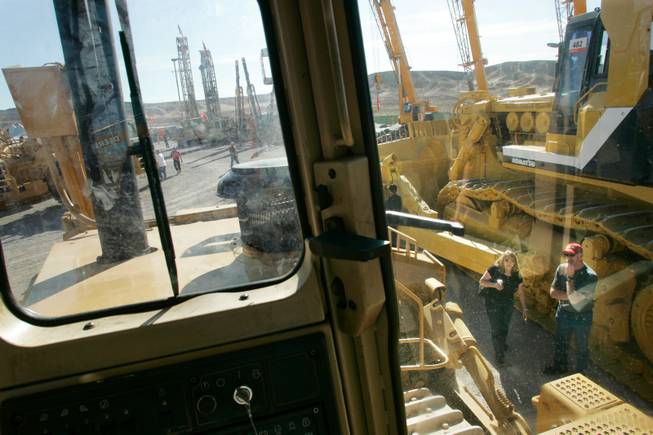
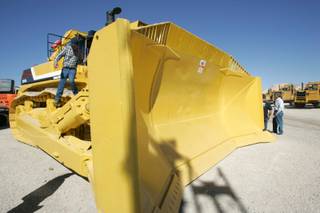
A large earth mover is inspected before an auction of construction equipment by Richie Bros. Auctioneers Friday, Nov. 6, 2009.
Sunday, Nov. 15, 2009 | 2 a.m.
Audio Clip
- Listen to an auctioneer from Ritchie Bros. Auctioneers.
-
Audio Clip
- Listen to an auctioneer from Ritchie Bros. Auctioneers.
-
Sun Coverage
Beyond the Sun
The auctioneer’s voice carries the pace, rhythm and lilt of bluegrass. You can even shake your hips and nod your head to it.
This is serious business, though.
He’s in a small RV with speakers attached, moving slowly through the lot, selling construction equipment, in effect dismantling what was once a pillar of the Las Vegas economy, brick by brick, machine by machine. A few dozen bidders are walking along side, keeping up with him.
Next is a 10,000-gallon water tank.
“9,000, 9,000, you want 9,500 sir?”
It sells for $14,000.
This is the massive auction yard off Interstate-15 about 25 miles north of downtown Las Vegas, in an industrial area known as Apex.
Ritchie Bros. Auctioneers, the world’s largest industrial auctioneer, is selling used front-end loaders, water wagons, scrapers, generators and everything else needed to build roads and sewers, strip malls and houses. The company has come to the right place, as Las Vegas’ once thriving construction industry has gone all but dark, so there’s plenty of fallow equipment to sell.
The office market, for instance, has 11.2 million square feet of empty space, and a vacancy rate of nearly 23 percent.
Homebuilding activity is one-seventh what it was during the boom years.
The equipment has come from Las Vegas and other locales within a 300-mile radius.
On this day, the company will auction off $19 million worth of equipment and goods. Most of it will be go to buyers who have traveled great distances to be here, or will have bid in real time on the Internet. License plates in the parking lot show Idaho, Utah, Texas. A shuttle bus takes bidders to and from the hotels.
“This is a bad sign,” says one attendee, watching construction equipment leaving town. “You see this much equipment and these many people, it means times are tough.”
He and two other locals aren’t bidding because they can’t afford it and don’t need equipment — they have too much unused equipment already. They seem to be here merely for the spectacle; one is a small contractor whose revenue this year, $300,000, will be one-tenth what it was at the peak. He laid off all his employees.
But capitalism’s grinding wheel of creative destruction, while imposing hardship on Las Vegas, means opportunities for others.
Ken Renton, of Kidco Construction in Calgary, Canada, is here to buy used equipment. With oil prices on the rise, Calgary, which is an oil and gas town, is again thriving.
A new scraper, used to move the earth for new housing developments, could cost $1 million, he says. He’ll buy his here for $75,000 and spend $20,000 to haul it north. A couple years ago, the same model would have gone for $200,000, the deep discount a function of the global construction downturn.
It’s not just the big boys who are getting a good deal.
Gordon Wade, owner of Dixie Auto Salvage in the St. George, Utah, area, snapped up a 2004 Ford F-250 — just the type of vehicle that could be seen zooming off a Strip construction site at quitting time, when there were still lots of those jobs.
Wade has 10 employees. They take wrecked cars, pull good parts out of them and then sell the parts. Business is good, he says, theorizing that during the recession, people are holding on to their cars and need parts.
He paid just $4,000 for the truck. “A great deal,” he says.
The real winner here, though, is Ritchie Bros, which was founded in Canada in the 1950s, then a family company that originally auctioned some surplus furniture to pay off a bank debt.
The company, now publicly traded on the big exchanges, is the heavyweight of the industrial auction business, according to Neil Forster, an analyst who covers Ritchie Bros. for Genuity Capital Markets.
The company organizes auctions at its 39 sites around the world, acquires equipment, markets the events and takes a fee. The company says a key to its success is instilling confidence in the process — sellers can’t bid on their own goods, so they can’t rig the game.
Forster estimates that the next largest rival does one-tenth the business.
“An interesting question is, why hasn’t anybody replicated this?” he says.
Companywide, gross auction proceeds in 2008 were a bit more than $3.5 billion. Forster sees continued growth and no wonder: He estimates that worldwide, $100 billion in used equipment will change hands this year.
And as this year has shown, the auction business can be countercyclical — in bad times, people want to buy used equipment, while sellers need to unload.
This month’s Las Vegas auction — there’ll be another in February — hosted more than 2,000 registered bidders, more than 50 percent above the company average. This year, the company has seen a 25 percent increase in new bidders, according to CEO Peter Blake, who has an agreeable Canadian accent.
For Las Vegans, Ritchie Bros. may seem like carrion crows, picking clean the dead carcasses of our economy.
If there’s any consolation, Blake says they’re seeing prices firm up. Higher prices are the result of increased demand. “This means confidence is eking its way back into the marketplace.”
Of course, he means confidence among buyers elsewhere, not Las Vegas.

Join the Discussion:
Check this out for a full explanation of our conversion to the LiveFyre commenting system and instructions on how to sign up for an account.
Full comments policy