
Tourism column:
Is train wreck ahead in high-speed transportation battle?
COURTESY PHOTO
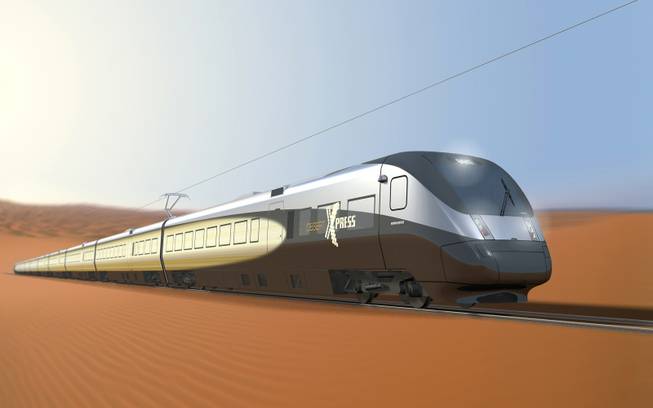
A rendering shows a DesertXpress train, which is expected to reach a top speed of about 150 miles per hour and travel between Victorville, Calif., and Las Vegas.
Fri, May 8, 2009 (2 a.m.)
The Federal Railroad Administration may be overseeing a huge train wreck in Southern Nevada.
Last week, the agency conducted a public hearing on a draft environmental impact statement on a high-speed train proposal developed by DesertXpress, a privately held company backed by Sig Rogich and Tony Marnell.
The hearing was well-attended. Federal officials anticipated about 50 or 60 people would show up for the hearing at the Hampton Inn Tropicana. Close to 100 were present.
After a 30-minute presentation explaining the DesertXpress plan, the public was invited to weigh in.
The DesertXpress plan first surfaced a couple of years ago when the company began the environmental impact statement process.
The plan, a little more refined now than it was months ago, proposes an electric or diesel-electric train capable of traveling 150 mph between Victorville, Calif., and Las Vegas along a 180-mile twin-track route primarily along Interstate 15.
The statement addresses stations and maintenance facilities on the Victorville and Las Vegas ends and the route includes an assortment of alternative track placements that would be nailed down as the proposal progresses.
For example, a portion of the route between Primm and Mountain Pass just south of there includes some options. One route would make a 1.5-mile intrusion into the Mojave National Preserve, but the alternative would require cutting tunnels through the Clark Mountains.
In Las Vegas, there are options to end the route close to the Strip or in downtown Las Vegas.
Twelve people addressed the public hearing and all had thoughtful insights. The general tone of their comments foreshadow the framework of the issues. Here are the key questions:
• Would rail riders in Southern California really drive to Victorville and then get on a quick train ride to Las Vegas, where they would have no vehicle?
• Should the proven technology planned by DesertXpress be used for a high-speed line linking Las Vegas with Los Angeles or should the limited right-of-way go for a high-tech magnetic levitation train or some other emerging technology?
• Should the nation’s taxpayers foot the bill for what is a California and Nevada problem, as it would if the maglev option goes forward or should privately financed entrepreneurs take the risk — and reap the rewards if it’s a success?
They’re tough questions, ones the Federal Railroad Administration couldn’t answer at the April 28 hearing. A representative of the agency said it isn’t in the business of picking winners and losers in what amounts to a race to develop high-speed transportation.
All it is doing is making sure desert wildlife is protected, cultural resources maintained and artifacts preserved.
Because the bulk of the property to be used for the route is public land — most of it I-15 right-of-way — it has to go through the federal government’s environmental protection process.
Although the high-speed race could have a photo finish, at least it appears that it’s a two-team contest. At one time, Amtrak, which discontinued its Desert Wind service between Los Angeles and Salt Lake City by way of Las Vegas in 1997, was backing a proposal to use conventional rail on existing tracks, with the addition of a parallel “passing line” through the Mojave National Preserve.
One of the reasons why the existing line couldn’t be used as it is now is because freight trains have priority on the track and the delays that would occur because of the steep grades of the route would result in trips taking six to seven hours between Los Angeles and Las Vegas.
A sidetrack that would enable passenger trains to pass the freight presented an option, but it still would have required an environmental impact statement on land in the heart of the preserve.
When the DesertXpress arrived on the scene, it proposed using all-new tracks and equipment.
But critics immediately jumped on the shortcoming of the route starting in Victorville.
For those unfamiliar with the geography, Victorville sits about 10 miles from the crest of a big hill, Cajon Pass, which empties into the San Bernardino Valley, the gateway to Southern California’s population centers.
To the west of Victorville is Palmdale and the northern end of those population centers. With the exception of Barstow, Victorville is the last population center on the road to Las Vegas.
Although the skeptics have good reason to question whether passengers would make the drive to Victorville to board a train, it is the best place to put a train station when you’re on a budget as DesertXpress is.
The developers are no dummies. They know it would make more sense to take the train line into the Los Angeles Basin. But the cost of taking the line down Cajon Pass is as steep as the highway grade and the company is content to finance the route to Victorville and expand to L.A. later.
The draft environmental impact statement has independent ridership studies that say Southern Californians would drive to Victorville to board a train to Las Vegas. The independent analysis was ordered because they, too, were skeptical about that.
Meanwhile, there’s the maglev. The technology is in use in China and American Magline Group, a Los Angeles-based company, wants to introduce it to Americans between two of the nation’s greatest tourism destinations, Las Vegas and Disneyland in Anaheim.
Because millions of people visit Las Vegas and Disneyland every year, they would be able to see tomorrow’s train transportation today.
That’s one of the reasons there’s even a conversation about using federal stimulus money to move the project forward.
Because there’s possible government money involved, maglev developers aren’t as concerned about costs and are making plans to take the line all the way to Los Angeles.
But the maglev environmental impact statement is running behind the DesertXpress proposal. A meeting similar to the one that took place last week probably won’t occur for at least a year. By then, DesertXpress could have permission to move ahead with design and construction.
The maglev and DesertXpress technologies aren’t compatible, but they both want to use the same right-of-way.
One other thing to remember is that just because we as Las Vegans might think a high-speed train to L.A. is a great idea, the project is by no means a slam dunk.
Count on the airline lobby to oppose federal funding for high-speed train transportation. Funding for a next-generation air traffic control system is so far behind that some wags are calling it a “now-gen” instead of a “next-gen” system. Airline lobbyists resent that tax money is being considered for trains when a satellite-based air traffic control system that would make air travel safer and more efficient languishes.
A US Airways executive recently asked me about the public sentiment for high-speed trains between Southern California and Las Vegas and when I told him there seemed to be some renewed interest, he told me the airlines would probably put up a fight.
He added that US Airways in particular would fight a Las Vegas-Los Angeles train because his company flies that route. The company wouldn’t mind so much if high-speed rail were considered between Dallas and Houston (where rival Southwest carries most of the air traffic) or Chicago and New York (where competitors American, Delta and JetBlue battle for market share).
There’s also no certainty that California would back maglev because it is embarking on its own high-speed train system along the coast and to major population centers with technology that wouldn’t be compatible.
DesertXpress officials also produced a single-page bullet-point piece casting doubts on the maglev with a primary focus on expenses. At $60 million to $199 million a mile, a 200-mile maglev line would cost $12 billion to $40 billion, they say.
They also say maglev is not completely proven despite the commercial operation of a system near the Shanghai, China airport. Temperature extremes, high winds and dust in California and Nevada provide some additional operational unknowns. And there are no U.S. safety standards for maglev technology.
But, if a maglev were available from Los Angeles or Anaheim to Victorville, DesertXpress would be interested in providing intermodal transfers.
It all goes back to the original question: Should the public get behind a proven, reliable system that has obvious location flaws that could be done in a few years or go for a technological leap that would have more commercial appeal, but take longer to build at a far greater cost?
Good luck, rail regulators.
Richard N. Velotta covers tourism for In Business Las Vegas and its sister publication, the Las Vegas Sun. He can be reached at 259-4061 or at rick.velotta@lasvegassun.com.
Discussion: 14 comments so far…
Post a comment
- Most Read
- Discussed
- Most E-mailed
- Police: 3 arrested in officer’s death have gang ties
- Franchione potential early candidate for UNLV football post
- Big fight headed for a New Frontier?
- Las Vegas condo hotels remain a tough sell — just ask Trump
- $60 million to stabilize neighborhoods buys five homes
- Hotels rein in risque advertising campaigns
- LV companies in denial about problem gambling
- Funny Face: Carrot Top’s stage act a mask of contradictions
- Reserve Rebels didn’t have time to panic
- Hospital privacy leak could harm patients
Blogs
The Kats Report
For props, Lewis Black needs only his manic delivery and torrid material (1 Comment)
Elsewhere
Sands China raises $2.5 billion in Hong Kong IPO
Marquardt v. Sonnen scheduled for UFC 109
Bloggity, Bloggity, Bloggity
Will a fourth consecutive title by Jimmie Johnson be good or bad for NASCAR? (2 Comments)
Top Chef: Las Vegas
The Jet Stream: And then there were four
Top Chef Episode 12: On keeping it simple
Miech Again
Chilly start for Chace, but Stanback says he'll warm up (1 Comment)
- Live chat
- Tuesday, noon PST
- Chat with Krista Creelman
- Problem Gambling Center executive director Krista Creelman will answer questions about gambling addiction from Las Vegas Sun readers from noon to 1 p.m. Tuesday, Nov. ... Submit question
Calendar »
- 21 Sat
- 22 Sun
- 23 Mon
- 24 Tue
- 25 Wed
-
UFC 106 at Mandalay Bay Events Center
Mandalay Bay Events Center | 7 p.m. to 11 p.m.
-
Julio Iglesias at the Las Vegas Hilton
Las Vegas Hilton
-
Natasha Wicks hosts at Hawaiian Tropic Zone
Hawaiian Tropic Zone | 10 p.m. to 11:59 p.m.
-
Tito Ortiz hosts at Tao
Tao | 10 p.m. to 11:59 p.m.
-
Hiroshima at Santa Fe Station
Santa Fe Station
-
Frank Mir hosts at LAX
LAX Nightclub | 10 p.m. to 11:59 p.m.
-
The Four Tops at The Orleans Showroom
Orleans Hotel-Casino
-
Amir Sadollah hosts at Prive
Prive | 10 p.m. to 11:59 p.m.
The Sun
Locally owned and independent for more than 50 years.

Technorati


US Airways has no right whatsoever to oppose any potential train between Los Angeles and Las Vegas. Especially in light of US Airways notoriously unreliable service and do not getting me started on there less than friendly customer service.
It is about time that Las Vegas starts the discussion about using trains to bring people back. Trains are environmentally safer, they provide a beautiful scenery to enjoy, and passengers will not have to go through the paranoia of the TSA every time they enter an airport.
Build the train and we will ride it...
Waste of money and time. They would have to get past the Feds, then every environmental nut groups opposing and filing lawsuits, and then every little towns (Baker, Barstow, etc.) in between LA and LV opposing and filing lawsuits after realizing they will be losing their bread and butter business from vehicle traffic. If they can get past all that and have the rail built, next thing they would have to do is convince the people, both in LA and LV, to actually ride this thing that cost more and take away their freedom of driving their cars. Good luck. Money would be better spent building wider roads and maintaining them.
I agree with cruiser. I love to ride trains, but this is crazy. A waste of money. Victorville is a desert wasteland, and there's no way people will drive there from LA, and then take a train to Vegas. You simply keep driving your fuel efficient car, and certainly get there faster than using the train. Yes, the train may go 150 miles per hour, but we all drive about 80-90 on I-15, so you will beat the train easily. What a joke....
Not that there is any guarantee that HSR will work in the US, however one of the key points for the DesertXpress route to Victorville is that it is about 40-50 miles from Palmdale where there will be a California HSR hub. I believe that the DesertXpress plans on expanding from Victorville to Palmdale. With a proposed time of 2-3 hours from LA to San Francisco, this link would allow people to travel from LA to Vegas in less than 3 hours and end up on the strip, not in the airport.
Regarding the Shanghai Maglev, I believe that it caught fire and one of the tracks is not currently functional while the German test track had a fire which resulted in a decision to entirely scap the program, currently the German company is trying to sell the technology.
Finally for all those people who worship their cars, think of it this way, how much faster will you be able to drive if 10, 20, 30% of the cars are not on the highway, then you really will be able to drive at 80-90mph (even though the speed limit is 70). It is a win for everybody, and unlike the maglev and the CHSRA plans, it is not being funded with tax dollars, so let them end it in Victorville and see what happens.
Looking at the history of the Monorail in Las Vegas and the Neonopolis project (Both are failures), we better stand back and take a second look. Both projects were conceived without a recession also. Hello?
Sorry to burst your bubble, wbsloat, but connecting to the Metrolink in Lancaster/Palmdale and then to LA is not as feasible time-wise as you might think. Number one is that you are going sideways to Lancaster from Victorville. Losing time. Number two is that the trip from Lancaster to LA is incredibly slow, due to a severe downhill drop until you get to Burbank. Sometimes the train goes 30 mph for safety reasons for quite a while. Yes it goes to 70 mph after Burbank, but it still is a long trip, about 1-1/2 hours. I worked in Lancaster, and used to take the train to Union Station. Beautiful clean, fun to ride train, but slow. The only reason I can rationalize having a train to Vegas is that with LA traffic, it's a PIA to get on the I-15 on a Friday afternoon. Not enough reason to waste billions, however.
Forget the maglev, go with Desert Xpress. The maglev technology is too risky and too expensive.
Las Vegas isn't on the federal government's high-speed rail radar, so your best option is a privately owned and operated rail line, and not a taxpayer-funded one.
If the Desert Xpress investors are smart, they will extend the line from Victorville to Palmdale. Not so they can connect to Metrolink but so they can connect to the L.A. to San Francisco high-speed train, which will be a different animal entirely from Metrolink. Much faster than Metrolink.
nednougat, what do you mean by sideways? If you're headed from Victorville to Los Angeles, your choices are: south to San Bernardino (via Cajon Pass) and then west through the Inland Empire. Or west to Palmdale and then south from there. The distance isn't that different.
This article says it is backed by a private group.
WRONG!
We have talked about about this plan for about 10 years!
President Obama and Congress has given money to this State now and no more talk; put people to work and build it Now! It is backed by the United States of America!
We need the train service but the distribution system in Las Vegas has to be updated. Presently shuttle companies can only take passengers from the airport to hotels. In other cities they can go to private residences and train and bus stations too. The taxi cab monopoly must be stopped, especially with there illegal practices of long hauling via the airport tunnels. The train service must be supported by NV equivalent to the subsidies to the airlines and highways. Three round trips daily using the existing track with passing sidings built by the state with a current reliable schedule would work, especially with all kinds of feeder service from Metrolink and the Subways to Union Station. If the trains have enough engines pulling them, the steep grades from Kelso to Cima and Cajon pass can be made at reasonable speed, despite all the money weighing down the train. Once in Vegas if shuttles can pick up the passengers with baggage and CAT can take those without the service can be successful with current trains run by Amtrak with a subsidy similar to the help that the state of California gives Amtrak.
Wrong, jfujita. To get to Palmdale from Victorville, you basically drive west, wasting time and gas. I've driven it hundreds of times on the State 58, and it's a PITA. And as I stated, the train at Lancaster is slower than you can believe to LA. Plus if you think that this pipe dream could connect to the North South Amtrak trains on the coast, you are delusional. Ever hear of the Tehachapi mountains? Right in the way to connect to Bakersfield. Sorry, it's impossible. Been there, seen it, it ain't gonna' happen.
Quote-Should the proven technology planned by DesertXpress be used for a high-speed line linking Las Vegas with Los Angeles or should the limited right-of-way go for a high-tech magnetic levitation train or some other emerging technology?Unquote. Or should the ROW be used for the highest and best purpose for which was designed, namely expanding the Interstate? This will have to be done at some time in the future. The taxpayers have paid for this ROW and if it is not used for highway, there must be compensation, adding to the woefully underestimated cost of DesertXpress.
Comment removed by staff.
Hey, Manny, WTF? Cali has been trying for years to figure out how to speed up the Metrolink to LA. And nothing is viable. Yes, there's a loop around Santa Clarita, but it's for the freight trains to wait while the passenger trains coast on through. Your idea that it will take 25 minutes from Lancaster to LA is utter stupidity. There is no way they can build a high speed track from the High Desert to La without gazillions that nobody has these days. Sorry, but I guess you must be an expert in rail transportation. Millions have been wasted attempting to figure out how to drop 2,500 feet from Lancaster to Burbank without putting passengers in danger. But then again, maybe you should offer your expertise to the authorities.
Second. Hwy 58 is the best way to get to Lancaster. The only other option is to drive much further to the Cajon Pass, and take Hwy 138, an astounding death trap road 25 miles further than taking the 58. Manuel, you are definitely a Manny clone, as in Manny being Manny. Watch those fertility drugs, you moron. And no I don't work for an airline, and I'm sure you work for a landscape company. Wanna' pull the weeds in my backyard?
Like I said before, look at a Map. From Victorville to Lancaster you can take the 18 to the 138. Plus the 138 is being converted to a 5 lane freeway. And again, when coming from Lancaster to LA the hills end at Sylmay not Burbank (15 miles apart). And typical to make a racist comment. Remember, that Manny is making 25 million a year. What you and I will never get to in our life time. So pretty dumb of you to use him for an insult. And I take it as a compliment for you to think of me (latinos) as garners. We at least work instead of beging for money. We'll clean toilets, flip burger or hit homeruns BEFORE WE BEG FOR MONEY.
