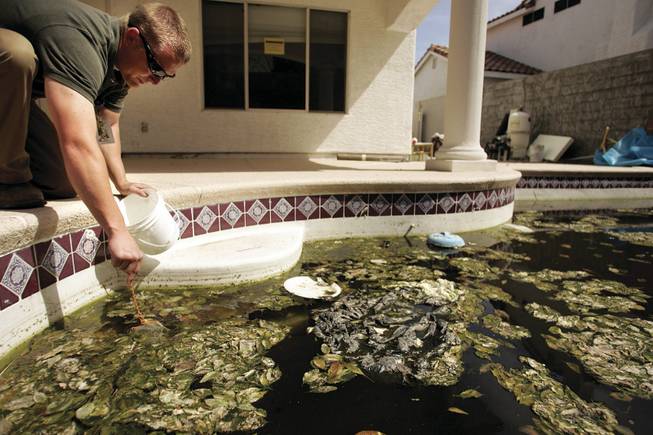
Phil Bondurant, an environmental health specialist, releases mosquito fish into pool Tuesday in Henderson. The fish can feed on mosquito larvae for years.
Thursday, March 19, 2009 | 2 a.m.
Sun Topics
Sun Archives
- Health district warns about West Nile virus (3-17-2009)
- Clean up foreclosed home, or city will (11-17-2008)
- Who dropped the ball? (6-9-2008)
Beyond the Sun
The newest sign of these economic times can be found hanging on back-yard gates throughout the valley:
“Fish at work.”
It’s public health authorities’ way of alerting neighbors that, yes, the algae-filled swimming pool in the back yard of that foreclosed or abandoned home is a potential breeding ground for mosquitoes — but not to worry, our fish are on the case.
And the sign is intended to get the attention of property caretakers, too: Please don’t add any chemicals to the pool, or you’ll kill our inch-long Gambusia affinis, or “mosquito fish.”
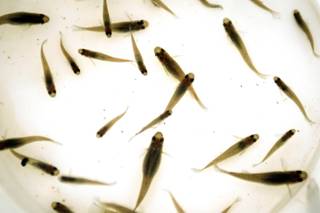
The surface-feeding minnows are the primary combatant in ridding the pools of mosquito larvae, by devouring them before they hatch.
These minnows are considered more effective than the chemicals that have been used in the past because the chemicals become ineffective after a month and need to be replenished. The minnows, on the other hand, can survive in an oxygenated pool for years.
Health officials used fish on a limited basis before 2007, but began to use them extensively in mid-2008 when they realized they’re an effective long-term solution for pools. Long term is key, as foreclosed homes tend to remain ignored for months or longer and fetid pools can lead to such mosquito-borne diseases as West Nile virus. Last year 16 cases of West Nile virus were reported statewide.
The district received 2,854 complaints about green pools last year, up from a previous high of 1,624 in 2007. This year the district has dealt with 271 complaints, nearly 100 more than this time last year. (Complaints can be phoned in to the district’s mosquito control hotline, 759-1220. Callers are asked to identify themselves, give the abandoned home’s address, describe the green pool and, if necessary, give the community’s gate code).
The use of minnows is growing across the West, says John Rusmisel, president of the Mosquito and Vector Control Association of California.
Their use has become so widespread in the Las Vegas Valley that the Southern Nevada Health District has a squad of seven specialists to deliver the aquatic cavalry to pools, among other mosquito-control tasks. Getting the fish is no problem: Earlier generations were captured from a local wash and placed in tubs at the health district, where they have happily multiplied.
On this day, specialist Phil Bondurant is revisiting a Henderson pool. The previous day, he put minnows in it. If they hadn’t survived the night, he would use chemicals to treat the pool, but yesterday’s minnows are doing fine and it’s time for reinforcements.
The pool isn’t pretty, with leaves, algae, a milk jug, a Styrofoam plate and a buoy floating on the surface. One treatment of chemicals had been applied on the technician’s first visit to the house as a short-term measure before the arrival of the minnows.
Bondurant releases the mosquito fish into the water and they dart out of sight.
In the winter months, when the females are pregnant, the mosquito fish linger near the pool bottom, sluggish. By spring — a prime minnow-breeding season, fortuitously as mosquito season approaches — the fish are more apt to return to the surface.
Mosquito season is under way but will ripen when the mercury hits 90 degrees consistently, Bondurant says.
After 5 minutes, Bondurant leaves this home for one in a meticulously manicured gated community off Green Valley Parkway. No, the foreclosure crisis — like the mosquitoes — doesn’t discriminate.
Fish were introduced into the pool in the fall and have done their assigned task: No mosquito larvae can be identified.
Mission accomplished. But for good measure, he adds another 20 to the pool, hungry little attack fish ready to pounce.

Join the Discussion:
Check this out for a full explanation of our conversion to the LiveFyre commenting system and instructions on how to sign up for an account.
Full comments policy