Higher education:
New nursing schools struggle
Reforms are under way to help Nevada programs, students make the grade
Steve Marcus
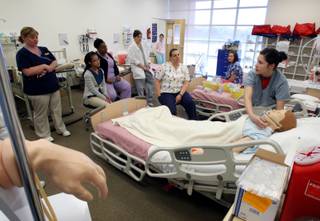
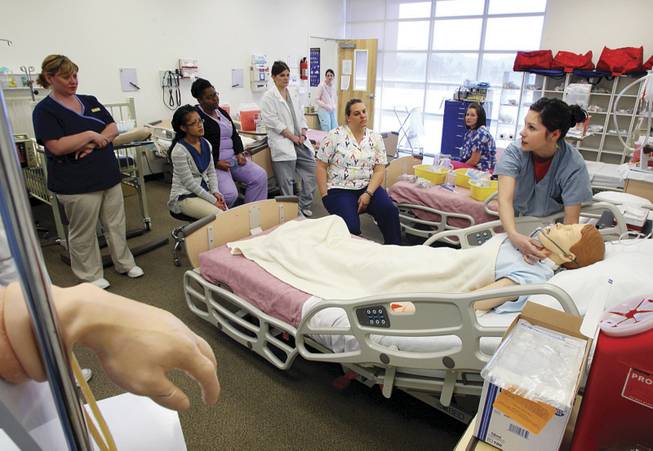
Nursing student Jill Petersen puts an oxygen mask on a medical mannequin Wednesday in a Nevada State College lab in Henderson. Eighty percent of the school’s first-time candidates for nurse licensing passed the exam in 2008, meeting the state’s minimum requirement for nursing schools after three years of falling short.
Saturday, March 14, 2009 | 2 a.m.
Sun Archives
- Health sciences center in abstract no more (3-11-2009)
- Nursing students to pay for new lab (12-18-2008)
- In infancy, health sciences stumbling (8-11-2008)
- UNLV nursing student earns one of state's first Ph.D.s in field (5-16-2008)
NURSING PROGRAM CHANGES
A sampling of improvements new nursing programs have made:
APOLLO COLLEGE
• Opened a simulation lab where students work with high-tech mannequins that exhibit “symptoms” of illnesses.
• Provided new and expanded practice tests.
• The school experienced high turnover in the past, with four permanent or interim nursing directors since its inception and some faculty leaving mid-semester. But no full-time nursing faculty members have left since the current director started in July.
NEVADA STATE COLLEGE
• Began requiring applicants to earn a 3.0 grade-point average in nursing prerequisites instead of a 2.5.
• Began requiring students to review material using programs created by nursing education resource company MEDS Publishing that ask questions of the type students see on the licensure test.
• Revised curriculum.
TOURO UNIVERSITY
• Began using MEDS Publishing products to reinforce students’ knowledge.
• Placed increased emphasis on encouraging students to take the licensure test soon after graduation.
• Revised curriculum.
UNIVERSITY OF SOUTHERN NEVADA
• Began requiring cumulative finals in courses instead of a midterm and final dealing with separate material.
• Began requiring applicants to complete a test assessing academic skills. Began giving applicants credit in the admissions process for high science grades.
• Interviewed former students to identify the program’s perceived strengths and weaknesses.
SOURCE: Each college provided its own information.
Nevada’s nursing shortage is one of the nation’s worst. So it should come as good news that four nursing schools launched over the past six years are now producing about a quarter of the state’s prospective registered nurses.
These new programs have struggled, however, to adequately prepare students for the licensure exam they must pass to obtain employment in nursing.
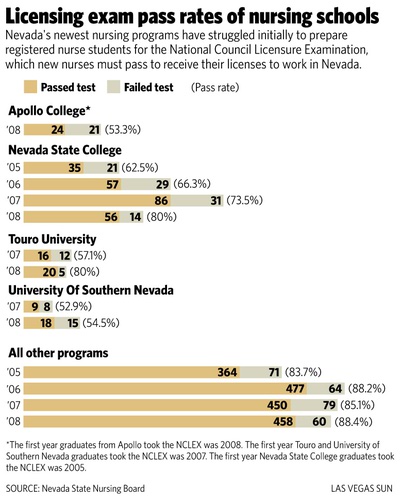
In 2008, nearly half the graduates of Apollo College and the University of Southern Nevada who took the test for the first time failed.
Statistics were less grim for Touro University and Nevada State College. Eighty percent of first-time candidates passed, the minimum the State Nursing Board requires for teaching programs to obtain full approval. Touro’s pass rate the previous year, the first in which its graduates took the exam, was a dismal 57 percent. Nevada State College had missed the 80 percent goal for three consecutive years.
Across the country, new schools often have trouble meeting standards. But in Arizona and California, few have logged pass rates as low as Nevada’s newest programs have.
Debra Scott, the Nevada Nursing Board’s executive director, says Apollo and the University of Southern Nevada — whose nursing programs opened in 2007 and 2006, respectively — should view graduates’ performance on the licensure test as problematic. Pass rates, she says, are an indicator of a program’s quality.
“It is the board’s role to protect the public, which includes all citizens of Nevada,” Scott says. “If students are not getting quality education, they (may) not be quality nurses.”
Prompted by those concerns, board staff will, beginning this year, visit campuses every 18 months to gauge whether programs with provisional approval are following policies and supporting students.
High failure rates on the licensure exam can pose problems for hospitals, which hire recent graduates with interim permits to work as nurses. Most facilities commit to keeping these employees even if they fail the test, but must shift them to different positions if that happens, says Vickie Wright, the Nevada Hospital Association’s nurse executive.
Nationwide, about 87 percent of first-time candidates passed the exam in 2008. In Nevada, more-established programs at six public colleges and universities had rates of at least 84 percent last year, though some struggled to meet goals in the recent past.
Problems at some of the new nursing schools include high turnover in faculty and administration (Touro and Apollo have each had four permanent or interim nursing directors); inexperienced teachers; troubles with curriculum; lax admission requirements; and students who put off taking the National Council Licensure Examination. Officials at some nursing schools say that candidates who test soon after graduation are more likely to pass.
Apollo reported to the state nursing board in April that after discovering one clinical instructor’s license was expired and another did not have at least a bachelor’s degree in nursing, the school was tracking license expiration dates and verifying new hires’ credentials.
Nevada State, which offers a two-year nursing program and an accelerated one-year program, reported to the nursing board in October that just 19 of 40 students entering the regular program in spring 2007 were still enrolled. A nursing school task group is focusing on retention.
Directors of all four new programs say improvements are on the way.
Apollo opened a lab in 2008 where students can work with high-tech dummies that exhibit “symptoms” of illnesses. The University of Southern Nevada modified entrance requirements, asking applicants to complete an exam assessing their academic aptitude, and awarding them for high marks in science courses.
Both the programs are tailoring students’ preparation for the licensure test toward individual needs.
At Nevada State College, similar changes are apparently paying off. The school’s pass rate for first-time test takers has ticked upward every year since 2005, when it was 62.5 percent.
The college increased nursing admissions standards a few years ago and recently began requiring students to use a review program that asks questions of the type they will see on the national licensure exam.
After Nevada State missed the state board’s 80 percent target for two straight years, a consultant suggested a temporary enrollment cap, more faculty development, and curriculum revisions including increasing students’ training in adult health nursing. The college adopted the recommendations.
Touro also retooled its curriculum and began using new remediation tools to reinforce students’ knowledge. Teachers have increased efforts to “emphasize critical thinking and application of content, rather than regurgitation,” the school informed the nursing board in a written report in October. In that report, Touro said students were memorizing to pass exams rather than studying to understand concepts.
Despite challenges, 17 of 21 spring 2008 nursing graduates said in a survey that they agreed, strongly agreed or somewhat agreed that they would choose Touro again if they could start over.
Cory Hatch, the elected president of Touro’s student nurses association, says he is satisfied with the school, even though other students complain broadly about the quality of their education. Hatch lauds faculty members for maintaining an “open-door” policy.
His comments echo those of Anna Friday, who graduated from Apollo in November 2008 and passed the licensure exam on her first try. Friday, now a nurse at North Vista Hospital, says Apollo had a “family feel.”
She says high turnover in faculty and administration bothered some classmates, but “I succeeded because of Apollo. (Teachers) put in the effort, they offered time before or after school.”
Robyn Nelson, health and human services dean and acting nursing director at Touro, says she wishes the nursing board would consider more than just first-time pass rates. “Often,” she says, “students have anxiety the first time they take the exam.”
In Nevada, candidates can sit for the licensure test three times before having to undergo remediation. Touro’s pass rate for November 2007 graduates rises to 97 percent when those who failed once but successfully repeated the test are included.
Pass rates for the first classes to finish at Apollo and the University of Southern Nevada also exceed 90 percent when repeat candidates are wrapped in.
Some states, such as Arizona, which expects 75 percent of graduates from each program who take the exam within 12 months of graduation to pass on the first try, have standards less stringent than Nevada. Nursing boards across the country use the first-time pass rate to judge colleges.
“It’s important because that’s probably the most direct reflection of the quality of the program” in terms of preparing the student for the national licensure exam, says Pam Randolph, the Arizona State Nursing Board’s associate director for education and evidence-based regulation. Repeat test takers’ success, in contrast, often reflects remediation they seek outside of school, she says.

Discussion: 9 comments so far…
Post a comment
- Most Read
- Discussed
- Most E-mailed
- Corrections officer with Metro killed in U.S. 95 crash
- The pull of a drug, a push to the brink
- System fails to catch contractor’s family tie with county
- Where to watch UFC 106
- Findlay guard Joseph scores 33, talks about UNLV
- Bishop Gorman takes Sunset Region title in win over Cimarron
- UNLV and Southern Illinois will be guarded tonight
- Basic’s magical season continues with trip to state semifinals
- Was there an ulterior motive in parking the stripper-mobile?
- Reid clears major health care hurdle, daunting weeks ahead
Blogs
Culture and Entertainment
UFC 106 walk-in music: Griffin changes his tune, secures win over Ortiz
The Kats Report
For props, Lewis Black needs only his manic delivery and torrid material (7 Comments)
Elsewhere
Sands China raises $2.5 billion in Hong Kong IPO (2 Comments)
Marquardt v. Sonnen scheduled for UFC 109
Bloggity, Bloggity, Bloggity
Will a fourth consecutive title by Jimmie Johnson be good or bad for NASCAR? (4 Comments)
Top Chef: Las Vegas
The Jet Stream: And then there were four
Top Chef Episode 12: On keeping it simple
- Live chat
- Tuesday, noon PST
- Chat with Krista Creelman
- Problem Gambling Center executive director Krista Creelman will answer questions about gambling addiction from Las Vegas Sun readers from noon to 1 p.m. Tuesday, Nov. ... Submit question
Calendar »
- 22 Sun
- 23 Mon
- 24 Tue
- 25 Wed
- 26 Thu
-
The Four Tops at The Orleans Showroom
Orleans Hotel-Casino
-
The Chase at Downtown Cocktail Room
Downtown Cocktail Room | 10 p.m. to 11:59 p.m.
-
Lady Gaga album release party at Revolution Lounge
Beatles Revolution Lounge | 10 p.m. to 11:59 p.m.
-
Food drive at Christian Audigier
Christian Audigier The Nightclub | 10 p.m. to 11:59 p.m.
-
Above & Beyond at Moon
Moon Nightclub | 10 p.m. to 11:59 p.m.
The Sun
Locally owned and independent for more than 50 years.
Technorati


Nevada State College does not have a "2 year program." It has a 4 year program leading to a baccalaureate degree. Apollo has a 2 year program leading to an associate's degree.
Also, your article should have identified which programs are for profit (e.g., Apollo) and which are not.
Which programs are fully accredited by the National League for Nursing or the American Association of Colleges of Nursing?
We continue to graduate more English Literature grads and other IN DEMAND degrees that lead to no employment opportunities except to teach the subject to someone else.
We are short on critical needs like nursing and engineering. How about letting the market dictate what departments get the money and the teachers instead of what students want to sign up for because they can't pass needed educational classes to get a job.
How much do the taxpayers spend just on sports and enrichment classes like Yoga? When your short of cash, priorities must be set.
We could start by allowing choice in grammar school and high school. Allow vouchers so students can go to private schools that actually prepare them for college instead of public schools that exist only to benefit the teachers union.
Ms. Hsu: I'm curious why you didn't mention the University of Nevada, Reno which has a pass rate of 91.67 percent:
http://www.unr.edu/nevadanews/templates/...
Charlotte Hsu likes to report skewed news articles that will be approved by her employers for publication, don't you know, BRST?
Some of you need to read more closely. This article specifically focused, as it said, on the struggling newer programs, not all of them, and it did point out the following: "In Nevada, more-established programs at six public colleges and universities had rates of at least 84 percent last year, though some struggled to meet goals in the recent past."
The dirty little secret of nursing education and first time NCLEX pass rates is that nursing schools (frequently) achieve the 90% standard by making sure that any student who might not pass the NCLEX never gets to take it. They do this by flunking out the student during the program, or never admitting them to the program in the first place. As noted in the article, one program eliminated 23 0f 40 students during the program! Then the 17 remaining students take the NCLEX and everyone at the school is proud about their 80+% first time pass rate (meaning 14 of the 17 who graduated passed the NCLEX on the first try). Factor in the attrition rate, however, (including the 23 students who were discarded by the school) and the real rate is 35%!
Has anyone thought that perhaps the standard is flawed? Attrition of students is given lip sevice, but the bottom line is the bottom line, and that is the only thing that is really looked at. I might suggest that if Ms. Hsu wants to give the full story, she take a look at the demographics of the schools she mentioned: Take a look at the minority population, and the number of American citizens who are English as second language students at the schools. There is a selecion process that makes sure that these individuals do not get into the program to begin with. The nursing profession proclaims that they (we) want to increase diversity in the profession, yet many of the policies (including the first time NCLEX pass rate)serves to preserve the status quo, which is that the nursing profession in the United States is 85% white female.
English language learners (in many cases) translate items in nursing exams into their native tongue, think about the test item in their native language, then have to translate this back into English and select the correct answer. Yet the standard on the NCLEX, a computerized test, is that the student complete each item in approximately one minute. We need to covet and welcome those people who share the Americn Dream, though they might speak with an accent and take a bit longer to think in two or more languages before selecting a multiple choice answer. Nursing, the Caring Profession, needs to care about every student who wants to become a nurse, and eliminate 'standards' that are serving to preserve the status quo.
The NCLEX is a minimum competency exam. There is no score. It is pass/fail. By passing the NCLEX, all that is proven about the student is that they have obtained the MINIMUM amount of knowledge required to safely BEGIN a career in nursing.
As an RN/BSN, I passed the NCLEX without studying. I maintained an average GPA in nursing school. I found the test to be too easy if anything. What I did realize from this experience is that the NCLEX, by no means, attributes any mastery of the subject matter to the student. Nursing schools are held to high standards for first-pass percentages because of this very fact, and I will reiterate - The NCLEX is a MINIMUM competency examination.
If Schools of Nursing cannot produce minimally competent nurses, how can they justify their curriculum? As to the 'stress factor' of the computerized exam - Nursing is a stressful job. The ability to think critically and quickly is essential to the RN. There are situations in nursing where split second decisions can make the difference between life and death - where nurses are given complex orders and objectives that can only be met if they are well educated, well trained, and well prepared to act.
Didn't pass the test? Love to 'care' for people? Be a nurse's aide and empty my bedpans please.
I am the president of the Nevada Student Nurses' Association. Here are my thoughts on this article.
Nurses are held to a high standard because we deal with life and death issues every day. We, as nursing students, should not expect anything less. 80% is not a lofty goal. In fact, I believe it is quite low. As in any school (new or established) students will fail and students will pass.
The newer schools seem to struggle at hitting the 80% first time pass rate on the NCLEX. That does not mean they are "bad" schools. It only means they need to work harder at preparing the students and teachers. In my discussion with students and administrators at the schools, I think they are working hard at this and have many great ideas. I think we'll see the numbers improve as these institutions implement their ideas.
We, as students, need to take responsibility for our own education. We should not be satisfied with substandard teaching if we encounter it. We need to be active with our student nurses' association and get to know the school administrators. From my experience, the schools really want to hear what is happening with the students. But remember, we need to pass the test at the end and we need to be prepared to manage critical decisions on our own. If you don't feel you are getting the proper education, talk with the school's student nurses' association and let them know your ideas. There are mentoring programs and NCLEX reviews happening all over all the time.
One of the biggest problems I see is the inability of schools to attract highly qualified instructors. The governor has suggested freezing salaries and even cutting the current salaries by 6%. Master's prepared clinicians can make twice as much practicing as they can teaching. The instructors we do have often work as a nurse and teach...because they love teaching and because they want to give back to their profession. We are approaching a critical point in Nevada Healthcare. Our legislators need to know that they cannot cut nursing education budgets without consequence. It will have a devastating effect on our future.
Maybe we should look at Carson City before we look at the nursing schools!
Chris Figueroa, President NVSNA
I was so excited to read this article. I have just re located to N Las Vegas and am looking for an accredited private school. I looked into both Nevada State College and Touro University, however I wanted to have a bigger variety to choose from. Does any one know if they have a program similar to the program they have in California (Maxine Waters Nursing Program)? I am going to be going to school for a RN then LVN. My sister advised me to find a program that is accredited and geared towards nursing (Private). Thank you for your input