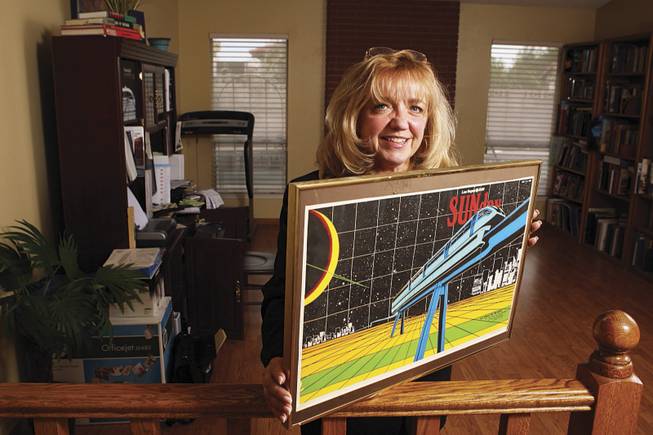
Richann Bender, executive director of California-Nevada Super Speed Train Commission, holds an illustration from a 1983 Las Vegas Sun feature on the California-Nevada high-speed train Monday in her home office. The economic stimulus bill contains money for such projects.
Tuesday, March 3, 2009 | 2 a.m.

Books and articles on high-speed trains cover the proposals for a line between Southern California and Las Vegas. Five proposals are in various stages, but none has broken ground yet.
Sun Archives
- Republicans don't let facts get in their way (2-26-2009)
- Did light-rail deriding Jindal get lost en route to '30 Rock'? (2-25-2009)
- Bill introduced to bring light rail system to Clark County (2-3-2009)
- Senator wants light rail system in Clark County (8-25-2008)
- Light rail option is derailed (3-4-3007)
The proposed $12 billion magnetic levitation train connecting Las Vegas to Anaheim, Calf., conjures images of engineers, administrators and environmental experts huddled over room-sized maps and computer modeling.
In fact, headquarters for the California-Nevada Super Speed Train Commission is in Richann Bender’s suburban tract home, a couple of miles from U.S. 95 on the west side of town.
There, a chipped cherry-wood desk stands against the wall of Bender’s spacious living room, across from five tall bookshelves, and under a framed poster celebrating Germany’s maglev trains. Shelves hold various studies of maglev trains, along with a book Bender prizes detailing the struggle to build the Chunnel rail tunnel under the English Channel between England and France.
Bureaucracies don’t come any simpler than this.
Bender, 60, is the commission’s executive director and only staffer — and an unpaid one at that. She retired from her Las Vegas city job last year and has headed the project for free since.
The commission, a public-private partnership, pays for the Internet connection for her Dell desktop but won’t reimburse her for mileage she drives for the cause. The commission has less than $50,000 in the bank.
“Someone told me long ago that it would take 20 years to do this,” Bender says. That proved wrong. Bender has been attached to the project since 1981.
She was hired into a temporary job as project coordinator for the proposed train shortly after moving here from Chicago, where she worked at a printing company. She took the job shortly after then-Las Vegas Mayor William Briare conceived the idea for a high-speed link between the tourist centers of Southern California and Las Vegas.
Her salary was funded by a federal grant. The city soon brought her on full-time in a job that had many other duties. She acted as a liaison to the city council, lobbied for Las Vegas, promoted business retention and helped plan the centennial celebration — all while pushing the fledgling maglev project.
For the proposal to move forward now, the commission needs to find $7 million to complete an environmental study of the route. Next would come persuading the federal government to fund much of the $12 billion in construction costs. (Orange County jurisdictions and nearby agencies are contributing $2 million toward the environmental study).
That’s not an easy task, even if $13 billion in federal money could be available for high-speed trains under President Barack Obama’s stimulus package, signed into law last month, and his proposed budget for next year.
“It’s very expensive — very expensive,” Bender says. “But compare it to building a couple of lanes on a highway in developed areas. They’re very comparable.”
Bruce Aguilera, vice president and general counsel of MGM Mirage’s Bellagio, assumed chairmanship of the commission for a year in the mid-1990s. He expected swift approval. “I thought, ‘This is cool, this is going to be built,’ ” says Aguilera, who returned as chairman a few years ago.
Not only did Aguilera’s prophecy prove incorrect, Amtrak in the late 1990s discontinued service between Las Vegas and Los Angeles. Las Vegas has been without a rail link to any Southern California city since.
The Federal Railroad Administration held a competition for regional maglev projects in 2001, but did not choose the Las Vegas application. (In the end, no projects were funded, leaving the United States without a high-speed train rivaling what can be taken in Germany, Japan, Taiwan and Singapore.)
Aguilera soon learned that every few years the project gets some ink, local politicians tout its merits and hopes are raised — only for it to fizzle when federal funding can’t be corralled.
“This project should have been completed a decade ago,” says Rep. Shelley Berkley, D-Las Vegas. “I’m not satisfied. There hasn’t been enough money from Congress.”
Some national transportation advocates contend that exploding Western cities, especially in the Intermountain West, have the biggest need for new trains and freeways. Las Vegas and Phoenix have no interstate highway link. Accidents on Interstate 15 between Primm and Victorville, Calif., can block most traffic to and from California’s coast.
Berkley suspects Congress perceives Las Vegas as something of a joke — not as a metropolitan area of 2 million people.
“There’s always the criticism of something going into Vegas,” says Neil Cummings, project manager for the American Magline Group in Los Angeles. “Gambling express, you know?”
Indeed, the Las Vegas maglev train came in for ridicule last month after Congress and Obama included $8 billion for high-speed rail projects in the stimulus legislation. Republican critics wrongly suggested the money was designated for the Las Vegas maglev proposal. In fact, Las Vegas will again have to compete for funding with other proposed high-speed projects.
Still, Bender pushes on. She expects to get a salary from the commission someday, but that’s contingent on the project moving forward.
She believes that will happen and finds the current circumstances the most promising in years. In her view, a maglev train is true to the spirit of Obama’s stimulus bill: It would create construction jobs in the short term and modernize the United States’ crumbling and obsolete infrastructure.
“And it would bring a whole new industry to the U.S.,” Bender says of the proposed 300-mile-per-hour maglev, which could allow travel from Las Vegas to Anaheim in 86 minutes — including stations along the way.
Critics question why a train would connect Las Vegas to Anaheim, rather than denser Los Angeles. But commission leaders say Anaheim is more committed — the city’s mayor is a commission member — and arguably needs it more: John Wayne Airport in nearby Santa Ana is maxed out, while Ontario Airport 45 miles northeast can absorb more traffic. The maglev would stop in Ontario on the way to Las Vegas from Anaheim, giving coastal residents quicker access to the less-crowded airport.
Aguilera estimates it would take just under 15 minutes to reach Ontario from Anaheim by maglev.
The next stop would be Victorville, possibly near the small city’s airport. The train would then continue along I-15 to Barstow, Primm and the proposed Ivanpah Airport.
The next stop would be near McCarran International Airport, possibly by Mandalay Bay, and the train would continue to its terminus in downtown Las Vegas.
The route isn’t definitive. URS Corporation, the planning and engineering giant tapped to do the environmental report, completed preliminary scoping of a route, but had to halt the study because the commission has secured only $2 million of $9 million in private funds required by FRA.
Dennis Papilion, a vice president for URS in Southern California, estimates another 18 months of study are needed — once the commission completes the fundraising effort. The commission has asked the casinos for help. They’re supportive but lack money to contribute, Aguilera says.
And therein lies the commission’s biggest problem: not enough support, governmental or otherwise.
Organizational problems also play a role. Nevada and California’s legislatures created the commission, but it expired in the Golden State.
But Bender remains dedicated.
“I’ll stop when somebody tells me to stop,” Bender says.

Join the Discussion:
Check this out for a full explanation of our conversion to the LiveFyre commenting system and instructions on how to sign up for an account.
Full comments policy