Monday, June 15, 2009 | 2 a.m.
Sun Archives
- Poker players swarm site seeking input on big issues (5-19-2009)
- Web betting is wedge for Big Gaming (11-25-2008)
- Bush administration moves on Internet gaming band (11-12-2008)
- Gaming’s new frontier (11-23-2007)
- Online gaming in the shadows (7-17-2007)
Sun Coverage
Other Coverage
- Newsday: Online poker assets seized
Beyond the Sun
Reader poll
The federal government’s recent seizure of millions of dollars from bank accounts used to process online poker transactions is sending shock waves through the Internet gambling community.
But insiders, including gaming giants poised to capitalize on the potential legalization of Internet wagering, disagree on how the action this month by the Justice Department will affect a controversial activity with millions of American participants.
The seizures, which follow other federal efforts to crack down on Internet gambling sites accepting bets from Americans, are among the most aggressive government actions to date involving poker sites.
Critics of the seizure say it won’t stop people from playing poker on the Internet and will fuel state and federal legalization efforts.
“I have not heard one person saying, ‘I am through with online poker,' ” said one industry official in Las Vegas, who declined to be named. “It’s just making people more militant and bitter against the government.”
But others think it will make players think twice about gambling online.
“If I begin to lose players because they’re afraid to deposit with me, then I lose games and the rake they generate,” said Christopher A. Krafcik, editor of the trade publication IGamingNews. “If I was a player, I’d consider taking my money elsewhere.”
Online gambling companies advertise extensively in the United States and generate billions of dollars from American gamblers, but are generally based in foreign countries. Their operators believe U.S. laws criminalizing gambling don’t apply to them.
By targeting payment processors, the Justice Department — which has long maintained that all forms of Internet gambling are illegal — aims to cut off the sites’ money supply.
Until recently, many operators and players believed their money was safe from federal meddling because it was handled by foreign companies and held in offshore accounts.
American banks and credit card companies have generally exited the business of processing credit card transactions for online bets, which can be traced by merchant codes. That void has been filled by debit card transactions and third-party payment processors, which maintain domestic bank accounts subject to U.S. laws.
On June 2, a federal judge signed a warrant issued by the U.S. attorney for the Southern District of New York to seize the assets in a Wells Fargo account in San Francisco held by Account Services Inc., a company that processes transactions for major online poker sites that accept U.S. bets.
Details of the seizure were filed under seal, and the U.S. attorney and Justice Department have declined to comment.
The U.S. attorney also sent a subpoena to Allied Wallet, another third-party payment processor, to appear before a grand jury in New York on June 18. The subpoena requested documents including correspondence, records of financial transactions and contracts between Allied Wallet and Internet gambling companies dating to 2001 as well as information on owners and employees.
Both documents cite alleged violations of Title 18, Section 1955, of the U.S. Code, which prohibits “illegal gambling businesses” operating in violation of state laws. The subpoena also cites Section 1956, which prohibits financial transactions with unlawfully obtained proceeds.
The feds reportedly seized or froze more than $30 million in online gambling funds at multiple banks doing business with major sites, including Full Tilt Poker and PokerStars.
This isn’t the first seizure of its kind.
Last year, the Justice Department seized more than $20 million in U.S. bank accounts linked to Bodog, a major online gambling site that operates in Antigua. The seizure included $9.9 million deposited in Las Vegas at Nevada State Bank.
This followed the 2006 arrest of BetOnSports.com CEO David Carruthers and the extraction of $105 million in fines from online gambling giant Party-
Gaming, which has admitted to breaking the law and has exited the U.S. market. PartyGaming’s co-founder also surrendered $300 million.
Internet poker supporters have downplayed the significance of such actions, saying the sites invited prosecution by offering sports betting, a major target for the feds.
Poker enthusiasts have argued that online poker involves a great deal of skill and therefore can’t be viewed as illegal gambling, which would involve games of chance. Some add that their sites aren’t conducting gambling themselves and are merely hosting bets that occur among players — an argument similar to that made by music file-sharing Web sites that attempted to skirt federal copyright laws.
Such arguments are no match for the will and means of the Justice Department and its associates in the FBI and IRS, said Sanford Millar, chief financial officer and general counsel of Centaurus Games, a Las Vegas company that hosts free and subscription-only poker tournaments online.
“The Department of Justice has never agreed with those arguments,” said Millar, a Los Angeles-based tax lawyer who teaches law at California State University, Northridge. “If they think they are going to outmaneuver the U.S. government they are out of their minds.”
The Poker Players Alliance, a lobbying group, thinks the Justice Department has overstepped its authority and is gathering a team of legal experts to assist the poker sites.
In a letter to its members Tuesday, the Alliance said some of the seizures were made “without the benefit of proper warrants” and show “an almost shocking trampling of due process.” The feds seized money that belonged to players rather than the Web sites, and no federal law makes it a crime for a player to gamble online, the Alliance contends.
The laws cited by the feds come into play only after other violations of law, which may be tough to establish given that only a few states have made it a crime to gamble online, said I. Nelson Rose, an Internet gambling law expert who teaches at Whittier Law School in Southern California.
On the other hand, players whose accounts have been credited the amount of any seized funds don’t have much of a claim against the feds, leaving that role to offshore companies, which are unlikely to come forward and stake a claim, Rose said.
Players or Web sites would have to identify themselves to make their case, giving the IRS an opportunity to demand tax records and any unpaid taxes, Millar added.
Rather than put up a fight, Bodog forfeited the money.
According to the poker alliance, major poker sites have credited the accounts of players whose money was seized and are “completely committed to staying the course and remaining in the U.S. market.”
Bricks-and-mortar casinos — which are no doubt concerned about opening the door to new competition, especially in a downturn — have remained largely silent.
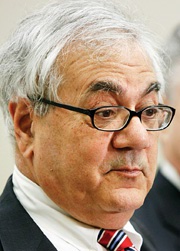
Rep. Barney Frank, D-Mass., has introduced legislation to repeal the 2006 ban on Internet gambling.
One exception is Harrah’s Entertainment, which is backing a bill by Massachusetts Rep. Barney Frank to have the feds regulate online gaming. The company recently created a Montreal-based interactive division to promote the company’s World Series of Poker-branded tournaments worldwide.
Harrah’s spokesman Gary Thompson calls the seizure of funds a “nonevent” that won’t slow online gambling or the company’s lobbying efforts.
“The fact that there are some zealots in the Justice Department that are cognizant of the support for legalizing Internet gambling in the United States and want to try to make a name for themselves before there’s some legislation that passes and some rational approach toward this in this country won’t deter us,” he said.
While federal regulators have framed their dislike of Internet gambling as a national security problem, Millar believes their primary concern is a social and financial one. Gambling at home presents a bigger risk to Americans’ homes and life savings, he says, than schlepping to the casino down the street — or across the country.
Based on the Bodog case, the feds appear to be creating a roadmap that will allow them to more quickly and effectively dry up gambling sites’ bank accounts, Millar said.
“This seems like an amazing waste of judicial resources when you’ve got multi-billion-dollar scandals to worry about,” Rose said.
And yet, this follow-the-money strategy, which has already yielded hundreds of millions of dollars for the Justice Department, could pay off big.

Join the Discussion:
Check this out for a full explanation of our conversion to the LiveFyre commenting system and instructions on how to sign up for an account.
Full comments policy