Published Thursday, July 2, 2009 | 1:30 p.m.
Updated Thursday, July 2, 2009 | 2:25 p.m.
Related Document (.pdf)
Sun Archives
- Practice of building before designs are done hits wall at Fontainebleau (6-28-2009)
- Flood of new hotel rooms dims Vegas outlook for '10 (6-23-2009)
- More subcontractors accuse Fontainebleau of failing to pay for work (6-23-2009)
- Fontainebleau subcontractors want bankruptcy case moved (6-22-09)
- State gaming regulators shied away from policing borrowing (6-21-2009)
- Fontainebleau subcontractors say contractor conflicted (6-19-09)
- Judge orders mediation for Fontainebleau, banks (6-19-09)
- Businesses file suits claiming Fontainebleau bills went unpaid (6-18-09)
- Judge to expedite Fontainebleau bankruptcy case (6-17-09)
- Lenders: Cost overruns led to Fontainebleau loan default (6-16-09)
- Bank of America wants change in Fontainebleau bankruptcy plan (6-11-09)
- Fontainebleau debt rating downgraded after bankruptcy (6-11-09)
- Fontainebleau wants expedited hearing on $656 million (6-10-09)
- Investment companies sue banks over Fontainebleau financing (6-10-09)
- Australian company writes off Fontainebleau ownership interest (6-10-09)
- Fontainebleau developer files for bankruptcy; more jobs cut (6-9-09)
Sun Coverage
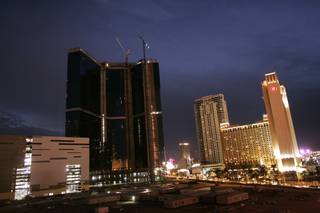
Big banks have offered new evidence backing their refusal to further finance the Fontainebleau Resort in Las Vegas. The bottom line, they assert, is that the project doesn't make economic or business sense.
In a flurry of filings Wednesday in Miami's bankruptcy court, Bank of America and other lenders submitted affidavits and an appraisal saying:
-- The hotel-casino on Las Vegas Boulevard would be worth just $1.764 billion if it opened in May 2010. That's far less than its projected financing cost of $3.175 billion -- $1.675 billion already borrowed plus another $1.5 billion needed to finish the project.
-- Fontainebleau, recognizing the project was insolvent, told the banks earlier this year that $675 million it borrowed for the project, in the form of second mortgage notes, needed to be "extinguished." In other words, Fontainebleau would default on that debt and the investors in the notes would likely receive nothing on their investments.
-- Fontainebleau said hundreds of millions of dollars in bank loans would also need to be extinguished or converted into equity.
In all, the banks assert, Fontainebleau had hoped that $1.3 billion in debt would be forgiven so that its balance sheet would support further development of the project.
If true, the Fontainebleau plan would be similar to other recent strategies in the gaming industry in which investors in casino companies' debt have been asked to make concessions in order to lower interest costs and keep companies afloat.
Asked about the new bank filings, Fontainebleau said in a statement Thursday: "The banks improperly terminated their contractual obligation to lend the money for this project. Nothing they say -- all of which is distorted and wrong -- relieves them of that obligation."
The banks' filings Wednesday came as Fontainebleau and the lenders are heading into court-ordered mediation of their dispute. Fontainebleau sued the banks in April, charging they had wrongly halted funding of the resort. Fontainebleau is asking the bankruptcy court to order the banks to release $656 million it says is needed to get the project back on track.
Fontainebleau said the banks' decision forced it to halt construction of the 3,815-room, 70 percent-completed resort, putting thousands of construction workers out of work and jeopardizing the jobs of thousands more people who would later work at the resort.
But in Wednesday's court filing, Bank of America said the banks properly terminated financing of the resort because Fontainebleau had defaulted on its credit agreement because of cost overruns and other problems -- not the least of which was that the project had become insolvent.
Court records indicate the resort's financial situation was harmed by cost overruns; a lack of condominium sales that would have covered substantial construction costs; and the 2008 bankruptcy of Lehman Brothers, a major lender to the project.
Henry Yu, a Bank of America senior vice president experienced in working out large troubled corporate loans, said in an affidavit that problems at Fontainebleau surfaced in January.
That's when Inspection & Valuation Inc. (IVI), the lenders' construction consultant, raised questions about the project's costs and said revenue from state energy efficiency tax credits was tracking behind projections.
In February, Yu said, Fontainebleau said the project was "in balance" by about $116 million -- meaning that with the projected financing in place, it was under budget by that amount.
But in the same month, he said, "Bank of America became increasingly concerned about the project's financial condition and projected costs" because of the IVI report and "worsening macroeconomic conditions in the country generally, and the Las Vegas market in particular."
By April, Fontainebleau reported the project was out of balance, with a shortfall of $383 million, Yu said.
"Fontainebleau also disclosed that it faced a risk of insolvency. It made a proposal to restructure its finances -- a plan that included extinguishing the second mortgage notes and converting a substantial potion of the senior secured credit facilities to equity," Yu said.
During an April 28 meeting with lenders in New York, Yu said, Fontainebleau said it would cost $1.504 billion to complete and open the project.
"Fontainebleau and its advisors asserted that the maximum amount of debt that can be serviced by the project is $1.4 billion," Yu said. "The company insisted that the $675 million of second mortgage notes had to be extinguished and a substantial portion of the senior secured credit facilities had to be converted to equity."
Bank of America retained real estate company Cushman & Wakefield to appraise the project and it reported on May 21 it would be worth $1.764 billion if it opened in May 2010.
"Given that Fontainebleau asserts that $1.5 billion is needed from this point forward to complete and open the project, and that most of that amount has to be debt on top of the existing $1 billion of outstanding term loans and $675 million of second mortgage notes, it is clear that the project at completion will have liabilities far exceeding its assets unless the existing debt is compromised," Yu said.
Yu also asserted: "I also believe that Fontainebleau's financial disclosures before and as of (March 2) were materially inaccurate because they failed to accurately present Fontainebleau's financial condition, including the fact that the remaining construction costs exceeded available funds."
In a separate filing, Bank of America attorneys said Fontainebleau had given the lenders financial projections showing it had no hope of making all of its debt payments.
"Fontainebleau also revealed at (an) April 17 meeting that, even if it raised additional financing and completed the project, it would not be able to repay the debt it incurred to build the project. Thus, Fontainebleau proposed a restructuring in which all of the $675 million in second-lien mortgage debt and $364 million of the first-lien term loan debt that had already been funded as well as nearly $277 million of future revolver loans would be forgiven," B of A's filing said.
"In sum, Fontainebleau represented that the project could support $1.4 billion in debt so that more than $1.3 billion in existing (or) requested debt would need to be forgiven," B of A's filing said.
The bank said Fontainebleau revealed projections showing the resort would generate annual EBITDA -- earnings before interest, taxes, depreciation and amortization -- of $162 million to $252 million by 2012. Those numbers are far below the $329 million in annual EBITDA Fontainebleau had initially projected, B of A said.
Soaring construction costs, the weak economy and risks inherent in hotel-casino investments compared to other investments appear to be responsible for the build out cost of the resort to be far in excess of its appraised value.
The Cushman & Wakefield appraisal projected key drivers of value at the resort -- gaming win and room revenue -- would be consistent with other large Strip properties.
But as has been widely reported, gaming win and revenue per available room on the Las Vegas Strip have suffered because of the recession.
For Fontainebleau, Cushman & Wakefield projected an occupancy rate of 91 percent and daily revenue per available room of $182.80 for its 3,815 rooms in 2010 and 2011.
That compares to the first-quarter 2009 occupancy rate for Las Vegas Sands Corp.'s Venetian resort of 89.1 percent and daily revenue per available room of $187.
Cushman & Wakefield projected Fontainebleau's slot machines and other gaming devices would produce daily win per machine of $203 and its table games would each generate $3,053 per day in 2010 and 2011.
At existing big Strip resorts, daily slot machine and other gaming device win fell from $215 in 2007 to $194 in 2008; and table game win fell from $2,708 to $2,380, Cushman and Wakefield said.
While predicting high table game win because of the high-end clientele that Fontainebleau would cater to, Cushman & Wakefield noted concerns about additional supply entering the Las Vegas market at MGM Mirage's CityCenter and other projects.
"Whether these new resorts will fuel additional demand is not yet clear. History shows that the market can expect to expand significantly, however the current state of the economy and unbelievable depth of the recession have given everyone pause," Cushman & Wakefield said in its appraisal.

Join the Discussion:
Check this out for a full explanation of our conversion to the LiveFyre commenting system and instructions on how to sign up for an account.
Full comments policy