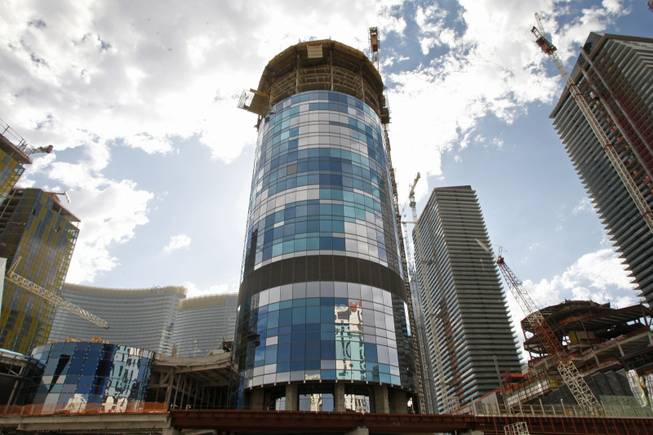
Although work continues this week on the Harmon tower, design changes and repairs will cause it to miss its planned opening date.
Wednesday, July 1, 2009 | 2 a.m.
Sun Archives
- Editorial: Easing up on oversight (6-14-2009)
- CityCenter inspectors told: Easy on the paper (6-11-2009)
- Harmon flaws haven’t brought big fallout (5-27-2009)
- Perini redirects blame for errors at Harmon (2-9-2009)
- Adaptation or ‘disaster’?: Depends on your view of the Harmon (2-8-2009)
- County wants proof CityCenter structures are free of defects (2-6-2009)
- Watchers were not watched (1-15-2009)
- How did CityCenter tower flaws persist? (1-8-2009)
- MGM Mirage cancels CityCenter condo project (1-7-2009)
- CityCenter hotel project slowed by corrective work (9-17-2008)
An inspector responsible for monitoring construction at the troubled Harmon hotel in CityCenter last year said he had never read engineering plans without assistance before taking that job, despite earning a civil engineering degree.
The revelation by inspector Joseph Glenn Laurente was contained in documents the county released Tuesday after a hearing addressing the role private inspectors played in mistakes at the Harmon.
Laurente and a second inspector, both employed by Converse Consultants, had issued numerous reports stating they had found no problems at the Harmon. An engineer later discovered major structural flaws.
At the hearing, Converse attorney Greg Gilbert sought to attribute the Harmon errors to bad communication. “There were numerous representatives on site during the entire process of construction, evaluation and implementation,” Gilbert said. “It is safe to say there was a shortfall in communication.”
Hearing officer Charles Thomas said the nature of that communication “shortfall” would be a central point in his decision, which he expects to deliver next week. He will then decide whether to take action against Converse, which could include suspending or revoking the company’s license to provide inspection services in the county.
The hearing covered Converse’s procedures and practices. Left mostly untouched were how and why inspectors issued false reports, and how it was possible that at least one of the inspectors had little experience reading construction plans.
The documents disclosing Laurente’s inexperience were transcripts of a meeting with the county in October. At that meeting, Laurente said that on previous jobs, he had not had to read plans without help from other inspectors, according to minutes recorded by the county and released Tuesday to the Sun.
“He did read the plans on Harmon towers,” which was his first job for Converse, he said.
The serious flaws were discovered in the first 15 floors of the project nearly a year ago. Reinforcing steel at the Harmon, one of the towers at MGM Mirage’s $9 billion CityCenter project, had in some cases been wrongly installed before being encased in concrete, the county said. Some of the steel, known as rebar, was so badly positioned that it stuck out of the concrete floor and was sawed off to conceal the mistake.
The discovery — combined with a lack of condo sales in the weak economy — prompted MGM Mirage to shorten the Harmon by 21 floors, removing 200 planned units. The flaws and subsequent changes will also delay the Harmon’s opening, which had been planned for the end of this year.
Tuesday’s hearing was the latest in the ongoing blame game involving Converse, general contractor Perini Building Co., subcontractor Pacific Coast Steel, owner MGM Mirage and the county’s building department.
Two months ago, Pacific Coast Steel reached a settlement with the Nevada Contractors Board to pay $14,105 in administrative and investigative fees for faulty work at the Harmon.
The Clark County Development Services Department referred Pacific Coast Steel to the Contractors Board after issuing five notices of violation against the ironworker subcontractor over the problems.
The complaint had alleged that Pacific Coast Steel “failed to provide workmanship.”
Under the settlement, Pacific Coast Steel did not admit responsibility or fault.
As required by the county, MGM Mirage had hired Converse Consultants to survey Pacific Coast Steel’s rebar installation at the Harmon to ensure that it complied with the county-approved plans.
The inspectors’ job was to compare plans with construction and note any discrepancies.
But over two months, inspectors Laurente and Scott Edberg issued 62 notices stating the rebar was in compliance.
Edberg left town soon after the discovery. The county met with Converse supervisors and Laurente in October and issued an administrative fine against the inspectors and the company to cover the cost of an investigation.
In the meeting, Laurente said he had inspected floors 17-20 and “made an error signing items that were in noncompliance with the approved construction documents.”
The county stripped Laurente of his certification to inspect concrete work in the county, but he is still approved as a soil inspector and still employed by Converse.
The Sun has not been able to reach Laurente. He was not at Tuesday’s hearing.
A few months after that October meeting, the county referred the case to a hearing officer for further review.
The county has taken no position yet on possible actions against Converse. County attorney Cliff Jeffers spent most of his opening argument Tuesday reading the statement of Bill Taylor, a consultant hired by Converse, who found the company itself was not responsible for the Harmon problems, even if its inspectors had erred.
“Converse Consultants’ inspectors did not identify the noncomforming reinforcing steel work,” Jeffers said, reading Taylor’s statement. “This may have been the result of a variety of different causes, including misinterpretation, incompetence, a mistake or something more nefarious.
“Other things, such as reinforcing steel and concrete placement during different shifts, night work, moving of reinforcing steel to facilitate concrete vibration, or accidental or intentional concealment of the problem by others may also have been contributing factors.”
In finding that the company had done nothing wrong, Taylor recommended that Converse provide more training for Laurente and Edberg, who has left the company.
Taylor also noted that blame could fall on the contractor for failure to notify the inspectors that they were making mistakes.
“By these individuals most knowledgeable of this issue not communicating this problem with the inspector, the engineer, the owner or the construction manager, the ability of all concerned to mitigate these issues early on was dismissed, and the chain of problem discovery, supervision and problem resolution was broken,” Taylor wrote.
At the hearing, Jeffers offered minimal comment on the report, tentatively questioning the assumption that third-party inspectors should take their cues from the contractors they are inspecting.
“The question is whether there is more to the role of special inspector,” Jeffers said.
Gilbert, Converse’s attorney, listed the steps Converse was taking to improve. The company made several changes in procedure, such as adopting a 90-day probation period for new hires and rotating inspectors on sites.
“We’ve learned our program has some weaknesses and we’ve taken corrective action,” Gilbert said.
Thomas, the hearing officer, indicated he would look closely at whether Converse had followed its own procedures, and would look at the company’s chain of command to see who was responsible for Edberg and Laurente’s work on the site.
Thomas also asked Converse to provide evidence that the inspectors were actually on the site looking at rebar installation.
In his audit, Taylor found that Laurente said he was unaware the reinforcing steel placement did not comply with approved plans, and did not observe the steel being cut with a torch.

Join the Discussion:
Check this out for a full explanation of our conversion to the LiveFyre commenting system and instructions on how to sign up for an account.
Full comments policy